- Delivers eye drops without gravity or electricity
- Designed for astronauts, Parkinson's patients and the elderly
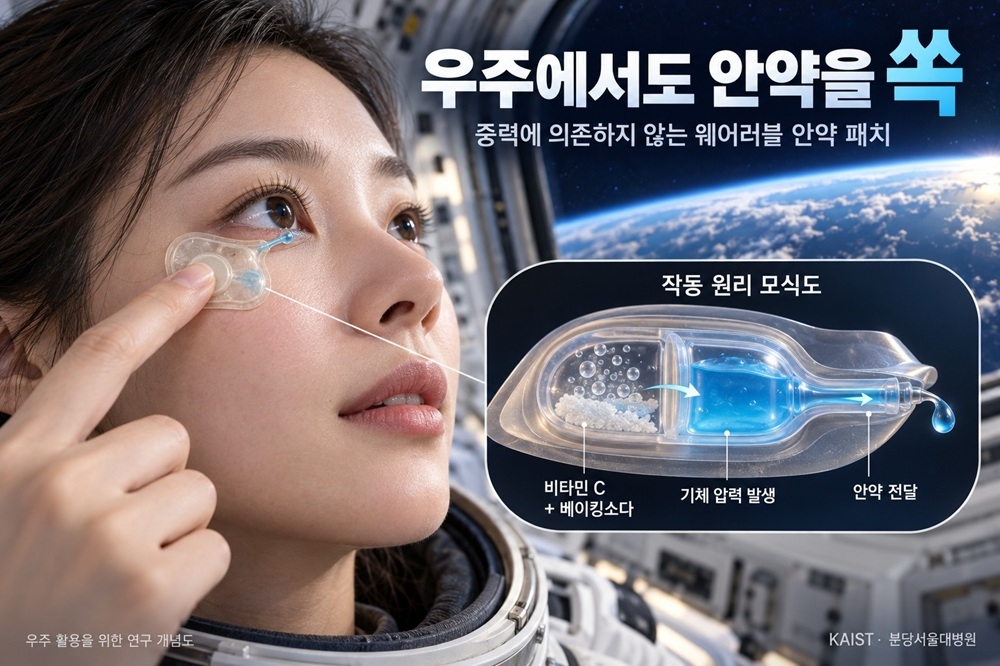
Researchers in South Korea have developed a wearable patch that can deliver eye drops with the press of a button — even in the near-zero gravity of space. The device uses a chemical reaction between vitamin C and baking soda to generate pressure that pushes the drops into the eye, requiring no electricity or external pump. Beyond space medicine, the technology could help Parkinson's patients, the elderly and others who struggle to self-administer eye drops due to hand tremors or physical limitations.
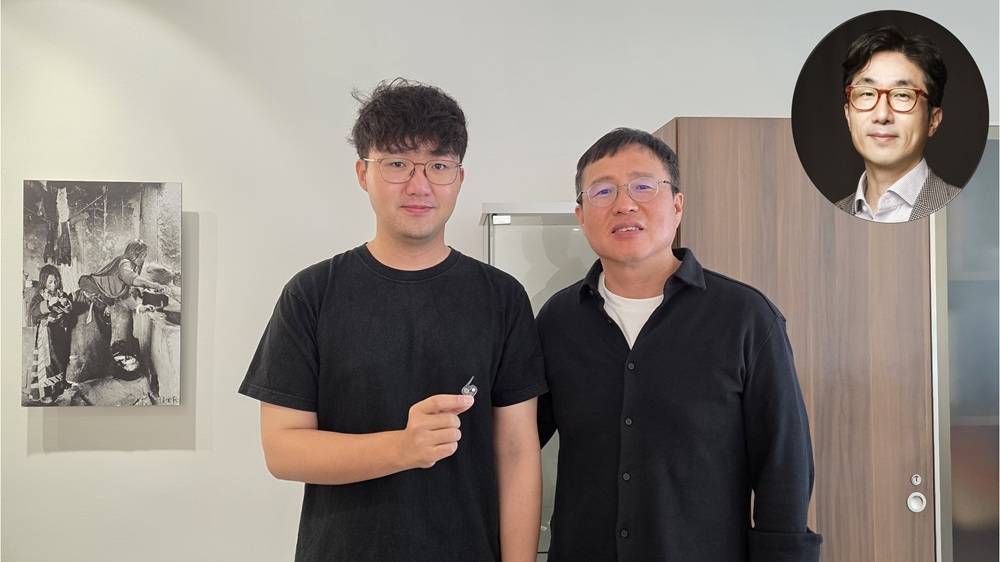
KAIST announced Wednesday that a research team led by Professor Jeong Ki-hun of its Department of Bio and Brain Engineering developed the patch in collaboration with a team led by Professor Woo Se-jun of Seoul National University Bundang Hospital.
In space, the near-absence of gravity makes it difficult to drip eye drops into the eye the way one would on Earth. Long-duration spaceflight poses a particular concern: as bodily fluids shift toward the head, the structure of the eye and visual function can change, making eye care a priority for astronauts.
To address this, the research team combined a chemical pressure-generating mechanism with a network of microfluidic channels, integrating both into a single flexible patch.
The key is a reaction between ascorbic acid — the active form of vitamin C — and sodium bicarbonate, the main component of baking soda. When the two substances come into contact with water, they produce carbon dioxide gas. The resulting pressure travels through the microchannels and pushes the eye drops toward the eye.
The user attaches the patch around the eye and presses an activation point to trigger delivery. Because the system needs no electrical components or external pump, it can function in space environments where medical equipment is limited.
A key design feature is a filter placed between the reaction chamber and the eye drop reservoir. The filter allows gas to pass through while blocking liquid, preventing the reactive substances from mixing with the medication while still transmitting the gas pressure effectively.
In tests conducted with the patch oriented in different gravitational directions, the device maintained consistent eye drop output. Human-wear evaluations also showed drug delivery performance comparable to conventional eye drop application.
However, performance in an actual space environment has not yet been verified. Further testing in simulated space conditions and safety validation using real pharmaceutical compounds will be needed.
The technology also has strong potential for use on the ground. It could benefit patients with hand tremors from Parkinson's disease, as well as elderly users and others with physical limitations who find it difficult to handle a conventional eye drop bottle, allowing them to administer drops with a simple button press.
The team plans to verify the patch's compatibility with various eye drop formulations, the stability of medications stored in the device over extended periods, and its safety under repeated use, with the goal of developing it into a personal medical device.
"The flexible eye drop injection patch developed in this research is a wearable platform capable of delivering medication without complex equipment," Professor Jeong said. "We expect it can be expanded into a medical technology applicable across a range of environments, including space medicine."
The findings were published in the international journal Sensors and Actuators B: Chemical.
nbgkoo@heraldcorp.com