LG Chem holds first biotech conference with LG AI Research and Flagship Pioneering; personalized mRNA cancer vaccine targeting 2029 clinical trials; AI to drive decision-making across full drug development cycle
LG Chem is positioning AI as the central decision-making engine of its drug development operations, aiming to improve success rates across the entire pipeline — from candidate discovery to clinical patient selection.
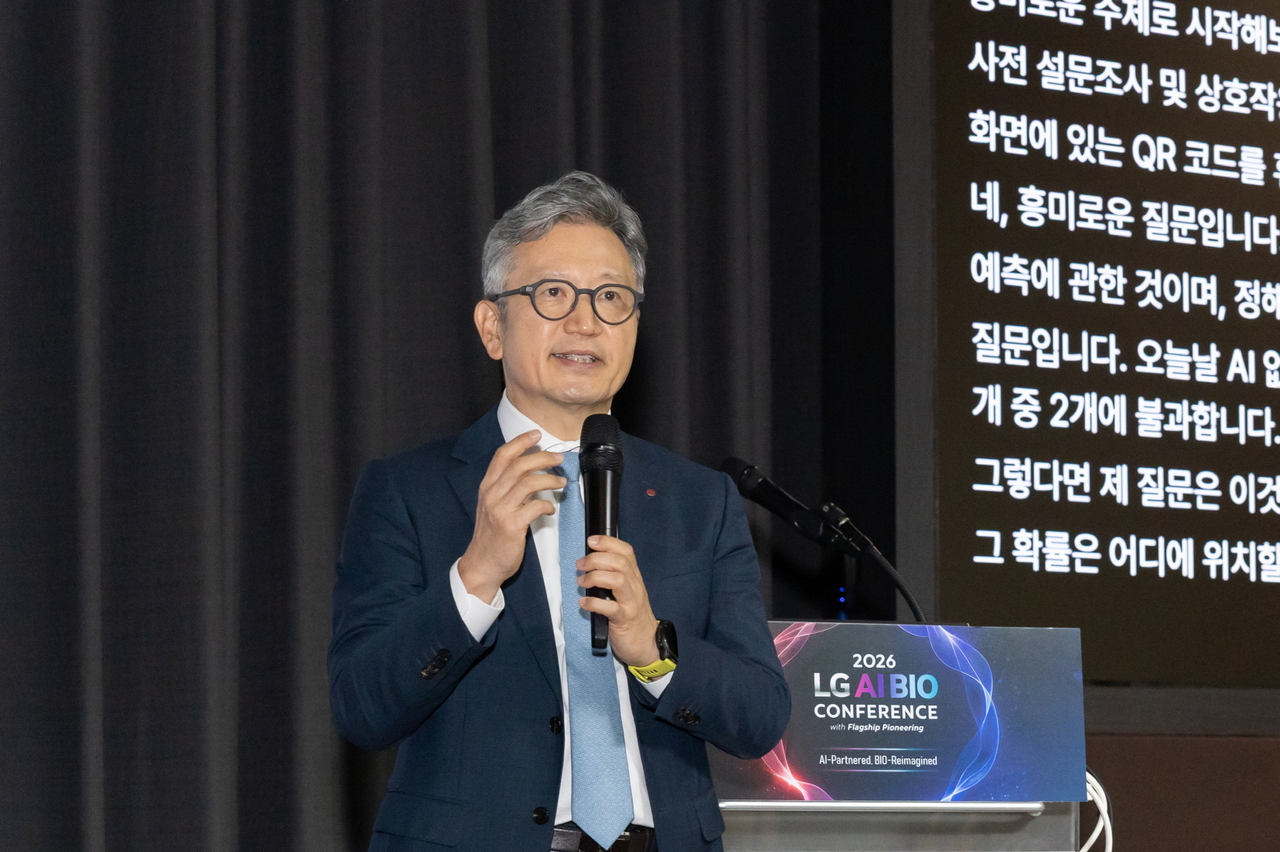
LG Chem co-hosted the "2026 LG AI Bio Conference" with LG AI Research and US biotech venture capital firm Flagship Pioneering on Tuesday at the ISC building of LG Science Park in Gangseo-gu, Seoul. The inaugural event, designed to build an AI-driven biotech innovation ecosystem in Korea and expand global collaboration, drew about 140 participants from domestic and international biotech companies.
At the conference, LG Chem highlighted the potential of AI in clinical development and unveiled its vision for innovation in precision oncology. The company's strategy centers on using biomarkers to precisely identify patient groups most likely to respond to treatment, maximizing the probability of clinical success.
"AI is evolving from a tool for drug development into the core engine that determines competitiveness," Son Ji-woong, president of LG Chem's life sciences division, said in his opening remarks. "The future of drug development lies not only in finding the right drug, but in using AI to identify the right patient — one most likely to benefit from treatment."
Andre Andonian, Asia-Pacific chairman of Flagship Pioneering, said LG Chem and Flagship Pioneering are deepening their life sciences collaboration with AI as a shared innovation engine. "Cases like Moderna and Lyla Sciences show that AI is becoming a core driver of corporate growth," he said.
LG Chem also shared progress on its AI-based personalized messenger RNA cancer vaccine. The company is refining an AI model that precisely predicts patient-specific neoantigens — proteins on cancer cells that trigger immune responses. It plans to complete preclinical trials in 2027 and enter full clinical development in 2029.
The event also featured presentations by Zhu Wang, head of global business development at Insilico Medicine, and Ryan Leung, head of life science products at Lyla Sciences, who shared case studies on generative AI-driven drug development and autonomous laboratory systems. A panel discussion brought together representatives from Inocras and Portrai to explore patient selection approaches based on cancer genomic data and spatial biology.
LG Chem said it intends to deploy AI not merely as a technical aid for early-stage candidate screening, but as a full-scale decision-making engine for high-stakes tasks such as late-stage clinical patient selection and strategy formulation — areas that demand enormous investment of time and resources — to fundamentally transform the productivity of drug development.
silverpaper@heraldcorp.com