President inspects Incheon Gyeyang district
Holds on-site meeting with urban experts, future residents
"I keep stressing this — speed is what matters most. We must produce visible results that carry the measures we have already announced all the way through to actual move-ins, and we must do it quickly."
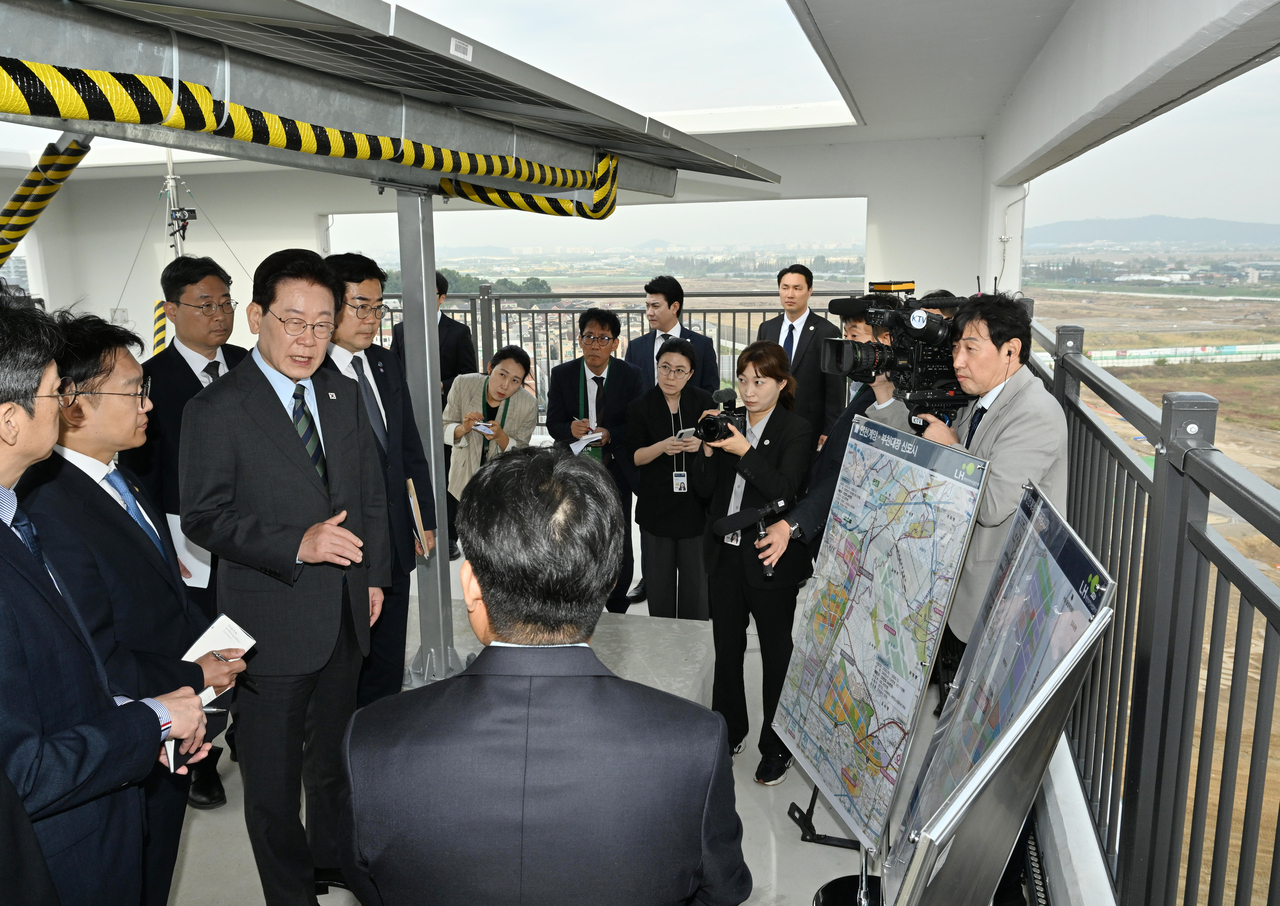
President Lee Jae Myung visited the Gyeyang district in Incheon on Tuesday to inspect a third-generation new town development site and held an on-site meeting with prospective residents and urban planning experts.
Lee's remarks underscored not only the need to accelerate housing supply under the third-generation new town program but also his insistence that announced supply measures must translate into actual move-ins rather than remain on paper. The complex he visited is the fastest-moving among the third-generation new town projects and is scheduled for move-in by the end of this year.
In his opening remarks at the meeting, Lee said, "I used to commute through here, so this visit is truly meaningful to me," adding that "the Incheon Gyeyang district holds great significance as the first fruit of housing supply from the third-generation new towns."
He went on to say that "swift housing supply in the third-generation new towns will be a critical turning point that determines the success or failure of real estate policy," and warned that "if the supply policies we have already announced appear to be falling short of proper implementation, public trust in real estate policy as a whole will inevitably erode."
Lee said the government must do as much as possible to close the supply gap caused by a decline in housing permits and ground-breakings since 2022.
"Housing supply typically takes about three years after permitting, and because a problem arose during a certain period, we need to pull new supply forward as much as possible to narrow that gap," he said. "We must find every additional way to reduce the shortfall and fill the supply void."
He then urged officials from the Ministry of Land, Infrastructure and Transport and Korea Land and Housing Corporation (LH) to "give everything you have to ensure that roughly 90 percent of the third-generation new town public housing units can break ground by 2030, in line with the targets we announced last August."
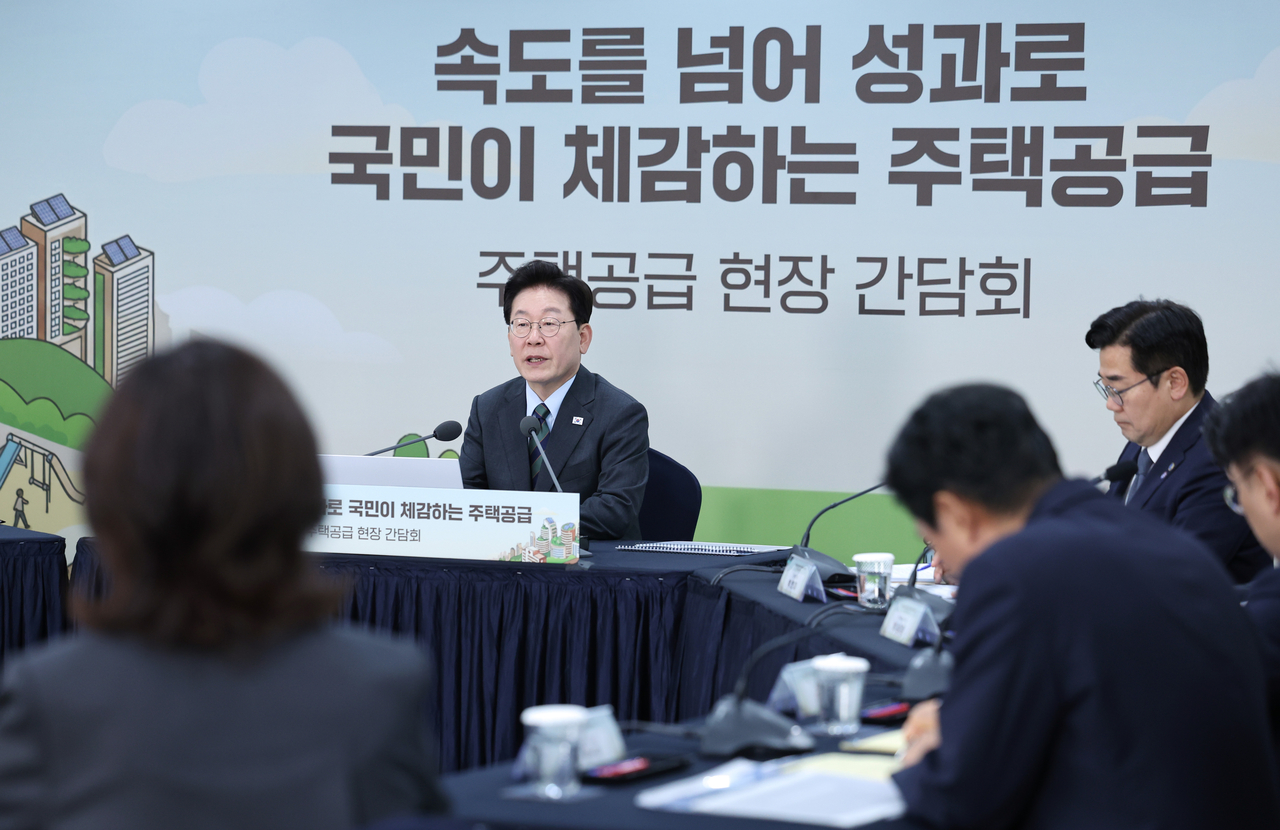
At the meeting, prospective residents called for better transportation planning, requesting that the government move quickly to improve regional transit — including express bus services — given that most future residents are expected to commute to Seoul.
Experts said the gap between the completion of transportation infrastructure and the move-in date must be minimized, and proposed using modular housing to shorten construction timelines. Modular housing, in which most components are manufactured in a factory and assembled on site, offers the advantage of significantly reducing construction time.
In response, Lee directed officials to verify whether construction timelines could in fact be shortened and to conduct a comprehensive review with an eye toward developing a modular housing market.
Before the meeting, Lee surveyed the state of the new town development from the rooftop of an apartment building where finishing work is still under way.
He asked LH President Lee Seong-hun to separately review the status of staffing for compensation work and to create a working environment in which employees are not disadvantaged or demoralized by the organization's restructuring process.
On the issue of project delays caused by civil litigation during compulsory acquisition proceedings, Lee pointed to possible gaps in existing legislation and directed officials to review whether the matter could be addressed through new laws, then report back separately.
sang@heraldcorp.com