An 1871 Nature report claimed a solar storm delayed a train by 16 minutes in 1841 — but the railway didn't open until 1846. New research points to 1848 as the true date of the incident.

When a large explosion occurs on the sun, it sends charged particles hurtling toward Earth, shaking the planet's magnetic field in what is known as a solar storm — an event capable of knocking out satellites, power grids and communications. The broader study of how solar activity affects Earth's environment is called space weather.
The most famous example of space weather crippling infrastructure is the Carrington Event of 1859, which paralyzed telegraph networks around the world.
Now, a new study has cast doubt on a claim that a solar storm stopped a train in England 18 years earlier, in 1841. Researchers who traced the original records found that the railway in question had not yet been built at the time, and that the incident most likely occurred seven years later, in 1848.
The findings were published in volume 24, issue 9 of the international journal Space Weather by a research team led by Professor James Wild of Lancaster University in the United Kingdom. The team re-examined historical records surrounding the 1841 train delay long cited as the world's first documented case of solar storm damage.

Nature's 1841 record: a train delayed 16 minutes by the sun
According to a report published in Nature in 1871, an express train scheduled to depart Exeter station in southwestern England at 10:05 p.m. on Oct. 18, 1841, left 16 minutes late.
The report attributed the delay to a magnetic disturbance that made it impossible to confirm whether the track toward Starcross was clear.
It added that the Exeter stationmaster reported the following morning that someone appeared to have tampered with the equipment, rendering it inoperable. The report carried no author's name.

Railways of the era relied on telegraph operators stationed several kilometers apart, communicating via needle telegraphs to determine whether the next section of track was occupied. During a solar storm, unwanted electrical currents can flow through long telegraph lines, causing the needles to move erratically.
American researcher William Cade III unearthed the 1871 report in 2013, after which the incident became widely known as the oldest documented case of solar storm damage.
The railway didn't open until 1846
When the research team examined historical records, they found that no train could have made that journey in 1841.
The act of Parliament authorizing construction of the railway linking Exeter and the southwestern port city of Plymouth passed in July 1844. The first section of the line, running from Exeter through Starcross, did not open until May 30, 1846 — nearly five years after the date cited in the Nature report.

The annual records of the Greenwich Magnetic Observatory also show no unusual geomagnetic activity on Oct. 18, 1841, and there are no reports of auroras observed in Britain that day.
Using the clue in the Nature report — a 10:05 p.m. express departure — the research team searched timetables published in local newspapers of the period and found that a train leaving Exeter at that time operated only between March 1848 and July 1849.
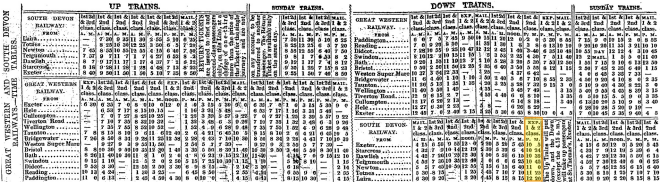
The real event happened seven years later — only the year was wrong
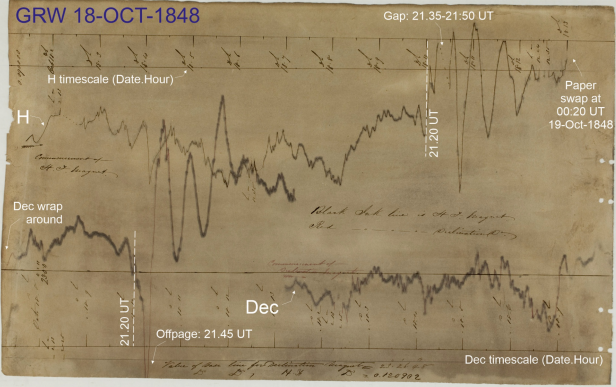
A powerful solar storm did in fact strike on the night of Oct. 18, 1848, within the period when that train was running. Records from the Greenwich Magnetic Observatory show significant geomagnetic disturbances beginning at 9:20 p.m. that night.
In the 20 minutes around 10 p.m., both the intensity and direction of the magnetic field shifted sharply — enough, the research team concluded, to have induced electrical currents in the telegraph lines along the Exeter railway.
A resident of Exeter wrote to a local newspaper around that time reporting that a cluster of dark spots was clearly visible on the sun. An astronomer at Durham University who observed the sun on the same day also sketched a large group of sunspots.
The research team concluded that 1848 was most likely misprinted as 1841. They noted that other historical records have similarly shown the year written incorrectly by exactly seven years on the same date.
The research team identified telegraph engineer Nathaniel John Holmes as the likely author of the 1871 Nature report.
A handwritten note bearing the name "Holmes" was found in the original Nature document, and he was known to have been close to Norman Lockyer, the journal's founding editor. However, the team said it could not determine why the year was recorded incorrectly, as no manuscript or related correspondence has survived. The error went uncorrected for 155 years after the 1871 report was published.
As a result, the title of oldest documented case of solar storm damage now belongs to a telegraph failure on the British Midland Railway on March 19, 1847.
The research team said the Exeter incident, while no longer the first, remains a valid example of solar storm damage.
Reference
DOI: 10.1029/2026SW005239
Wild, J. A., Beggan, C. D., Boteler, D. H., Cade, W. B., III, Carter, B. A., & Hapgood, M. (2026). Did space weather delay the 10:05 p.m. train departure from Exeter on 18 October 1841? Space Weather, 24, e2026SW005239.
dbsdn1110@heraldcorp.com