Existing branch upgraded to full legal entity; China's shipbuilding engine capacity lags Korea's by up to five years; DF engine technology seen as decisive edge; China accounts for 46% of order backlog in first half
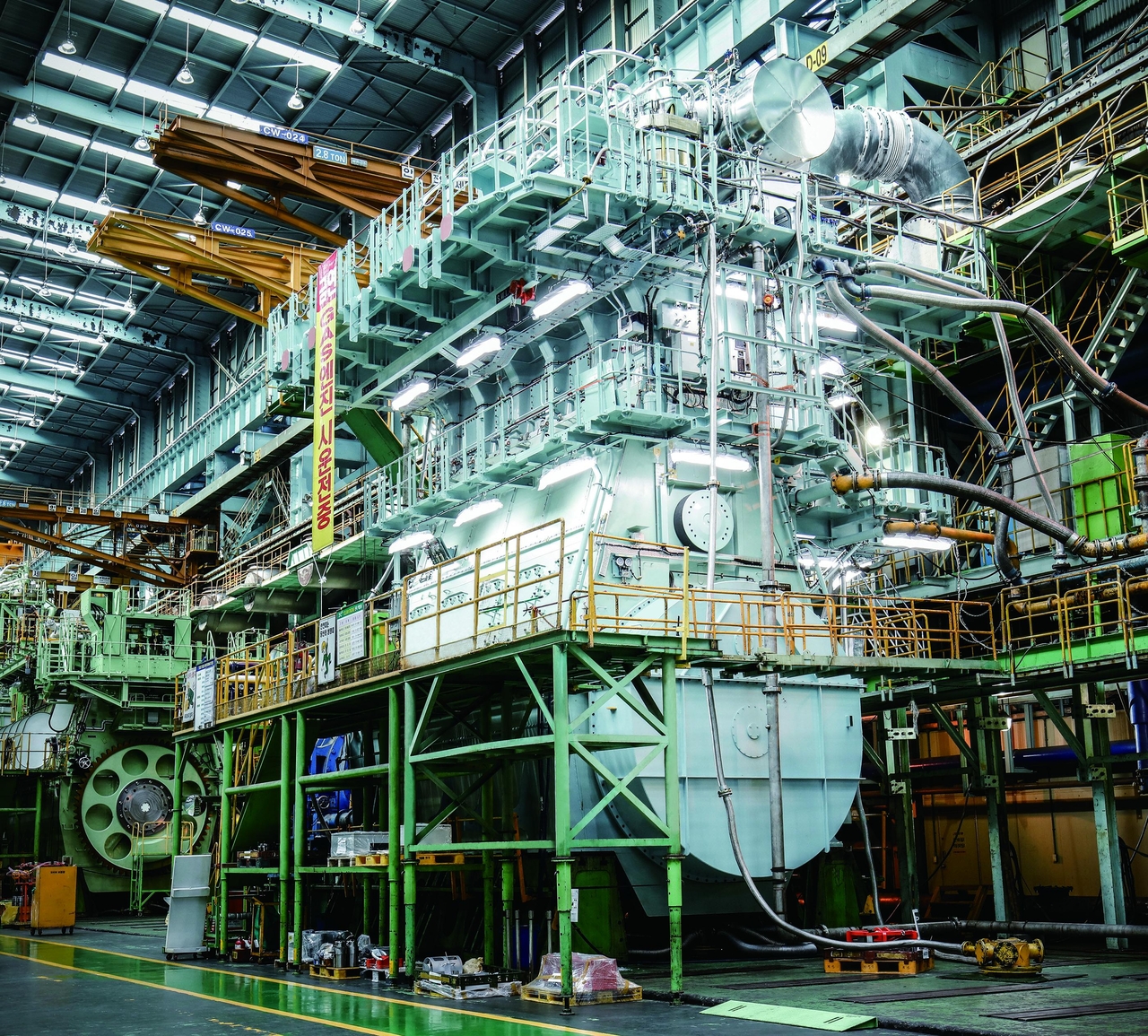
Hanwha Engine has established a local subsidiary in China to capitalize on surging demand for marine engines, targeting Chinese customers with a growing appetite for eco-friendly propulsion systems as part of a broader strategy to expand its order book and sustain earnings momentum.
Industry sources said Tuesday that Hanwha Engine set up a legal entity in Shanghai this year, upgrading its existing Shanghai branch office to a full subsidiary. The move is aimed at strengthening sales activities with local shipyards and enabling faster delivery of technical support and services.
The push into China comes as demand for marine engines there has surged. China has overtaken South Korea to lead the global shipbuilding market. According to Clarkson Research, a UK-based shipping and shipbuilding analysis firm, China's cumulative new orders from the start of this year through last month reached 53.91 million compensated gross tons across 1,995 vessels — a 92 percent increase from the same period last year.
The challenge is that China's shipbuilding output is growing faster than its capacity to supply the engines needed to power those vessels. Industry analysts estimate that China's marine engine manufacturing capability lags South Korea's by as much as five years.
South Korea's advantage is particularly pronounced in dual-fuel, or DF, engines, a field where Korean makers are widely regarded as holding an overwhelming technological edge. DF engines can run on either conventional diesel or lower-carbon fuels such as LNG, making them the preferred choice for global shipping companies seeking to comply with tightening carbon emission regulations. That demand puts Chinese shipyards under pressure to secure a reliable supply of DF engines from outside the country.
Hanwha Engine stands out as a prime beneficiary of that dynamic. The company became the world's first to achieve mass production of a low-speed DF engine in 2013, cementing its position in the high-value engine segment. That track record led the company to move proactively, establishing the Shanghai subsidiary to get ahead of China-driven demand.
The results are already showing. China's share of Hanwha Engine's order backlog reached 46 percent in the first half of this year, up from 28 percent two years ago — a 1.6-fold increase. As Chinese orders poured in, the company's total order backlog climbed to around 6 trillion won ($4.47 billion) as of the end of June, up 44.5 percent from 4.14 trillion won at the end of last year.
Orders from Chinese shipyards have continued into the third quarter. In July, Hanwha Engine disclosed that it had signed a marine engine supply contract worth 115.8 billion won with an Asian customer, which industry sources believe to be a Chinese shipyard.
The China-driven growth is lifting Hanwha Engine's overall financial performance sharply. Securities industry forecasts put the company's operating profit for this year at 215.3 billion won, up 65.5 percent from 130.1 billion won the previous year. Sales over the same period are expected to rise 13.7 percent to 1.56 trillion won.
As Hanwha Engine rides the wave, other marine engine makers are also accelerating their push into China. HD Hyundai Marine Engine is a notable example: of the 19 contracts it signed from the start of this year through August, 14 — well over half — were destined for Chinese customers, representing 569.3 billion won, or 65.4 percent of the total contract value. To keep pace with rising orders, HD Hyundai Marine Engine plans to invest 65.3 billion won in optimizing its production facilities.
yeongdai@heraldcorp.com