Hwaseong Mayor Jeong Myeong-geun says cooperation with Yongin is "not optional but essential"; Yongin Mayor Lee Sang-il calls the MOU meaningful for mutual growth and traffic relief
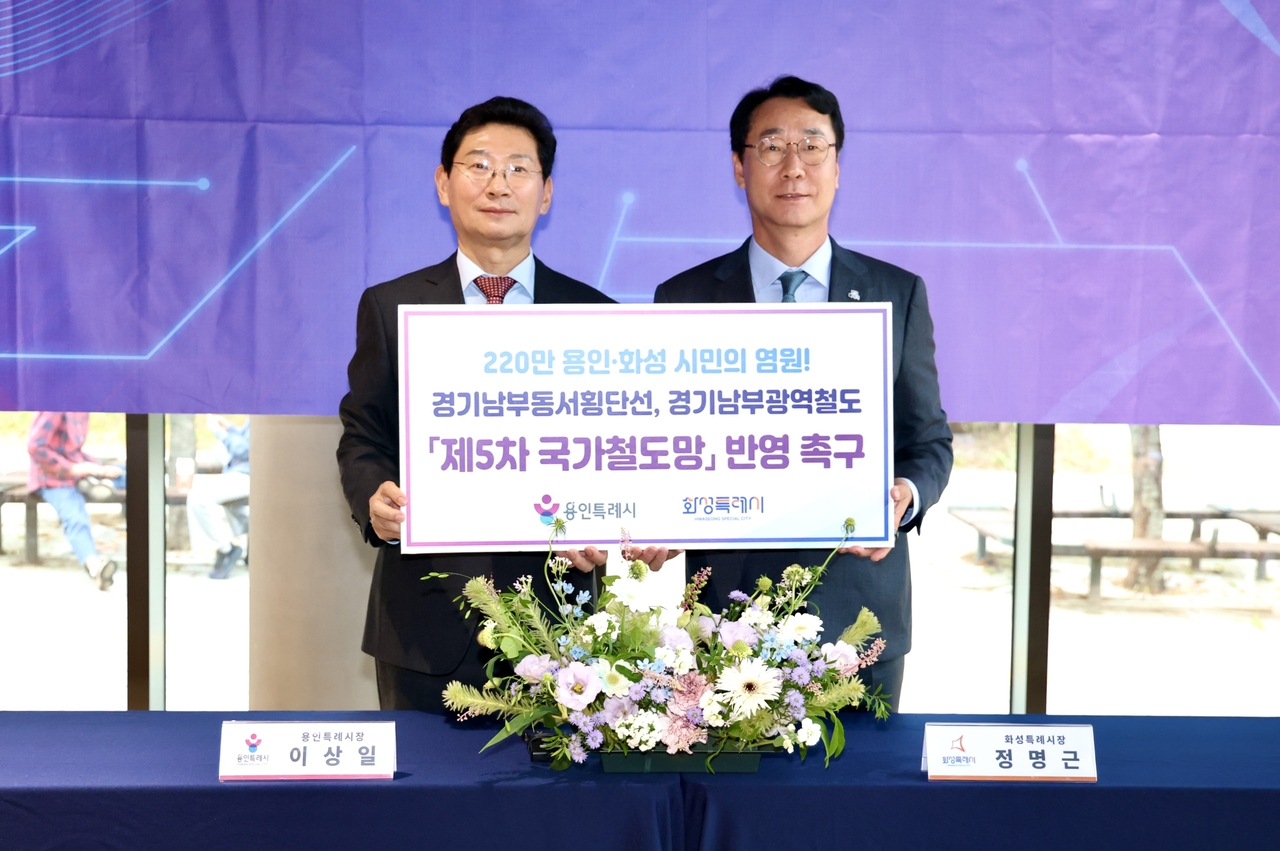
Hwaseong Special City Mayor Jeong Myeong-geun said cooperation with Yongin is "not optional but essential" to solving the region's traffic problems, and pledged to keep working toward "an environment where residents can move around conveniently through sufficient transportation infrastructure supply."
Jeong, a Democratic Party mayor, and Yongin Mayor Lee Sang-il of the People Power Party joined forces Monday to build an integrated transportation network between the two cities.
Hwaseong held a project briefing at the Dongtan 9-dong Community Service Center and signed a business cooperation agreement on securing a linked transportation network for the mutual development of Hwaseong and Yongin at the Nansa Library in Yongin.
The two cities have been coordinating through a working-level council since their mayors issued a joint declaration on mutual development of a Hwaseong-Yongin linked transportation network on Nov. 21 last year. The MOU signed Monday marks the start of full-scale implementation.
Hwaseong and Yongin share a border, and traffic between them has been consistently rising with the influx of residents into the Dongtan 2 new town. The accelerating development of a semiconductor cluster in Yongin's Nansa-eup area has added further urgency, prompting the two cities to get ahead of looming transportation challenges together.
The planned road connecting Hwaseong's Sindong and Yongin's Nansa is now moving into full development.
Hwaseong conducted a preliminary feasibility study on the Sindong-Nansa road link beginning in February and, in September, commissioned a full feasibility study from the Korea Research Institute for Local Administration with Yongin as the lead agency.
A separate east-west rail line spanning southern Gyeonggi Province — known as the "semiconductor line" — would run 89.4 kilometers from Hwaseong's Jeonggok Port through Dongtan, Yongin's Idong and Nansa, and Wonsamyeon to Icheon's Bubal. The line would cut across the heart of South Korea's semiconductor industry corridor and is expected to significantly ease the movement of people and goods.
Once the Sindong-Nansa road opens, the two cities expect it to ease traffic conditions between them, help distribute regional traffic loads and partially relieve the severe congestion on Local Road 23.
The two mayors also said they must accelerate the preliminary feasibility study for a Bundang Line extension — roughly 16.9 kilometers — running from Giheung through Dongtan to Osan. They added that a private-investment viability review for the Central Region Metropolitan Express Railway (JTX), a 135-kilometer line connecting Seoul's Jamsil through Gwangju, Yongin and Anseong to Jincheon, and on to Cheongju International Airport and Osong Station, a KTX stop, must also be wrapped up quickly.
The two cities will also work together toward inclusion in the Fifth National Railway Network Development Plan.
With public interest in railway construction growing and rail projects typically spanning multiple administrative jurisdictions, the two cities plan to jointly push for their proposed projects to be reflected as fully as possible in the Fifth National Railway Network Development Plan.
The two cities will also cooperate to ensure the timely opening of Local Road 82 — linking Hwaseong's Jangji and Yongin's Nansa — and Local Road 84, connecting Hwaseong's Jungni and Yongin's Cheonni.
Because Gyeonggi Province and the Korea Land and Housing Corporation are the implementing agencies for both projects, the two cities plan to share key information on project progress and coordinate responses to keep construction on schedule.
fob140@heraldcorp.com