Invests in 13 companies across South Korea, Japan and Taiwan
'AI bottleneck moving beyond memory to MLCC, substrates'
Mirae Asset Global Investments will list the TIGER Global MLCC & Semiconductor Substrate ETF on Tuesday.
Jung Eui-hyun, head of the ETF management division at Mirae Asset Global Investments, said Monday morning at a webinar on the company's YouTube channel "TIGER ETF" that as the AI industry expands from training to inference, data center computing loads and power demand are rising, and hardware bottlenecks are spreading beyond memory chips to multilayer ceramic capacitors (MLCCs) and semiconductor substrates. "We need to pay attention to the global MLCC and substrate companies that hold those bottleneck points," he said.
The TIGER Global MLCC & Semiconductor Substrate ETF invests in South Korean, Japanese and Taiwanese companies that produce MLCCs and semiconductor substrates — core components of AI infrastructure.
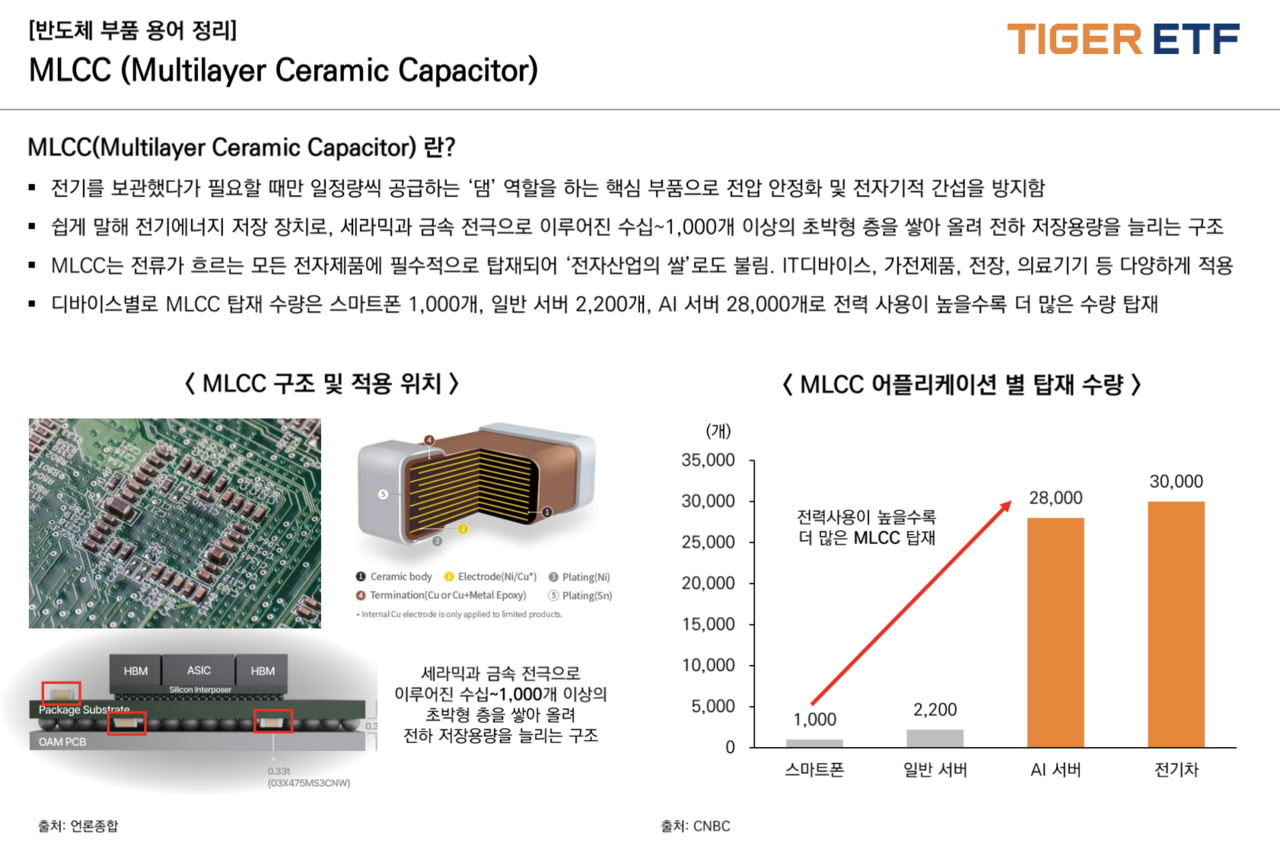
MLCCs are key components that stabilize voltage and prevent electromagnetic interference. In AI servers, they help ensure a stable power supply to each semiconductor chip by responding to instantaneous fluctuations in power demand as workloads change.
AI servers equipped with high-performance semiconductors require more MLCCs than conventional servers. Jung said the estimated number of MLCCs per AI server generation is expected to grow exponentially — from more than 20,000 in the Hopper generation to more than 400,000 in Blackwell, and to 1.8 million in Rubin Ultra.
Mirae Asset Global Investments projects that demand for AI server MLCCs will grow at an average annual rate of 30 percent from 2025 through 2030. Jung said industry production capacity is expected to increase by 10 to 15 percent per year, while AI demand is estimated to grow by more than 80 percent annually, meaning supply will remain tight even as manufacturers scale up.
The AI server MLCC market is led by Japan's Murata and South Korea's Samsung Electro-Mechanics. As these companies concentrate their production capacity on high-value AI products, demand is also expected to expand to manufacturers of general-purpose MLCCs.
Semiconductor package substrates are components that connect semiconductor chips to mainboards, transmitting electrical signals and power. FC-BGA substrates — used in central processing units (CPUs) and GPUs — must grow larger and add more layers to handle the increasing size of AI accelerators and rising data throughput, while at the same time achieving finer circuit patterns.
Jung said FC-BGA has moved beyond a cycle dependent on temporary supply shortages and has transformed into a structurally high-margin business, driven by expanding AI infrastructure investment and a shortage of high-spec substrates.
The customer base is also diversifying. Demand for FC-BGA substrates is spreading to GPUs, application-specific integrated circuits (ASICs) and network semiconductors. Supply constraints on key materials — including fiberglass, copper foil and copper-clad laminates — are also persisting, meaning production capacity and yield will be decisive competitive factors.
The ETF tracks the Solactive-KEDI Global MLCC and Semiconductor Substrate Index, which weights constituents by float-adjusted market capitalization and caps any single holding at 20 percent.
As of Sept. 30, the index comprises 13 constituents. Major holdings include Japan's Murata (19.28 percent), Taiwan's Unimicron (16.98 percent), Samsung Electro-Mechanics (16.61 percent), Japan's TDK (10.71 percent), Ibiden (9.43 percent) and Taiwan's Yageo (9.26 percent). Kyocera, Kinsus, Nanya PCB, Taiyo Yuden, Daeduck Electronics, Simtech and Walsin Technology are also included.
Jung said MLCCs handle power supply and voltage control while substrates manage signal transmission between chips and systems, and both components are affected by the push for higher AI server performance. "Advanced packaging and high-value component manufacturing capabilities are difficult to build in a short time, so the competitiveness of companies with proven technology and production capacity will become increasingly important," he said.
moon@heraldcorp.com