Investing in US stocks is no longer optional — it has become essential. Yet knowing what to watch and how to invest remains a challenge. Accurate information and timely analysis are both the starting point and the destination for US stock investors. We will make that journey with you. "Seohak Gaemi Jusik Hoesa" tackles your questions and concerns.
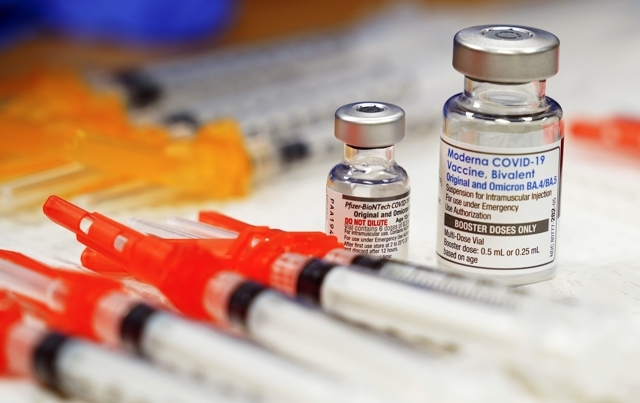
Which stock posted the biggest gain in the S&P 500 this year? It was not a chipmaker riding the AI wave. The answer is Moderna, the US biotech company best known for its COVID-19 vaccine, whose share price has surged nearly sevenfold on the back of growing excitement over its cancer vaccine program.
According to Investing.com, Moderna's year-to-date gain stood at 599.12 percent as of Tuesday (local time), making it the top performer among S&P 500 components and far outpacing second-place chipmaker SanDisk at 438.54 percent. Returns over the past one month and three months reached 47 percent and 219 percent, respectively.
Moderna closed Wednesday (local time) up 4.65 percent at $226.30.
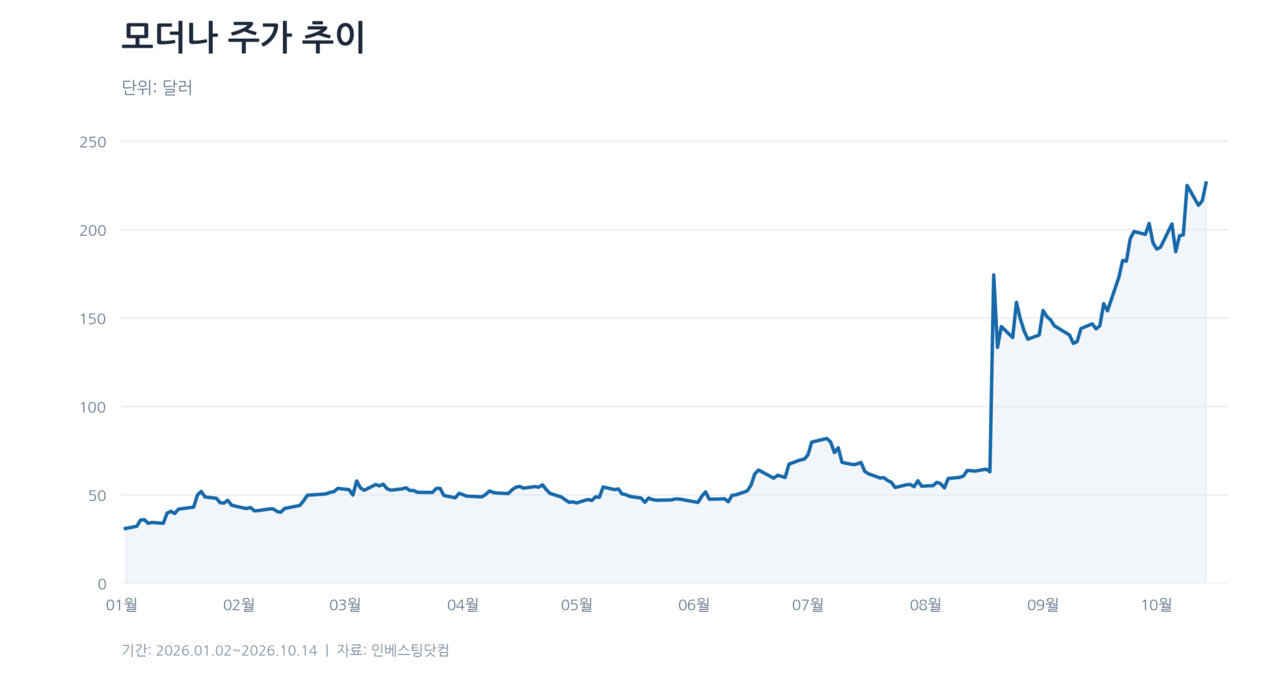
The rally has been fueled by progress on cancer vaccine development. In August, Moderna and Merck announced that their messenger RNA cancer vaccine intismeran autogene had met its primary endpoints in a Phase 3 trial involving high-risk melanoma patients. The stock surged 177 percent in a single day following the announcement.
The results drew particular attention because they marked the first time an mRNA-based personalized cancer therapy had produced positive outcomes in a Phase 3 trial.
What is a cancer vaccine? Moderna's stock soared 177% in a single day
Intismeran autogene is a personalized vaccine designed by analyzing the specific characteristics of each patient's cancer cells. It identifies mutations found in a patient's tumor and trains the immune system to recognize and attack them. Unlike COVID-19 vaccines, which are engineered to target the same viral antigen in every recipient, the composition of this vaccine differs from patient to patient.
The full Phase 3 trial results for intismeran autogene in melanoma are expected to be presented at the ESMO Congress 2026, the European Society for Medical Oncology's annual meeting being held this month.
Beyond melanoma, Moderna and Merck are conducting Phase 2 and Phase 3 trials targeting non-small cell lung cancer, bladder cancer, head and neck cancer, and renal cell carcinoma. If the treatment proves effective across additional cancer types, the cancer vaccine market is expected to expand significantly.

Moderna's cancer vaccine push is significant because it gives the company a new engine of growth. Moderna rose to global prominence in December 2020 when it received emergency use authorization in the United States for its COVID-19 vaccine, a milestone that validated its mRNA technology platform.
After the pandemic, demand for COVID-19 vaccines declined and growth slowed. Moderna's COVID-19 vaccine sales fell from $18 billion in 2022 to $1.8 billion last year. With the company heavily dependent on that single product for revenue, finding new income streams became an urgent priority.
COVID vaccine sales down 90% — cancer vaccine seen as the way out
Global financial data firm Morningstar projects that Moderna could generate $8.4 billion in annual sales from intismeran autogene by 2035, based on assumptions that the vaccine has a 100 percent chance of winning approval as a melanoma treatment and a 60 percent chance for lung cancer.
The clinical results also prompted analysts to raise their price targets. Bank of America sharply lifted its target on Moderna from $40 to $170 and upgraded its investment rating from underperform to neutral.
Analyst Alec Stranahan called the trial results a pivotal turning point for Moderna. "The company should be able to diversify away from its heavy reliance on COVID-19 vaccines and ease the financial burden of sustained research and development investment," he said.
This month, news of US government support for cancer vaccine development gave the stock another lift. The National Institutes of Health announced plans to pursue a public-private partnership to develop personalized therapeutic vaccines for cancer patients, fueling expectations that Moderna would be among the primary beneficiaries of expanded government research funding.
Seo Sang-young, a managing director at Mirae Asset Securities, said companies in the space rallied on the news that the US government was pursuing a public-private initiative to develop personalized cancer vaccines. "Moderna in particular stood out, given the strong results it has already achieved in clinical trials for the cancer vaccine it is co-developing with Merck," he said.
Moderna's inclusion in the NASDAQ 100 on Friday also contributed to the share price gains, raising expectations of capital inflows from ETFs and index funds that track the benchmark.
'Is it still a buy?' Commercialization and earnings recovery remain hurdles
The rapid share price appreciation has, however, raised valuation concerns. Citigroup downgraded Moderna from neutral to sell on Sept. 30, and while it raised its price target from $60 to $80, that figure remained well below the stock's price of around $200 at the time.
Citigroup argued that expectations for cancer vaccine commercialization had become excessively priced into the stock. The bank also flagged uncertainty over whether the treatment efficacy seen in melanoma trials would be replicated in other cancer types.
Intismeran autogene still faces significant hurdles before it can generate actual sales. The company must secure additional clinical data and obtain regulatory approval for commercialization. Demonstrating efficacy beyond melanoma — in lung cancer and other tumor types — is seen as the key determinant of the company's long-term growth potential.
Heo Hye-min, a researcher at Kiwoom Securities, said that following clinical success, "how quickly and cost-effectively the company can mass-produce patient-specific products at scale will determine actual market penetration and profitability."
Overcoming weak earnings is another challenge. Moderna's sales fell roughly 40 percent, from $3.24 billion in 2024 to $1.94 billion last year. Operating losses narrowed from $3.45 billion in 2024 to $2.78 billion last year.
Second-quarter earnings per share came in at $1.97, missing the market consensus of $2.03. Sales for the same period totaled $145 million.
moon@heraldcorp.com