Major institutions forecast October hold, November hike
Dot plot median at 3.25%; inflation, growth and financial imbalances all point to tightening
Shin Hyun-song: 'Will maintain restrictive stance until confident inflation converges to target'
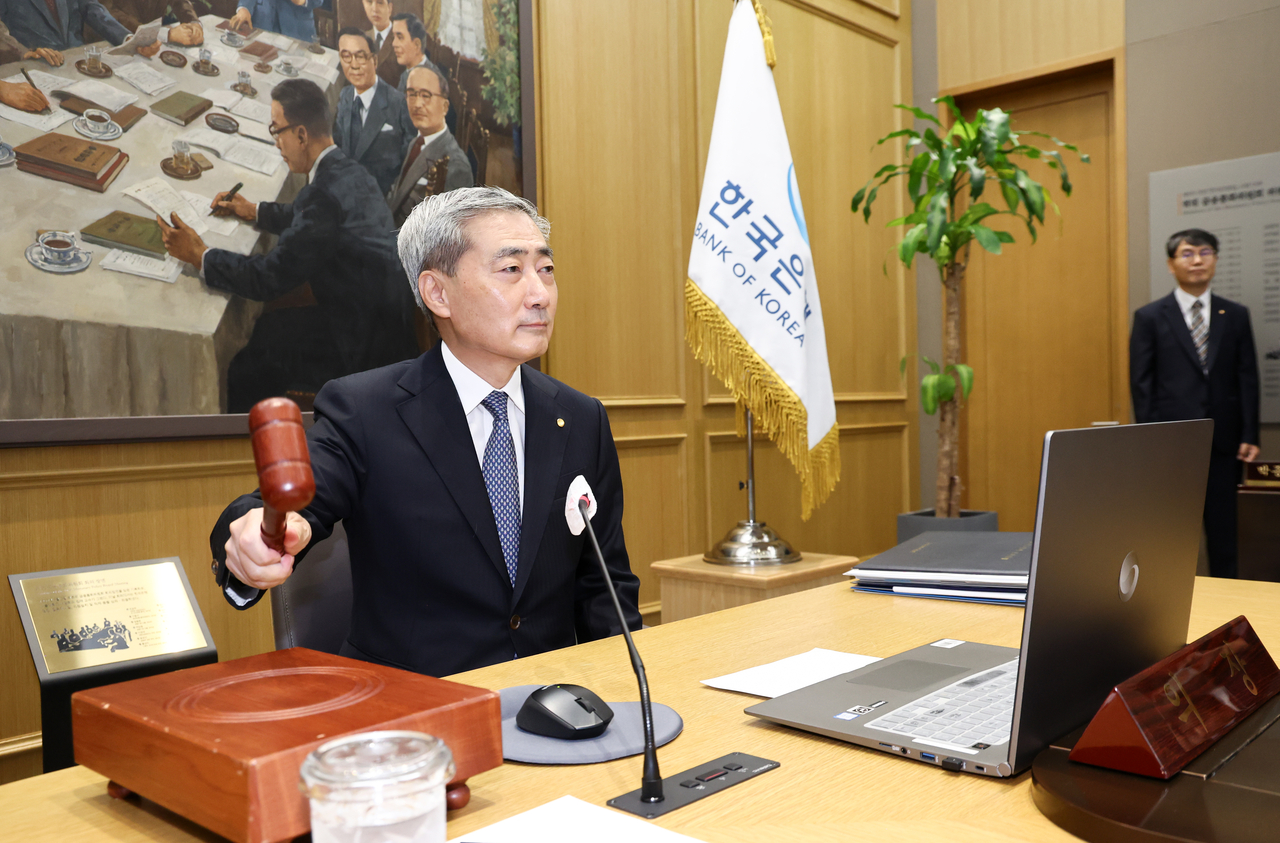
Expectations are growing that the Bank of Korea's Monetary Policy Board will hold its benchmark interest rate Thursday before delivering one additional hike at its final meeting of the year next month. After two consecutive rate increases, the central bank is widely expected to pause to assess the impact of its tightening, then raise rates once more before year-end to actively counter upside inflation pressure.
According to financial industry sources Monday, major domestic and international institutions are increasingly forecasting a BOK path of an October hold followed by a November hike. Morgan Stanley said in a recent report that the BOK would keep rates unchanged this month before lifting them to 3.25 percent in November, with the terminal rate reaching 3.5 percent in the first quarter of next year. Citibank Korea also projected two additional quarter-point increases — in November and February — bringing the terminal rate to 3.5 percent.
The BOK raised rates in consecutive months in July and August and signaled it would take time to assess the policy impact, leading markets to expect a pause at this week's meeting.
Still, inflation trends and economic growth conditions raise the prospect of another hike in November. The median of the dot plot released at the August Monetary Policy Board meeting stood at 3.25 percent. The dot plot reflects each of the seven board members' individual projections for the benchmark interest rate six months out, and the median implied a broad consensus for one more hike by February next year.
Inflation remains a concern. Consumer prices rose 2.9 percent in September, pulling back into the 2 percent range within a month, and the core inflation rate eased from 3.4 percent to 2.8 percent. However, those figures were heavily influenced by a temporary base effect from last year's telecommunications fee discounts. BOK Deputy Governor Lee Ji-ho said at an inflation monitoring meeting that "taking into account the dissipation of last month's temporary base effect, the pace of price increases has in fact expanded somewhat," adding that October consumer price inflation was likely to "remain at a high level of around 3 percent as the upward trend in core items continues."
The renewed surge in global oil prices, driven by fresh tensions in the Middle East, adds another variable. The average price of Dubai crude in September was $113.7 per barrel, up 28.1 percent from the previous month's $88.8. Import prices rose 1.7 percent month-on-month, reversing four months of declines. Import prices feed through to consumer prices with a lag, adding upside pressure. On top of that, the BOK is closely watching whether income gains from the semiconductor boom could stoke demand-side inflation.
Growth conditions are also improving steadily. In its revised economic outlook in August, the BOK projected growth of 3.3 percent this year and 2.9 percent next year. The IMF recently raised its growth forecast for South Korea by 0.7 percentage points to 3.3 percent as well. Some market participants expect actual growth to exceed those projections by a wider margin, driven by strong semiconductor exports amid a global AI investment boom. If the BOK upgrades its growth forecast further at the November meeting, the argument that rate hikes carry limited risk of economic contraction would gain additional weight.
Financial imbalances, including household debt, also remain unsettled. Minutes from the Sept. 22 Monetary Policy Board meeting, released Tuesday, showed that a proposal was made to explicitly state that "addressing the buildup of financial imbalances" was among the reasons for the consecutive rate hikes — a signal that Greater Seoul home prices and household debt remain firmly on the BOK's radar. The Financial Vulnerability Index, which gauges South Korea's medium- to long-term financial imbalances, has risen for nine consecutive quarters, from 37.6 in the first quarter of 2024 to 46.5 in the second quarter of this year, reaching its long-term average. That reflects household credit growing at a pace that outstrips the underlying strength of the economy.
Offsetting factors include financial market jitters over concerns about the profitability of AI investment and the won-dollar exchange rate, which has fallen back to the 1,330-won range, both of which reduce the urgency of a hike. The outcome of the Federal Open Market Committee meeting scheduled for Oct. 27-28 (local time) is also expected to influence the BOK's November decision.
Markets are closely watching what message Governor Shin will deliver at this week's meeting. Given the string of hawkish signals he has sent at recent public appearances, analysts expect him to stay on that course.
Speaking at a panel discussion on the sidelines of the IMF-World Bank Group annual meetings in Bangkok, Thailand, on Tuesday, Shin said: "Inflation is too high, the exchange rate has room to strengthen further, and there are financial stability considerations. All three point in the same direction." He added that the BOK would "maintain a restrictive monetary policy stance until we are confident that inflation will converge to the target in a timely manner."
At a National Assembly national audit Wednesday, Shin forecast that "inflation will continue to rise above the target level for a considerable period." He described the July and August hikes as having "bought time" and confirmed the tightening bias, saying the BOK planned to "determine the timing and pace of additional hikes going forward."
Other points of focus include whether the monetary policy statement will retain language about "determining the timing and pace of additional hikes," whether any board members will dissent in favor of an immediate hike, and if so, how many. The dot plot will not be released at this meeting.

kimstar@heraldcorp.com