Government to expand economic outlook releases to three times a year from next year
Second-half growth strategy to be replaced with targeted policy responses
Inequality seen as key challenge; jobs at center of three-pronged policy push
Historic Korea-US fiscal and monetary '2+2' meeting yields results in Bangkok
Current exchange rate described as 'returning to economic fundamentals'
South Korea's Deputy Prime Minister and Minister of Economy and Finance Lee Hyung-il said the country's economic growth rate this year could rise as high as 3.6 percent, citing strong exports and facility investment driven by a semiconductor boom. He also said a rebound in the country's potential growth rate is imminent, buoyed by expanding capital investment.
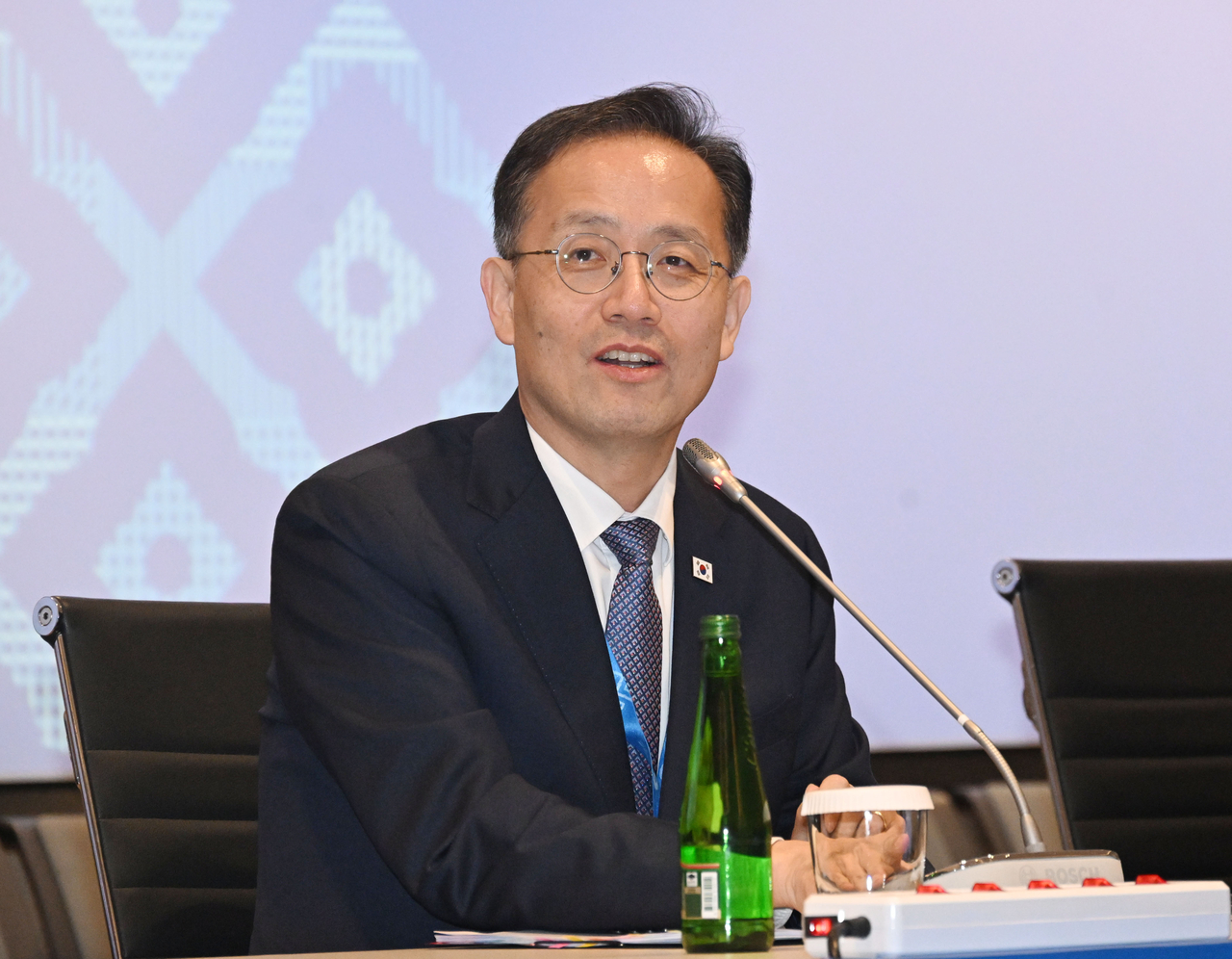
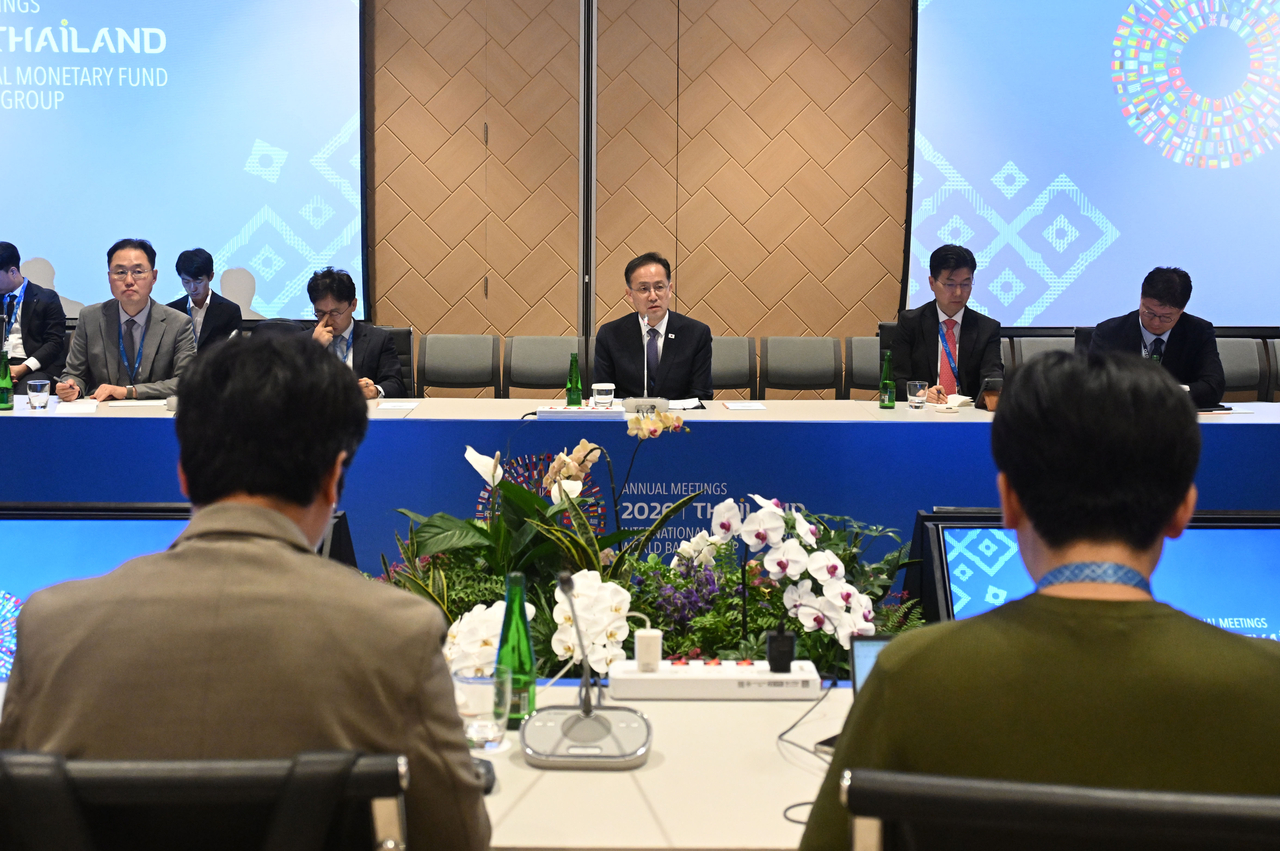
Speaking at a press briefing at the Queen Sirikit National Convention Center in Bangkok on Friday (local time), Lee said growth in the "mid-3 percent range" is achievable this year, provided no major external shocks emerge in the remaining months. "We think it will likely exceed the 3.3 percent forecast by the IMF," he said, adding that the mid-3 percent range means "3.4 to 3.6 percent."
Major institutions' current growth forecasts for South Korea this year range widely: the government projects 3.0 percent, the Korea Development Institute and the Asian Development Bank each forecast 3.2 percent, the Bank of Korea and the IMF each project 3.3 percent, Moody's 3.5 percent, and the OECD 3.7 percent. Lee's figure would surpass not only the government's own earlier projection but also those of the Bank of Korea and the IMF.
"The first and second quarters came in at 1.8 percent and 0.6 percent, a very steep climb," Lee said. "If the third quarter holds up at this level, growth could turn out much better than expected."
On potential growth, Lee said recent growth trends and their composition suggest the country is on the verge of breaking out of a prolonged decline. "I think that moment is approaching — in some ways, it's imminent," he said. The OECD projected in June that South Korea's potential growth rate would fall from 1.85 percent last year to 1.66 percent this year, and drop further to a record low of 1.52 percent next year.
Lee pointed to the United States as an example where expanded facility investment led to productivity gains and a rise in potential growth, expressing hope that South Korea would follow a similar path. "Facility investment is very strong right now, and I expect that trend to continue into next year," he said. "Semiconductor demand remains high while supply is still short, so efforts to close that supply gap are ongoing."
Starting next year, the government plans to release its economic outlook three times annually, up from the current two. "The economy moves so fast that I find myself questioning whether twice a year is still adequate," Lee said. He said an end-of-year review of the following year's economy is a given, and that one additional update is not enough — two would better reflect the pace of change. The timing of the additional releases has yet to be decided.
The annual second-half economic growth strategy, a fixture of government policy, will also be overhauled starting next year. Lee said the priority should shift toward more accurate forecasting and targeted responses to gaps identified in those forecasts, rather than mounting another large-scale policy exercise. "If my thinking stays the same through year-end, I don't think we'll see a growth strategy under the 'second-half' label next year," he said.
On the concept of issuing "pinpoint" policy responses to problems identified during forecast revisions, Lee said staying silent when gaps are visible is not an option. "The intent is to prepare countermeasures or response plans as needed," he said.
Lee identified narrowing inequality as the central challenge for sustainable growth, saying leaders of major credit rating agencies and multilateral development banks shared that view while otherwise praising South Korea's growth momentum. On the multiple dimensions of inequality — income and assets, regional disparities, firm size and generational gaps — he said the issues are deeply intertwined. "Jobs, I think, are the thread connecting all of these problems," he said.
The government is discussing inequality measures centered on three core social policy areas: residential support, employment and financial services for lower-income households. "Relevant ministries are putting their heads together on this," Lee said, adding that no announcement date has been set. "We started from the idea that with expanded fiscal room, we should look for more we can do — and we're beginning by asking what measures are truly needed," he said.
On the use of excess tax revenue, Lee said 5 trillion won ($3.71 billion) has already been applied to reduce government bond issuance, and that any further reduction would depend on market conditions. He noted that domestic government bond yields have since fallen, saying the move to cut issuance volume "is producing results to some degree."
On buybacks to stabilize the government bond market, Lee said a regular October buyback of 3.5 trillion won has already been decided, and that whether to conduct an emergency buyback — and at what scale — would be assessed based on market conditions.
Lee described the historic first "2+2" meeting between the fiscal and monetary authorities of South Korea and the United States as highly significant. "Finance ministries hold bilateral talks, and central banks hold their own — but discussing things together carries even greater meaning," he said. "I think it will be a great help when various situations arise down the road."
The meeting was arranged through consultations between the two countries before Lee's Bangkok visit and came together after both sides agreed, he said. The specific content of the discussions remains confidential under a mutual agreement, and whether the format will become a regular fixture has not yet been decided, Lee added.
Asked whether the meeting was intended to lay the groundwork for a Korea-US currency swap, Lee said such an arrangement "is meaningful and necessary as a solid safety net for our foreign exchange market."
When asked whether the government had shifted from its January position that a currency swap was not immediately needed, Lee said the earlier stance reflected the absence of foreign exchange liquidity concerns at the time — "the idea being that a life jacket wasn't necessary." He said the situation has since changed. "Our market has come a long way and our economy has grown, so the point now is that we need a currency swap at the level befitting an advanced economy," he said. "Overall, it will serve as a strong shield for our economy."
On the won-dollar exchange rate, Lee said the rate's rise to 1,550 won per dollar in July was "actually a departure from our fundamentals." The current level, he said, represents "a process of returning to economic fundamentals."
Asked whether the government would revise its tax revenue forecast in light of exchange rate movements, Lee said chipmaker earnings had already been heavily factored into corporate tax estimates. "The exchange rate impact and other upside and downside factors have been reflected, so I don't think this is a moment to change the revenue forecast," he said.
On the Alaska LNG development project as a potential avenue for investment in the United States, Lee reaffirmed that the government would carefully review the project's details before making any judgment. "When a concrete proposal comes in, there is a process of evaluating it and assessing its commercial viability," he said.
Lee's Bangkok trip, from Thursday through Saturday, marked his first multilateral diplomatic engagement since taking office. He attended the G20 finance ministers' meeting and the IMF-World Bank Annual Meetings, completing 25 official engagements over three days — five multilateral sessions, 19 bilateral meetings and one foreign media interview. The schedule included the inaugural Korea-US 2+2 meeting, discussions on economic and financial cooperation with major countries and international financial institutions, and meetings with the world's three major credit rating agencies.
y2k@heraldcorp.com