
Laser-only vs. full system costs differ; military eyes rockets, missiles as future targets
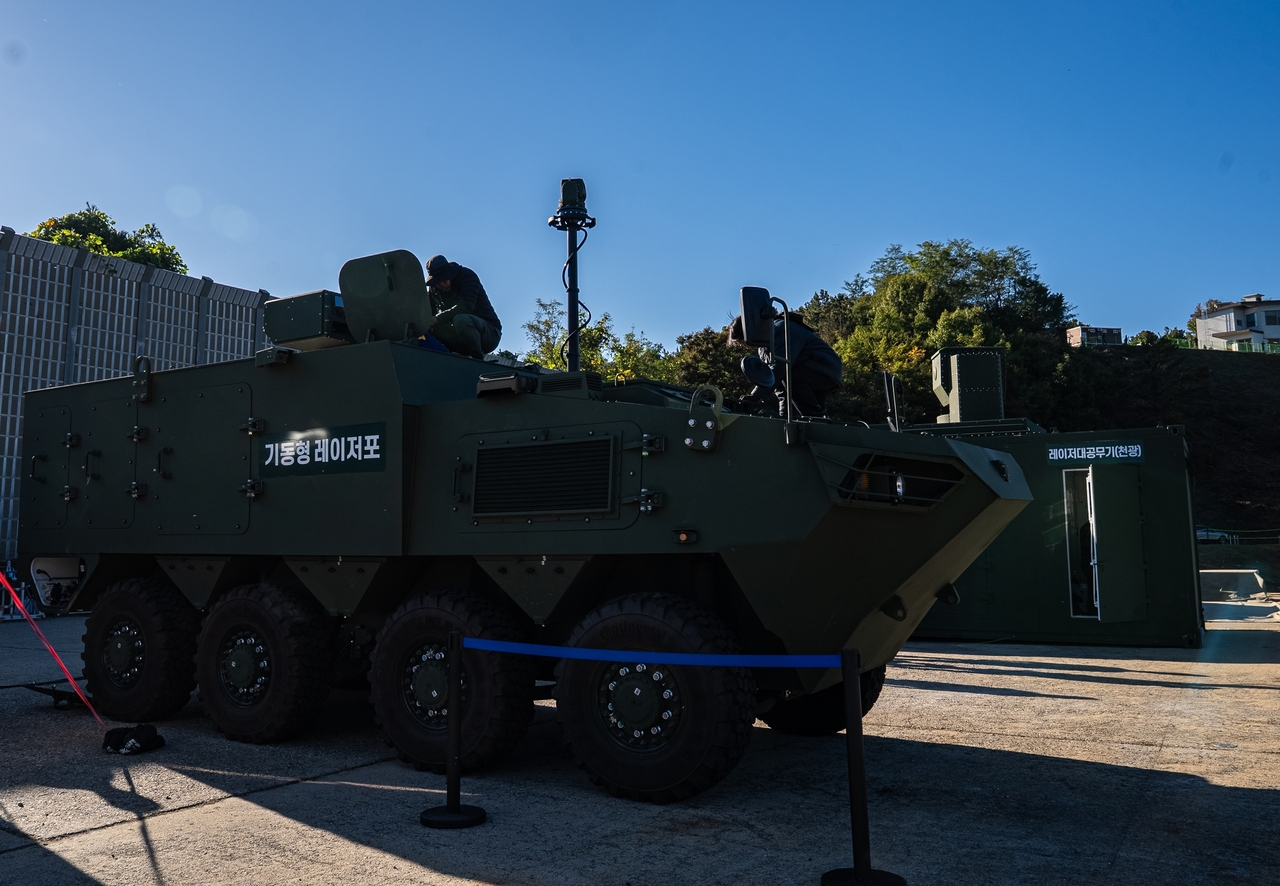
The Cheongwang laser air-defense weapon was once described as costing 2,000 won per shot, but at this year's Armed Forces Day ceremony it was introduced as costing 10,000 to 20,000 won (about $15) per shot. The same weapon, designed to intercept North Korean small drones, was quoted at prices differing by as much as tenfold — and the reason comes down to how the cost is calculated.
The discrepancy lies in what is included in the calculation. Whether the figure covers only the laser itself, or also the electricity consumed by the cooling and power-supply systems, determines what the military calls the "cost per shot."
"When you look only at the laser, you can express it as 2,000 won, and when you factor in the energy costs for the entire system, it comes to 10,000 to 20,000 won — so both figures are being used interchangeably," a military official said Sunday in a phone interview.
Cheongwang works by firing a high-powered laser beam at a target to burn it. Rather than launching conventional ammunition, it draws on electrical power to neutralize drones and similar threats. It is the Block-I laser air-defense weapon developed primarily by the Agency for Defense Development, with Hanwha Systems participating as the prototype manufacturer.
However, firing a laser at a target requires more than just the laser device itself. The cooling unit that dissipates heat, the power-supply unit and communications equipment must all operate simultaneously.
A military official cited the example of generating 20 kW of laser output, explaining that the entire system requires roughly 120 to 130 kW of electricity. The official put the total electricity cost at around 15,000 won. Once the power consumption of peripheral equipment — excluded from the roughly 2,000-won figure — is factored in, the cost rises.
Even so, the output figure alone does not allow a straightforward calculation of the electricity cost for a single shot. Verifying the actual cost requires knowing the laser irradiation time, the operating time of peripheral equipment and the applicable electricity rate.
Cheongwang recently demonstrated its drone-interception capability during an Army exercise. At the Army TIGER+ Future Warfare Integrated Combat Training Exercise hosted by Army Headquarters, both Cheongwang and a 30 kW vehicle-mounted high-energy laser cannon conducted interception demonstrations. The two systems successfully struck all three drones used in the exercise.
Cheongwang's drone-interception capability was also showcased at the 78th Armed Forces Day ceremony held at Gyeryong in South Chungcheong Province on Oct. 1. However, not all four drones prepared for the demonstration that day were shot down by laser.
In the first demonstration, one of two drones crashed during takeoff after its fiber-optic cable snapped, while the other was intercepted by the laser. In the second demonstration, one drone was downed by laser, but the other strayed outside the safety zone and the military cut its power. A total of two drones were intercepted by laser.
The development trajectory for laser weapons points toward higher output and a broader range of targets. The military plans to gradually expand its response capability beyond the small drones it currently focuses on.
"We will keep raising the output," a military official said. "The benefit of higher output is that the number of targets we can engage keeps growing." The official added that the military intends to improve the system's performance to handle rockets and missiles as well.
The official also cited helicopters, fighter jets, ground-based armored vehicles and tanks as long-term targets for high-powered laser weapons.
Development of a separate, more mobile laser weapon is also under way. The 30 kW vehicle-mounted high-energy laser cannon demonstrated at the exercise features miniaturized and lightened key components. A phase-change-based cooling technology has also been applied to manage the heat generated during high-output operation.
The military also plans to develop a 50 kW laser armored vehicle with enhanced mobility and output, incorporating future export customers' requirements, by 2027. The performance upgrade of the currently deployed Cheongwang and the development of the vehicle-mounted laser weapon should be viewed as separate efforts.
Higher output means greater power consumption. The military believes, however, that even as costs rise, the system will remain economically competitive compared with conventional ammunition-based weapons.
"It is only natural that higher output means more electricity use," a military official said. "But even if costs go up, it is far cheaper than weapons systems that use guided missiles or other conventional munitions."
rimsclub@heraldcorp.com




