
Green network linking mountains, parks, streams and neighborhoods — 12.5 billion won across five areas
40% of plantings tied to private development; shade trees and residential greenery to expand along Hongjechen and Bulgwangcheon
Seodaemun-gu plans to extend the forests of its mountains and streams to the walking paths and neighborhood parks residents use every day. The district will plant 300,000 trees to weave a single green network across the area, adding shade throughout residential zones to offer relief during heat waves.
The district will pursue its "300,000 Trees Project" with a goal of one tree per resident by the first half of 2030. The urban greening initiative will link ecological corridors between mountains, expand greenery along streams and roads, and make use of neighborhood parks and underutilized urban spaces.
The project's core aim is not just the number of trees planted but the connectivity of green spaces. Publicly developed forests and parks will be linked to greenery secured through private development, with residents, universities and businesses all invited to participate in extending the green network across the district. The plan calls for residents to encounter greenery not only near mountains and streams but also on the streets and in the neighborhoods where they live.
Seodaemun-gu encompasses five mountains — Ansan, Inwangsan, Baengnyeonsan, Gungdongsan and Bukhansan — and two streams, Hongjechen and Bulgwangcheon. According to Korea Meteorological Administration data the district released earlier, Seodaemun recorded the lowest daytime high temperature among Seoul's 25 autonomous districts for three consecutive days from Aug. 3 to 5, with a difference of up to 4.8 degrees Celsius compared with the hottest areas of the city. The district intends to build on this natural environment of forests and waterways as an asset, expanding residential greenery and shade.
The project is organized into five areas: building a forest-trail ecological network, expanding residential park greenery, connecting green corridors along urban roads and streams, increasing greenery through private development, and resident-participation commemorative planting. A total of 12.5 billion won ($9.27 million) will be invested in expanding green spaces and developing related facilities.
The forest-trail ecological network area will receive 4 billion won to plant 50,000 trees. The work will be coordinated with the construction of an ecological bridge linking Ansan and Goeunsan, the Inwangsan connecting trail and the Baengnyeonsan healing circular path, improving forest connectivity and refurbishing mountain hiking trails. Mountain-specific species will be planted to create distinctive seasonal landscapes — royal azaleas and Korean winter hazel on Ansan, forsythia and Japanese kerria on Bukhansan.
The residential park greenery area will receive 3.4 billion won for 48,000 trees. A vitality plaza will be created on long-unexecuted park compensation land at Baengnyeon Neighborhood Park, while Bokjusan Neighborhood Park will gain a pedestrian bridge, a nature-themed playground and a water play area. Greenery expansion will also be incorporated into the construction of a forest therapy center at Baengnyeon Neighborhood Park and into repairs and maintenance of existing parks, creating spaces where residents can rest and be active close to home.
Streets and streams that residents use daily will receive 4.4 billion won for 62,000 trees. Street trees and green strips will be supplemented and expanded, and shade trees such as weeping willows and ash trees, along with seasonal species including cherry trees, hydrangeas and roses, will be planted along Hongjechen and Bulgwangcheon. Greening under elevated structures and around urban infrastructure, child-safe green forest zones and decorative garden installations will add to urban greenery and help counter heat waves and the urban heat island effect.
Some 120,000 trees — 40 percent of the total target — will be secured through private development projects. The district will draw on park and green space donations tied to reconstruction and redevelopment projects such as Yeonhui District 1 and Hongje District 3, as well as mandatory landscaping requirements attached to building projects. This approach connects greenery created through private development to the district-wide green network without requiring a separate planting budget from the district.
Resident-led planting and stewardship activities will receive 700 million won ($519,000) for 20,000 trees. Through a "one household, one commemorative tree" program, families will plant trees to mark personal milestones such as births, marriages and school enrollments, with name plaques attached. Certified community gardeners trained by the district will provide on-site technical guidance, and an online registration system will be set up to facilitate resident participation.
Local universities and community organizations will also be brought in. The district is in talks with local businesses about creating company-sponsored forests through ESG corporate social responsibility programs. The initiative aims to build a foundation for residents, universities and businesses to jointly expand and tend the district's green spaces.
To secure planting sites in the urban core, the district will identify unused strips along roadsides, space beneath elevated structures and gaps around urban infrastructure. Green space expansion will also be reviewed during consultations on redevelopment projects, and national and city government funding, public funds and corporate participation will be tapped to reduce the burden on the district's own finances.
"The heart of this project is not simply planting 300,000 individual trees but weaving them into a dense network that connects mountains, streams and residential areas," Seodaemun-gu District Mayor Park Un-gi said. "We will make sure residents can find shade and forest on the paths they walk and the places they rest every day."
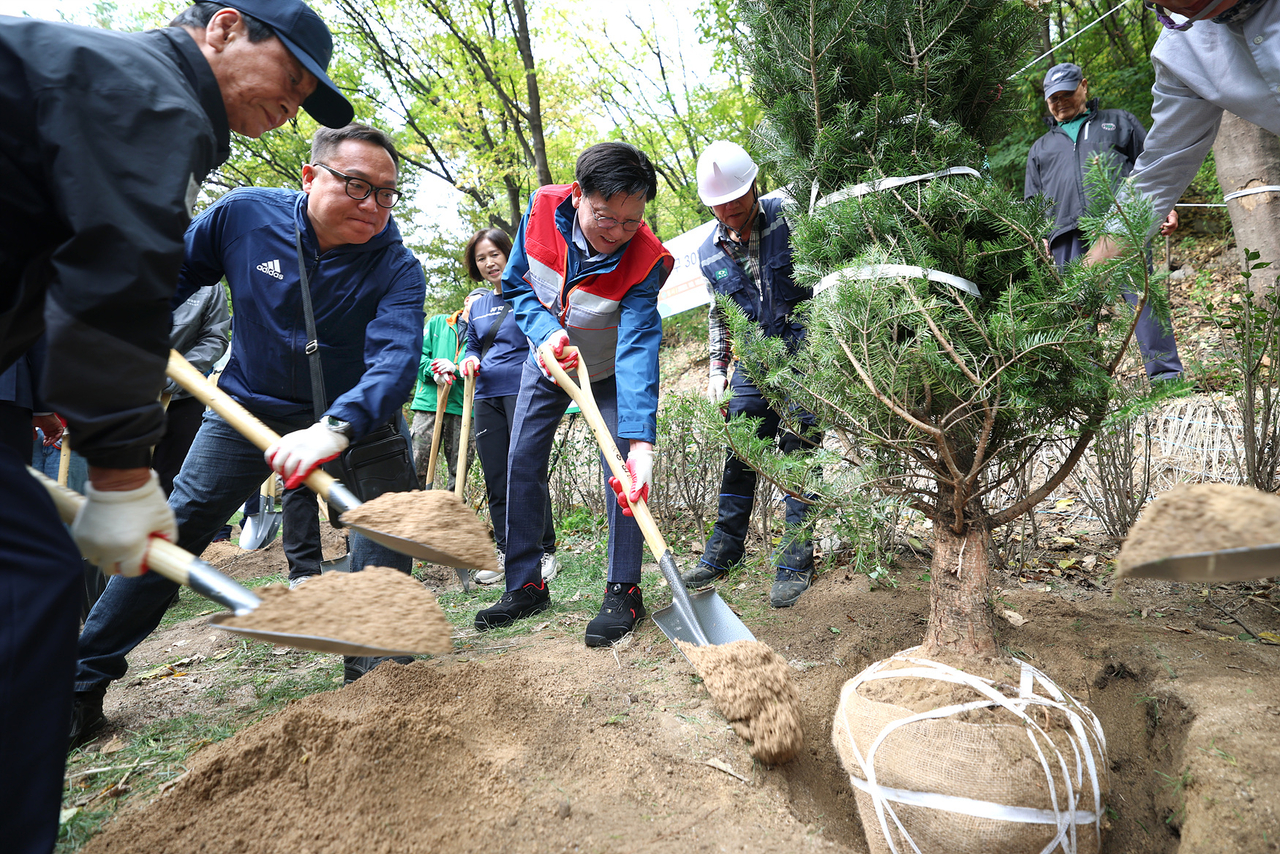
The district held a commemorative planting ceremony near Silrak Children's Park on Bukhansan on Friday to mark the launch of the project. About 100 residents and officials took part, planting roughly 2,500 trees of seven species — including mountain cherry, fir, mountain maple, royal azalea and Japanese kerria — across a 650-square-meter site.
seouldream01@heraldcorp.com



