AI power chip orders surge as global 8-inch capacity shrinks
SMIC, Hua Hong among Chinese foundries reaping spillover gains
Process prices seen rising further next year; earnings outlook bright
12-inch foundry Yuexin Semiconductor makes stock market debut
![The headquarters of SMIC in Shanghai. [Provided by SMIC]](https://wimg.heraldcorp.com/news/cms/2026/10/16/news-p.v1.20261016.88985c455fc34c4f88a8d918461da000_P1.png)
Surging AI demand has brought an unexpected boom not only to Taiwan's TSMC but also to Chinese legacy-process foundries operating at lower levels of technological complexity.
The rapid expansion of AI data centers has triggered a flood of orders for power semiconductors — chips that convert and regulate electricity — keeping 8-inch foundries running at full capacity.
With a structural supply shortage showing no signs of easing, process prices are expected to keep rising through next year, and analysts say the benefits will extend to Chinese foundry players as well as memory chip makers.
According to market research firm SigmaIntel, Chinese legacy-process foundries including SMIC, Hua Hong and Nextchip have been operating at full capacity since the start of the year.
SigmaIntel forecast that wafer prices for mature processes of 28 nanometers and above — based on 12-inch wafers — will rise 5 to 8 percent in the first quarter of next year compared with the fourth quarter of this year. Prices for 8-inch wafers are expected to increase by 4 percent.
With utilization rates high across the industry and the cost of power and materials used in production also climbing, process price increases are seen as unavoidable.
Demand for power semiconductors used in AI servers has been particularly strong, pushing 8-inch foundry utilization rates higher — yet even full capacity is proving insufficient to meet orders.
Power semiconductors, long driven by demand from mobile devices and home appliances, are now being sought across a widening range of power-intensive industries including AI data centers, robotics and electric vehicles, further fueling the order backlog.
Eight-inch foundries, which manufacture chips on 200-millimeter wafers, handle contract manufacturing for power semiconductors as well as image sensors and display driver ICs.
The supply crunch has deepened as Samsung Electronics and TSMC have scaled back their 8-inch production capacity to focus on larger 12-inch (300-millimeter) foundry operations.
SigmaIntel projected that the pullback by Samsung Electronics and TSMC will shrink global 8-inch foundry capacity by about 6 percent this year compared with last year, with a further decline of about 2 percent expected by 2027.
As orders increasingly concentrate on Chinese 8-inch foundries such as SMIC and Hua Hong, the spillover benefits for those players are set to grow. The bottleneck is intensifying — order books across the 8-inch industry are already filled six months out, analysts said.
SigmaIntel said the supply shortage is unlikely to ease quickly, given the time required for 8-inch foundries to expand capacity. Process prices are expected to continue rising next year, following increases already seen this year.
The foundry industry had earlier estimated that SMIC's cumulative 8-inch process price increases this year would reach 10 to 20 percent. Hua Hong also raised prices by 5 to 10 percent in the first quarter.
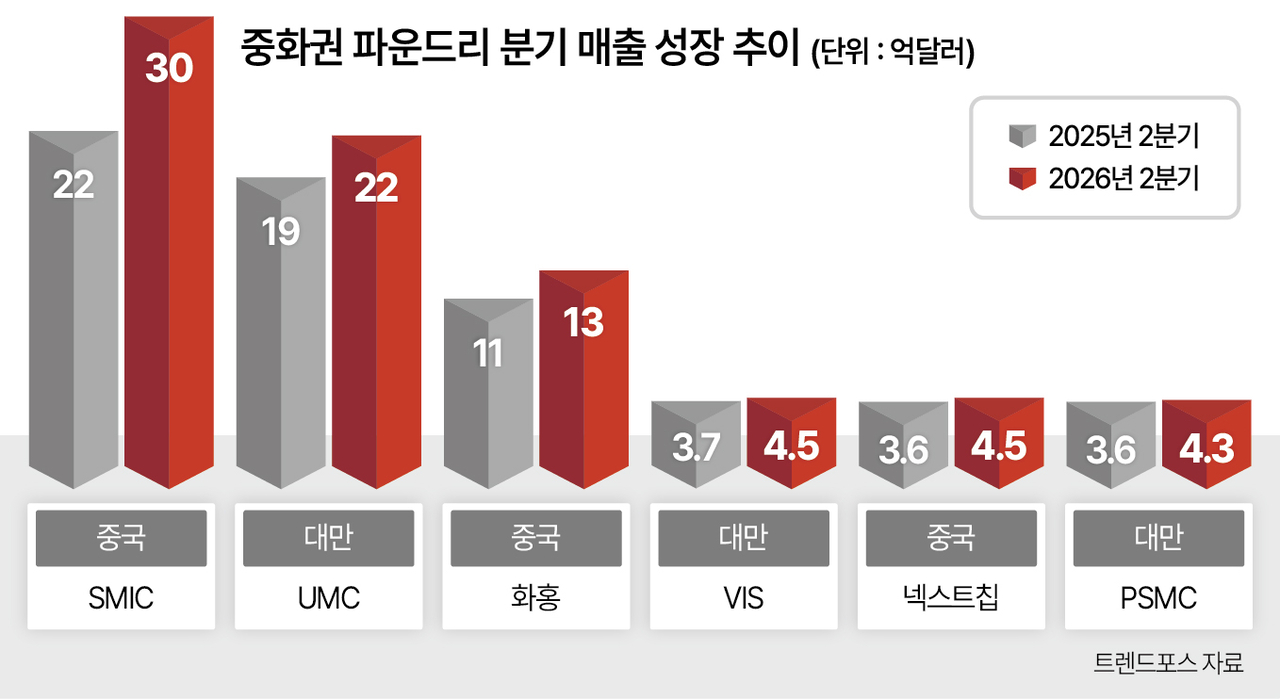
Earnings are keeping pace with the price increases. According to TrendForce, SMIC's sales in the second quarter of this year rose 36 percent from a year earlier, while Hua Hong and Nextchip posted sales gains of 17 percent and 21 percent, respectively.
With the gains flowing to Chinese legacy-process foundries now well established, companies are also moving to raise capital through initial public offerings. Yuexin Semiconductor, a Guangzhou-based 12-inch foundry, listed on the ChiNext board of the Shenzhen Stock Exchange on Tuesday, raising approximately 6.16 billion yuan ($921 million) before the exercise of any overallotment option.
joze@heraldcorp.com