
Produces heated asphalt concrete on-site — optimized for potholes and small-scale emergency repairs — the technology was designated a construction innovation by the Ministry of Land, Infrastructure and Transport in 2016, with output capacity and performance steadily improved since.
Daenung Co.'s Mobile Mini Ascon Plant (MMP) technology, which produces heated asphalt concrete directly at road repair sites, has expanded beyond the Greater Seoul area to regions across the country — a decade after receiving its construction new-technology designation from the Ministry of Land, Infrastructure and Transport.
The partial road-pavement repair method using MMP was designated Construction New Technology No. 799 on Oct. 17, 2016. It produces heated asphalt concrete on-site for small-scale and emergency repairs such as potholes and localized road damage.
Conventional heated asphalt concrete is produced at a factory and transported to construction sites by dump truck. While suitable for large-scale paving projects, this approach makes it difficult to secure the right amount of material in time for small-scale repairs, and prolonged transport and waiting times can cause the asphalt concrete to lose heat.
Road damage caused by heavy summer rains or winter de-icing agents requires rapid restoration, but securing small quantities of heated asphalt concrete at short notice can be particularly challenging.
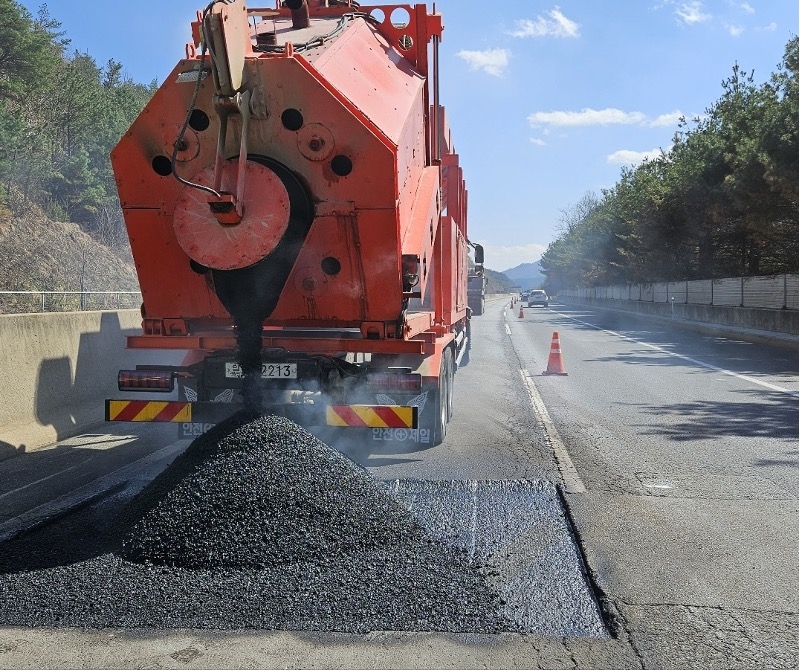
MMP brings a compact production unit directly to the repair site and produces only the quantity needed. Because the asphalt concrete can be laid immediately after production, the technology significantly reduces the heat loss that occurs during transport from a factory to a job site. It has earned particular recognition for its usefulness in small-scale road repairs that do not meet the minimum order volumes required by conventional asphalt concrete plants.
The range of applications has broadened since the technology received its new-technology designation. According to data compiled by the company, MMP was used at five sites in 2018 — including the Korea Expressway Corporation's Hwaseong, Gunpo and Siheung branches, the Seoul Facilities Management Corporation, and the Yesan National Highway Management Office — producing a total of 458 metric tons across 2,598 square meters. Use subsequently expanded to Korea Expressway Corporation branches in Suwon and Incheon, with the Suwon, Gunpo, Siheung and Incheon branches repeatedly deploying MMP for small-scale and irregular pavement repairs.
The technology's reach has recently spread rapidly beyond the Greater Seoul area. Last year, the Jeonju, Buan and Boryeong branches adopted MMP for the first time, and this year the technology has been extended to branches in Muju, Jinan, Nonsan, Sangju, Icheon, Gyeonggi Gwangju and Guri-Pocheon. Including scheduled work at the Chungju branch and contracts pending at the Cheonan and Daejeon branches, the total number of sites using MMP this year stands at 19 — 3.8 times the five sites recorded in 2018.
Production and delivery volumes have grown as well. Output of 458 metric tons in 2018 has risen to 1,871 metric tons this year, including work completed and contracts scheduled — an approximately 4.1-fold increase. Over the same period, the total work area expanded from 2,599 square meters to 8,833 square meters, roughly 3.4 times larger.
The growth has been especially pronounced in recent years. Production and delivery volume in 2025 rose about 56 percent from the previous year, while the work area roughly tripled. Including planned output for this year, production and delivery volume is on track to reach approximately 3.8 times last year's level.
Equipment performance has also improved over the past decade. The initial MMP unit had a single-batch production capacity of about 0.5 metric tons, but current models can produce up to 3.5 metric tons per batch. Remote operation capability has been added to what was originally a tow-and-manual-control system, and the heating, mixing and aggregate-transfer processes have been mechanized.
kyhong@heraldcorp.com




