
On-site crackdown at Wednesday's wild-card game yields zero arrests as ticket prices hit 2 million won on resale platforms
Repeat or commercial scalping now punishable by up to one year in prison
"My daughter managed to get a ticket, but I couldn't. There were scalped tickets online going for 2 million won ($1,490), but buying one never crossed my mind."
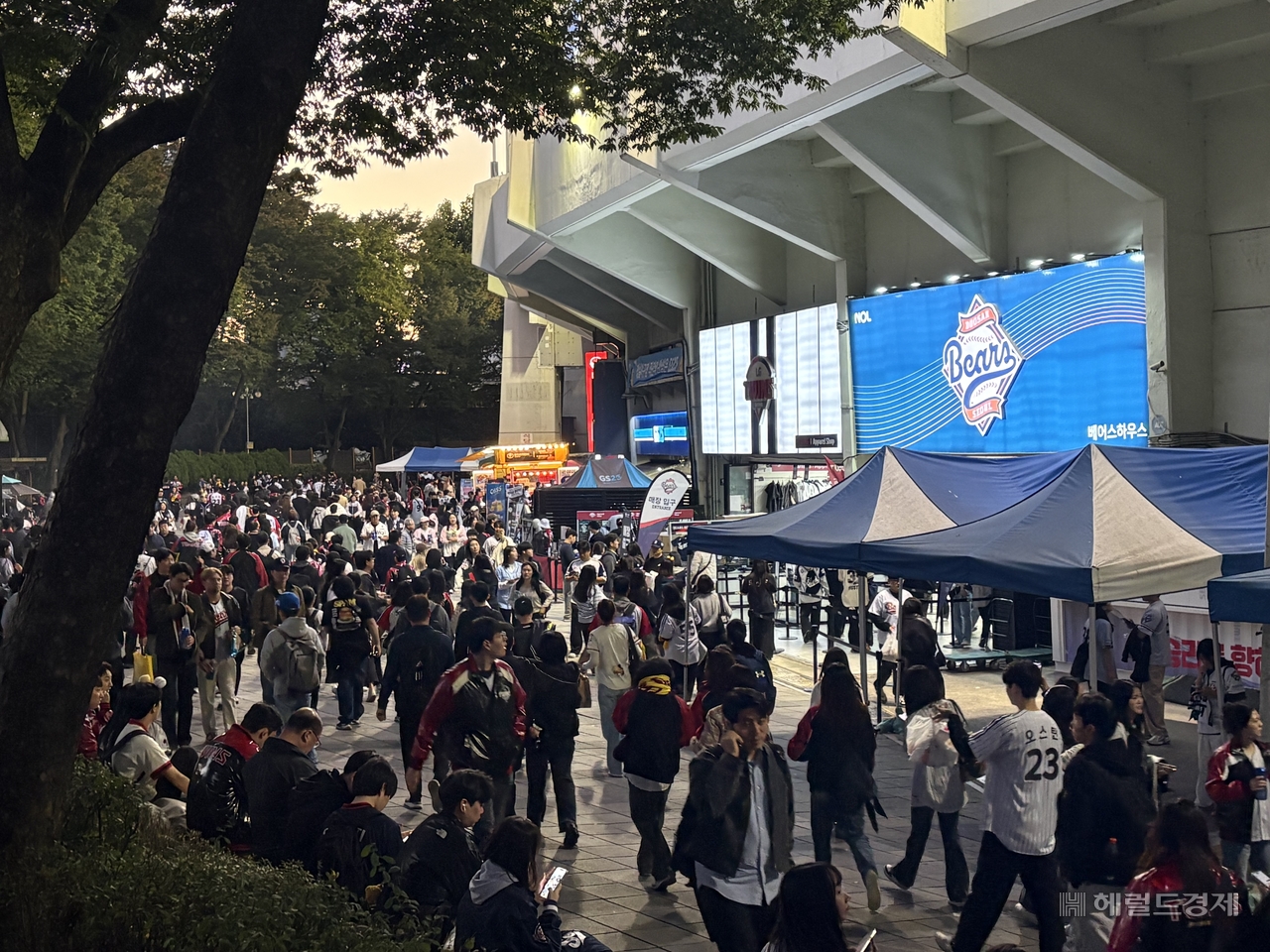
At around 4:30 p.m. Wednesday at Jamsil Baseball Stadium in Songpa-gu, Seoul, fans of the LG Twins and Doosan Bears were already packing the area around the central ticket booth and Exit 6 of Jamsil Sports Complex Station — two hours before the first game of the postseason wild-card series between the two clubs.
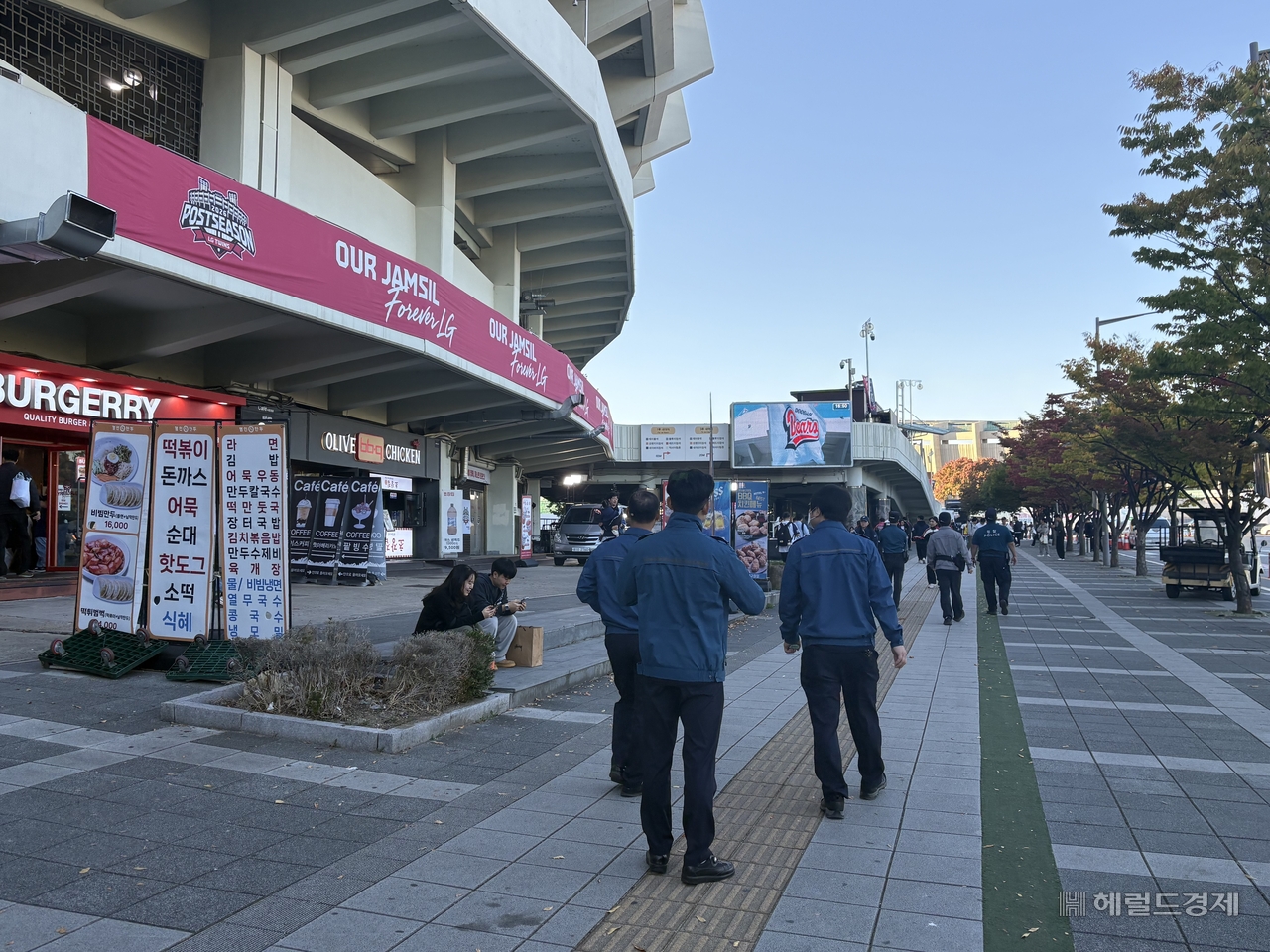
Supporters in LG windbreakers and Doosan jerseys, cheering towels and thunder sticks in hand, streamed toward the stadium gates. Plainclothes officers moved through the crowd, watching for scalping activity, as fans checked mobile tickets or waited for friends. The street touts who once openly hawked tickets outside the stadium were nowhere to be seen.
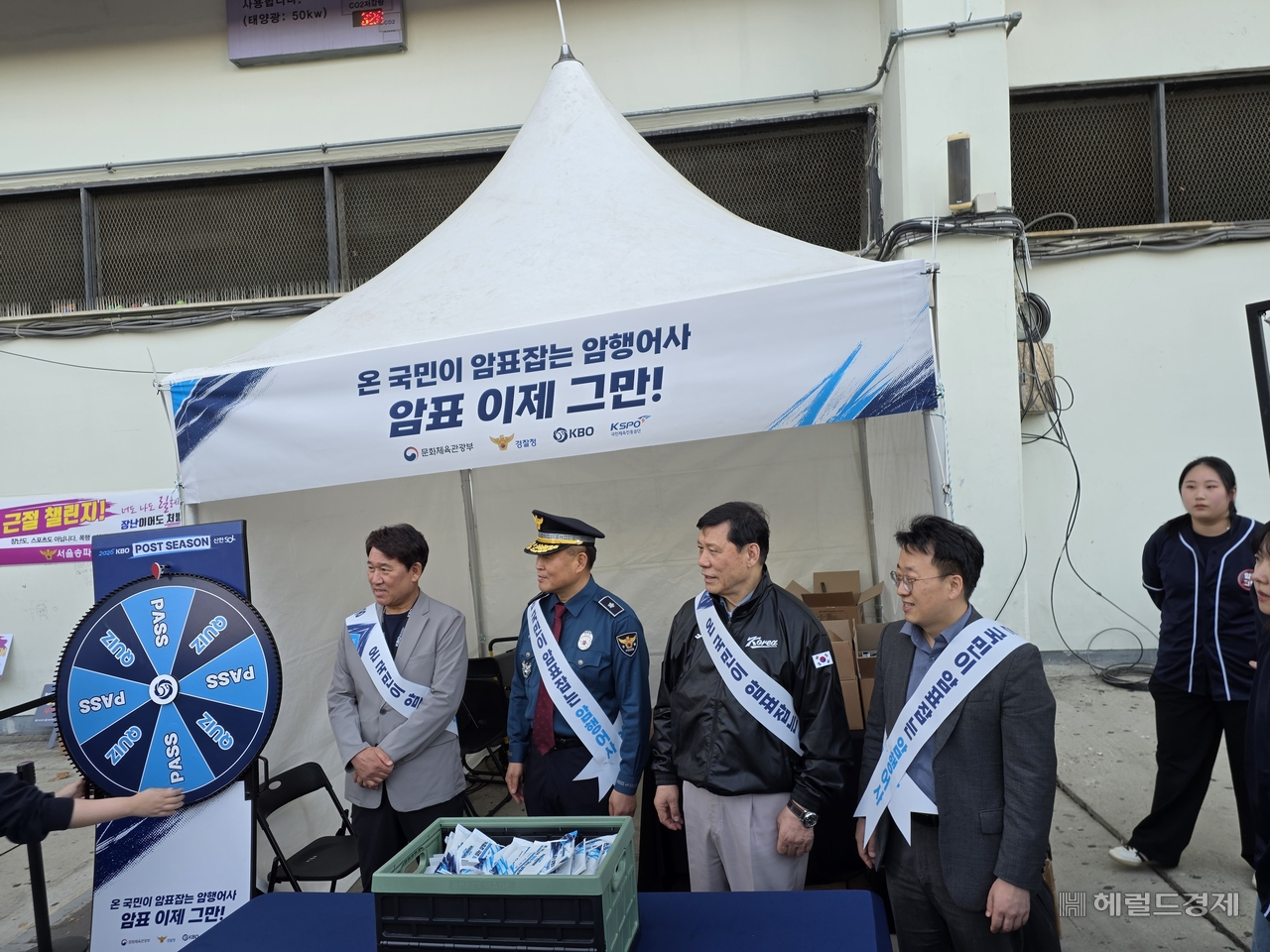
By 6 p.m., thirty minutes before first pitch, the area was packed shoulder to shoulder. Fans also gathered at an anti-scalping campaign booth jointly run by the Korean National Police Agency, the Ministry of Culture, Sports and Tourism and the Korea Baseball Organization (KBO), picking up hand warmers and reading informational leaflets. KBO Commissioner Heo Gu-yeon and Songpa Police Station Chief Kim Sang-hyeong visited the scene to take part in the campaign.
Stadium scalpers vanish — but online listings reach 2 million won
Fans at the stadium agreed that in-person scalping had dropped sharply compared with years past. "Up until about 10 years ago, there were people right out front handing over tickets in person," said a man in his 40s who gave only his surname, Choi, and identified himself as an LG fan. "You barely see that anymore. Professional scalpers hurt ordinary fans, so this needs to stop."
In fact, despite deploying 37 officers and a total of 56 personnel from the police agency, the Ministry of Culture, Sports and Tourism and the KBO, authorities recorded zero on-site scalping arrests on the day.
![Ticket listings on an online resale platform briefly approached 2 million won for Wednesday's game. [Ticketbay]](https://wimg.heraldcorp.com/news/cms/2026/10/15/news-p.v1.20261015.a1a469c6827a4f44bc2f9e2882a85de1_P1.jpeg)
Scalping had not disappeared, however — it had simply moved online. Tickets for the game appeared on online resale platforms at prices ranging from hundreds of thousands of won per seat, with some listings reaching 2 million won. Whether those listings resulted in actual transactions could not be confirmed, but the asking prices far exceeded face value.
Online reaction was swift, with many questioning whether on-site enforcement could ever address the problem. Posts on various SNS platforms Wednesday read: "They say they're cracking down on scalpers, but prices on ticket resale platforms are still soaring" and "Online scalping needs to be tackled before the stuff happening outside the stadium." As mobile ticketing has become the norm, the argument goes, enforcement must follow the trade to where it actually happens.
Park Beom-su, 49, a Doosan fan since the club's founding, had wanted to watch the Jamsil game with his middle-school daughter — but only she succeeded in buying a ticket. "My father worked at Doosan, so I've been an OB fan since I was little, and my daughter is a huge baseball fan too, so I really wanted to go together," Park said. "While she watches the game alone, I'm planning to drink beer at a nearby restaurant and follow the broadcast, then pick her up when it's over."
Buying a scalped ticket was never an option for Park. "When I searched online, I saw listings up to 2 million won, and I thought there was absolutely no way I should buy one," he said. "Getting tickets this year seemed particularly hard."
![Numerous posts expressing frustration over the scalping crackdown appeared on Threads and other SNS platforms on Wednesday. [Threads]](https://wimg.heraldcorp.com/news/cms/2026/10/15/news-p.v1.20261015.bfcecb27d6224a55af132f5326239776_P1.png)
Lee Seung-ju, 19, who attended the game with his family, also had to fight through fierce competition to secure tickets. "I got in with a queue number in the 3,000s and barely managed to buy one," he said. "I'm still a student, so buying an expensive scalped ticket was never something I considered."
Some fans, however, admitted to having paid above face value in the past. A 22-year-old university student who gave only her surname, Jeong, said she bought a regular-season ticket in Suwon two years ago at roughly twice the face value. "When you try to book yourself, your queue number comes up as 30,000 or 100,000, but when bots grab the tickets it's almost impossible to compete," she and her group said. "For a really important game, we could see ourselves paying two or three times face value."
A married couple in their 30s, also baseball fans, said they too had once paid double the face value for a regular-season ticket. "Coming out to enforce and raise awareness on-site is a good thing," they said, "but while you can create an atmosphere where people think twice, it's going to be hard to stamp this out completely in a short time when there are still people looking to buy."
'Online enforcement has to be the priority' — the limits of on-site crackdowns
Among fans, there was a growing sense that on-site enforcement alone cannot stop online scalping. Hwang, a 31-year-old office worker who gave only his surname, said: "This year too, I saw a lot of scalped tickets on ticket resale platforms and secondhand trading sites. With so much trading happening online, I'm skeptical about how effective on-site crackdowns can really be."
The university student Jeong also pointed to a structural problem with online listings. "Sometimes sellers don't disclose the exact seat number — they only list the block and row," she said. "You need to know the seat to report it, but you can't find that out until after you've bought it."
Police acknowledged that scalping has increasingly shifted online. "These days, in-person scalping at venues is rare, so cyber enforcement has to become the main focus," a Korean National Police Agency official said. "We're hoping the on-site campaign will also get the message out to people buying and selling scalped tickets online that they can face punishment."
On-site enforcement has also been stepped up starting this postseason. The Korean National Police Agency has deployed joint crackdown teams with the Ministry of Culture, Sports and Tourism and the KBO around postseason venues in Seoul, Daegu, Gwangju and Suwon. Plainclothes officers and joint patrol units are stationed at ticket booths, subway exits and main pedestrian routes before and after games to watch for organized selling and touting.
Penalties have also grown stiffer. Before an amended National Sports Promotion Act took effect on Aug. 28, those caught scalping at venues faced only a minor-offense fine of 160,000 won under the Minor Offenses Act. Under the current law, anyone who habitually or commercially resells tickets above their purchase price — or brokers such sales — can face up to one year in prison or a fine of up to 10 million won ($7,470).
Police said the crackdown aims not only to catch scalpers on the spot but also to publicize the tougher penalties. "Through this enforcement effort, we want to spread the word that scalping is a crime that can result in criminal punishment, and we will continue working with relevant agencies to foster a healthy fan culture," a Korean National Police Agency official said.
jookapooka@heraldcorp.com
kido@heraldcorp.com




