
Interview with Ulsan Nam-gu District Mayor Im Hyeon-cheol on his first 100 days in office
Focused on restoring livelihoods amid small-business hardship
Nam-gu's strained finances demand careful prioritization
Districts push city to adjust adjustment grant ratio
Three-zone redevelopment project centered on Taehwagang Station
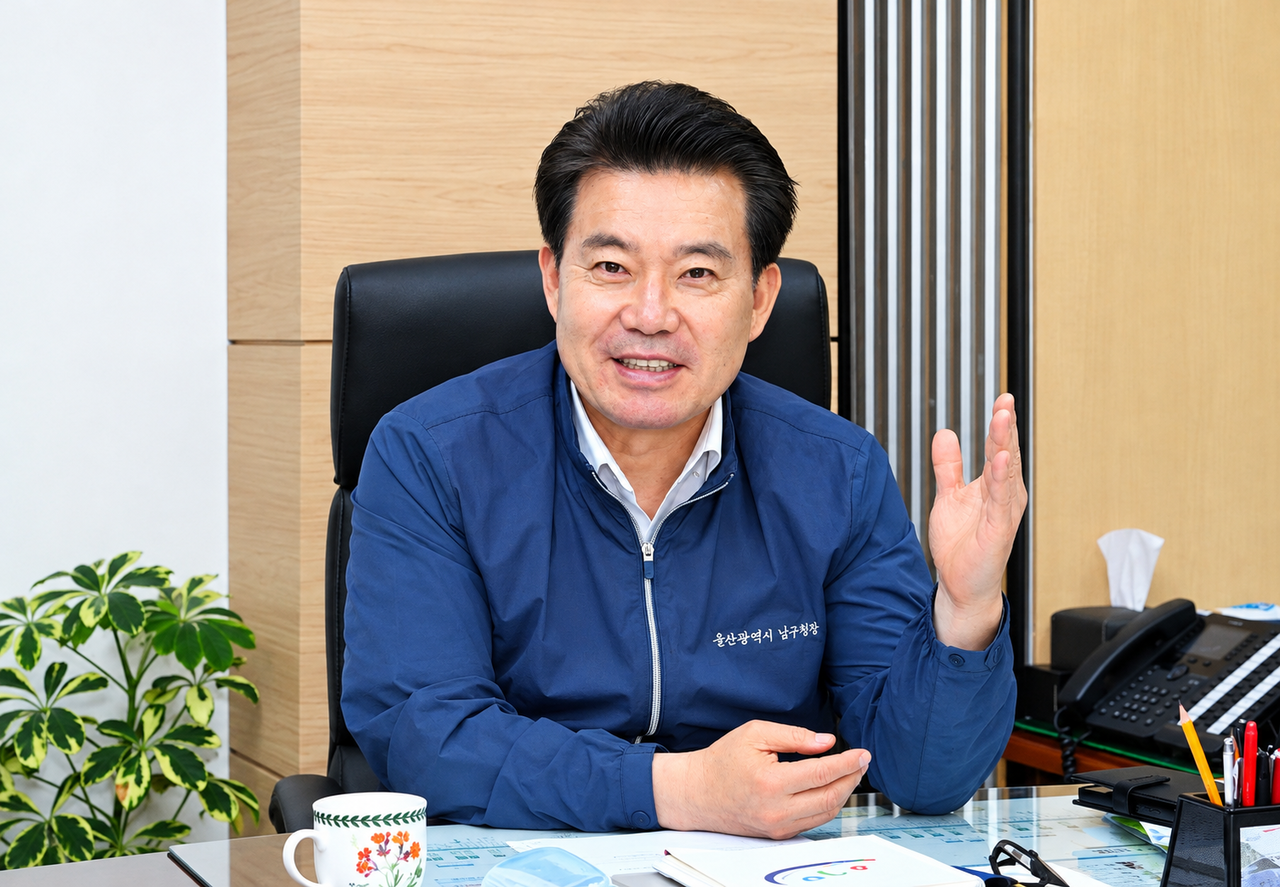
"Now that I bear administrative responsibility, the district's weak finances are a real obstacle. Still, I am working with staff to go through existing projects and find where the budget can be stretched, and I am asking Ulsan Metropolitan City to raise the share of adjustment grants it distributes to us."
Nam-gu District Mayor Im Hyeon-cheol said he felt the full weight of the district's fiscal constraints over his first 100 days in office. He found the finances so tight that even existing projects had to be scaled back, let alone new ones. Im had studied Nam-gu's key issues during his time as chair of the Nam-gu District Council, a member of the Ulsan City Council and a city spokesperson — but a constrained budget, he discovered, is an administrator's Achilles' heel.
In an interview Monday, Im said Nam-gu's fiscal self-reliance ratio stood at 25.82 percent and its fiscal autonomy ratio at 35.88 percent based on this year's base budget. "The closer to 100 percent, the freer the fiscal management — and we fall well short of that," he said.
Compared with other Ulsan districts and counties, Nam-gu ranks second in fiscal self-reliance after Ulju-gun (30.86 percent), but fourth in fiscal autonomy, behind Ulju-gun (55.34 percent), Buk-gu (36.8 percent) and Dong-gu (36.24 percent). The district collects relatively strong direct revenue through local taxes and non-tax income, but receives comparatively little from the central government's local allocation tax and city-distributed adjustment grants.
Compounding the pressure, the welfare budget — which requires matching funds from the district — jumped from about 55 percent of total expenditure in 2023 to 61 percent this year, further squeezing available resources. Maintenance and operating costs for existing facilities add to the burden.
Im said that if the city raised the adjustment grant ratio from the current 20 percent of ordinary tax revenue to 30 percent, Nam-gu alone could secure an additional 31.3 billion won ($23.4 million) a year. "Adjusting the city's adjustment grant ratio has become a shared concern for all of Ulsan's basic local governments, and I am putting real effort into it," he said.
On the wall of Im's office, visited for the interview, hung the slogan: "Nam-gu on the move again, livelihoods back on their feet." Im said the phrase came directly from voters. "At every doorstep during the June 3 local elections, people told me the economy was hard," he said. "That is why I set restoring the livelihood economy as the vision for running the district."
On his first day in office, Im signed off on a plan to form and operate a "Livelihood Economy 119 Rapid Response Team" as his first official act, then headed straight to Sinjeong Market, the district's main traditional market. He has since visited livelihood sites across all 14 neighborhoods to hear from residents, and the rapid response team has handled more than 300 complaints to date.
It is a short 100 days, but the results reflect a district mayor who looks for answers in the field rather than at a desk, and listens to residents rather than relying on reports.
Im is also expanding the designation of "alley-type shopping districts," a status that unlocks various forms of central government support. In August, the commercial area in front of the main gate of the University of Ulsan — home to 310 shops at the Babo intersection — received the designation, followed in September by the commercial strip along Wolpyeong-ro 171 and 159-gil near Ulsan Hospital.
The district is now encouraging 19 alley-type shopping districts and traditional markets in Nam-gu to apply for government grant programs. The initiative allows merchant associations to lead efforts on brand development for alley commerce, market specialization linked to local culture and tourism resources, and revitalization through improvements to aging facilities.
As a long-term vision for Nam-gu, Im campaigned on a "three-zone major redevelopment project." The plan reorganizes the district's spatial structure around three areas: a transit and logistics gateway centered on the Taehwagang Station zone, a commercial and cultural hub in the Daldong and Samsandong zone, and a convergence education and startup district in the Okdong and Mugeo-dong zone.
"The Taehwagang Station complex transfer center project was incorporated into the Ministry of Land, Infrastructure and Transport's master plan for 2026 to 2030 in August, giving real momentum to the ninth-term campaign pledges for Nam-gu's next 100 years," Im said. "The Taehwagang Station zone will be transformed into a city equipped with a bus-rail transfer center and commercial, cultural and accommodation facilities."
On the Ulsan urban railway (tram) Line 1 project — which would install 15 stations along a 10.85-kilometer stretch from Taehwagang Station to Sinbok intersection — Im said the tram would create synergy with buses, combining the tram's schedule reliability with the bus network's broad reach. "By systematically developing the areas around the 15 stations under the transit-oriented area law, we can make Nam-gu a vibrant city where everyone wants to live," he said, calling the project a turning point for the district's transformation.
As population decline grips cities across the country, Nam-gu has seen its population fall from 315,118 in September 2021 to 304,783 — a drop of roughly 2,000 people a year. Im said the priority was creating an environment where young people can work, stay and raise children. "I will concentrate administrative resources on policies supporting youth employment, childbirth and child-rearing," he said.
Looking ahead, Im outlined his plans for the remainder of the ninth term, drawing on the key issues and field voices gathered over his first 100 days. He said the district would steadily advance three areas, 10 tasks and 46 projects: the three-zone development project; construction of three growth corridors covering leisure and tourism, advanced industry and urban regeneration; and a four-category tailored welfare and care program for all generations.
cityblue@heraldcorp.com




