
Agency kept contract with firm that leaked 575,000 farmers' records despite 17 pledges to delete data
Livestock division relocation to Hampyeong-gun delayed 3 years, project cost up 89.5 billion won
RDA chief acknowledges oversight failures, vows to boost farm income
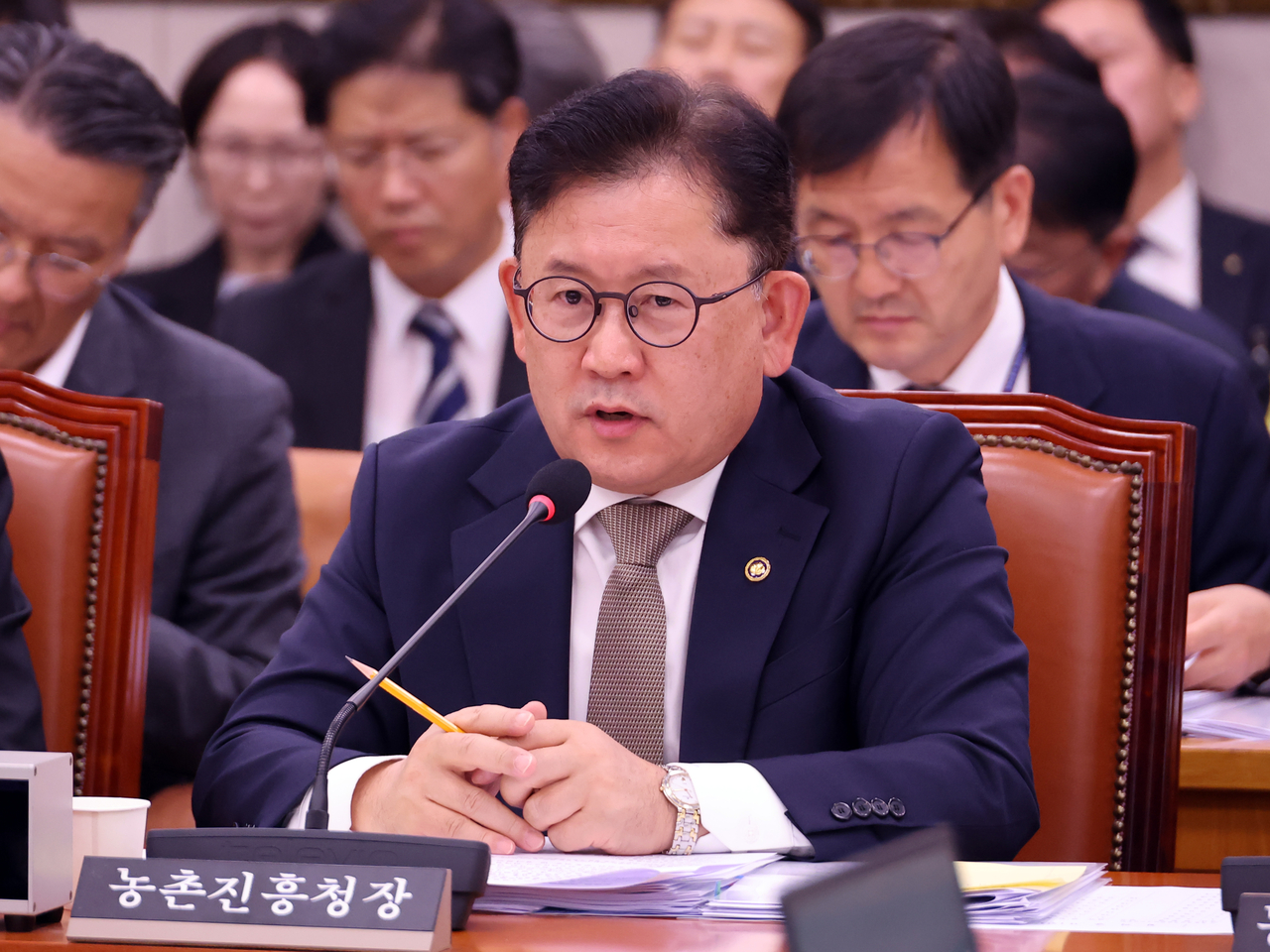
The Rural Development Administration has been found to be maintaining a contract with a service provider that leaked 575,000 personal records belonging to farmers. Lawmakers said the agency failed to prevent the breach despite receiving 17 written pledges from the contractor to delete the data, and that it made no contractual changes to prevent a recurrence after the incident came to light. Also under scrutiny was a three-year delay and an 89.5 billion won ($66.8 million) cost overrun in the relocation of the National Institute of Animal Science's livestock resources development division to Hampyeong-gun in South Jeolla Province.
At the National Assembly Agriculture, Food, Rural Affairs, Oceans and Fisheries Committee's national audit of the RDA on Wednesday, People Power Party lawmaker Lee Seong-gwon pressed the agency over its handling of the personal data breach that occurred last year, focusing on what he called a failure of oversight and management.
According to Lee, the leaked information included farmers' names, addresses and contact details, as well as farm names, farm codes, farm addresses and business registration numbers — 575,000 records in total. The contractor had signed 17 separate pledges to destroy the data but never did so. The RDA conducted dozens of security inspections over 59 months without detecting the violation.
RDA Administrator Lee Seung-don acknowledged that 575,000 records had been compromised. He said the breach occurred because the contractor, which was required to delete the data after the service contract ended, instead allowed it to be leaked externally. When asked whether the RDA's own oversight was also at fault, he said it was.
The ongoing contract drew further criticism. Lee Seong-gwon said a comparison of last year's and this year's contracts showed that no additional safeguards against a recurrence had been inserted. He added that the Public Procurement Service had confirmed that the contracting parties could, by mutual agreement, add such protections.
Lee Seung-don said the agency was not in a newly signed contract but was simply continuing an existing one. On the question of strengthening the contract terms, he said he would look into it.
Lee Seong-gwon called for a comprehensive review of the RDA's contracting and oversight practices, noting that the same firm had won contracts for 12 consecutive years and had been awarded 13 sole-source contracts.
The delayed relocation of the livestock resources development division to Hampyeong-gun also came under fire. Democratic Party of Korea lawmaker Lee Gae-ho said the project, covering 5.87 million square meters across the Singwang and Sonbul areas of Hampyeong-gun, had been pushed back from a 2027 completion target to 2030. Rising material and labor costs drove total project costs up 89.5 billion won, or 11.6 percent, from 769.2 billion won to 858.7 billion won.
Lee Gae-ho urged the RDA to accelerate the project and develop livelihood support measures for displaced residents. The agency had sought to donate a portion of its own milk production to local residents over 10 years — valued at 1.7 billion won — but was told this was not permitted under the State Property Management Act. Lee called on the agency to explore alternatives, including securing additional funding through the National Assembly, seeking an active-administration review within the RDA, and pursuing a pre-consultation with the Board of Audit and Inspection. He also proposed two cooperative projects to support local farm income: establishing a Hampyeong Cheonji Hanwoo genetic resources center at a cost of 6 billion won, and funding research and development for a locally led Hanwoo industry growth model at 5 billion won.
In his policy briefing that day, Lee Seung-don said the RDA would focus its efforts on raising farm income and addressing difficulties in the field. He said the agency was conducting safety assessments and consultations for 5,000 farming households through dedicated farm safety managers, and was expanding the rollout of mechanization and cost-reduction technologies for eight major upland crops.
The RDA also plans to use an agricultural satellite successfully launched last July to monitor crop growth, cultivation areas and agricultural disasters with greater precision, and to deploy its agriculture-specific AI service "AI Isaki 2.0" in the field.
"We will do our utmost to boost farm income and protect the livelihoods of farmers by delivering results they can feel on the ground," Lee said.
adastra@heraldcorp.com




