
CDO president delivers keynote at SEDEX 2026
'HBM's emergence changed the game in the AI era'
Market seen shifting toward custom HBM
Data movement between memory tiers emerging as new bottleneck
HBF to offer more than 10 times the capacity of HBM
AI infrastructure scale seen growing 20-fold by 2030
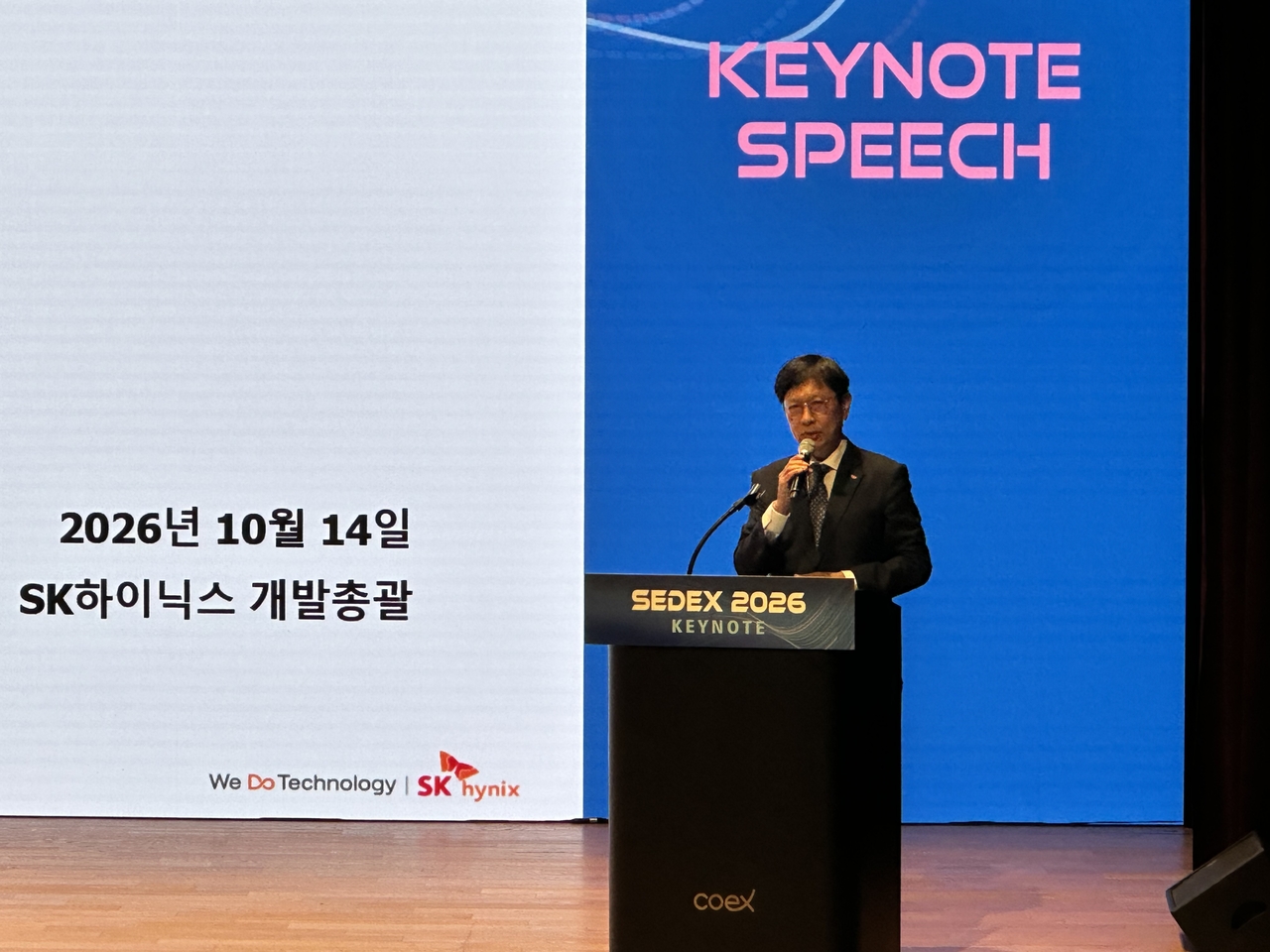
SK hynix President and Chief Development Officer An Hyun said Wednesday that HBM alone will not be enough to meet rapidly growing memory demand driven by the rise of the AI inference market, as the company accelerates development of new memory tiers including high-bandwidth flash, or HBF, and 3D stacked DRAM.
An said surging demand for tokens will drive a long-term increase in memory investment by global technology giants, projecting that AI infrastructure performance will grow nearly 20-fold by 2030 compared with this year.
An made the remarks in a keynote address at the 28th Korea Semiconductor Exhibition (SEDEX 2026) at COEX in Gangnam-gu, Seoul, on Wednesday, speaking on the theme of "The Evolution of Memory Technology in the AI Era."
"In the past, memory was divided into SRAM, DRAM and NAND flash, but the emergence of HBM completely changed the game," he said. "Extending that logic, SK hynix believes that new forms of memory need to be developed between existing memory tiers, in the direction customers want."
An said SK hynix, which has led the HBM market, remains focused on advancing HBM technology. He projected that after HBM4E — the seventh-generation HBM — the company will pursue custom HBM4E and HBM5 in parallel starting next year.
"The base die of custom HBM will incorporate various IP assets tailored in consultation with customers," he said. "Custom and standard HBM will coexist for now, but we expect the custom trend to gradually expand."
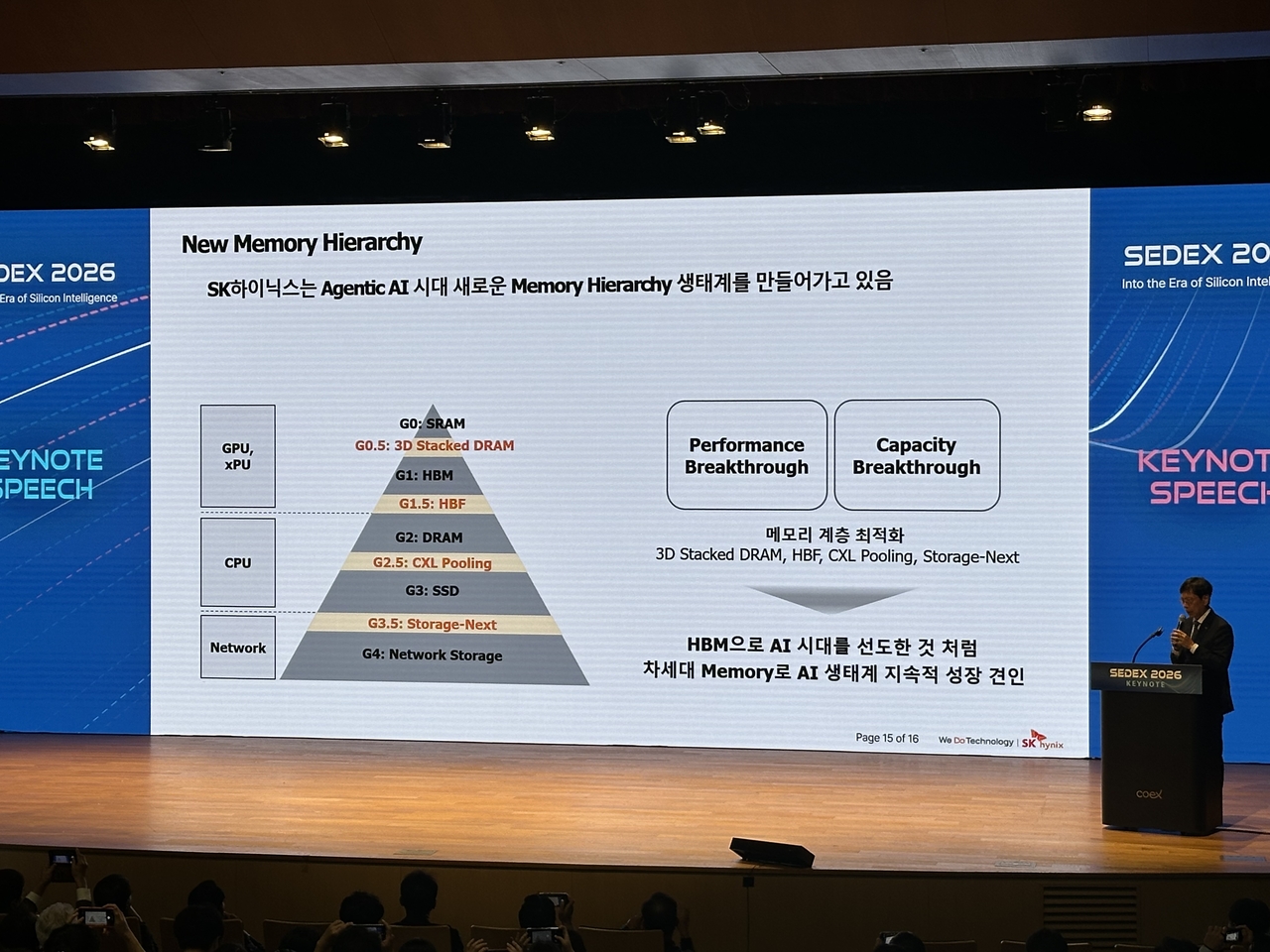
He added that SK hynix is developing 3D stacked DRAM and HBF as future memory tiers. While the memory wall of the past mainly arose between processors and memory, the AI era is seeing a new bottleneck emerge from performance gaps and data movement between different memory tiers, he said.
He identified 3D stacked DRAM as the first solution. "Until now, HBM was placed beside the GPU and data moved between them, but 3D stacked DRAM places DRAM directly on top of a GPU or NPU, enabling nearly a 10-fold increase in bandwidth and a reduction in power consumption," he said.
He also discussed HBF, which is currently under development. An said the idea came from wondering what would happen if NAND were stacked in the same way as HBM. "HBF offers about half the bandwidth of HBM, but capacity can increase 10 times or more," he said. "There are extremely difficult technical challenges to solve, but we are pushing ahead using the know-how we built up developing HBM."
To establish the new memory tier, SK hynix partnered with SanDisk to release a draft standard in August. Cloud service providers including Google and makers of custom AI accelerators have joined the effort. SK hynix added that it plans to release the final specification in January next year.
SK hynix is also developing next-generation memory products including CXL-based pooled memory and a next-generation storage solution called Storage-Next.
"Implementing memory pooling technology to share memory is seen as a realistic concept for relieving data center bottlenecks," An said. "We are also preparing a solution that completely redesigns NAND to deliver four to eight times higher input/output performance than current products."
He said SK hynix's long-term goal is to establish leadership in new memory tiers as well. "We aim to expand the new memory tier that began with HBM into 3D stacked DRAM, HBF, CXL and beyond to address performance and capacity bottlenecks," he said. "It won't happen all at once, but we will respond to customer needs in a tailored way and lead the AI ecosystem."
SK hynix's focus on new memory tiers reflects its expectation that long-term AI infrastructure investment will continue to grow. An said global technology giants are still in the early stages of their AI spending.
"Efforts by AI service companies to reduce token usage are showing results, but token consumption is still rising," he said. "As we move toward consumer agents and enterprise agents, token usage will surge dramatically."
Citing Nvidia CEO Jensen Huang, An said, "The amount of computing that agentic AI will require is estimated at 15 to 100 times that of humans," adding, "Going forward, as agentic AI uses other agentic AI, total usage will explode."
He said the surge in AI inference is rapidly lengthening the "context length" — the amount of information an AI model can process at once — which in turn is driving demand for large-capacity memory. To keep pace, AI infrastructure performance will need to expand up to 20 times by 2030 compared with this year, he said.
An closed by saying AI investment will create new opportunities across South Korea's AI ecosystem. "When the United States sent people to the moon in the late 1960s, the biggest beneficiary was Intel," he said. "A demanding project dramatically increased computing needs, and that catalyzed the development of Intel and the broader American semiconductor ecosystem." He added that as memory has become South Korea's leading industry on the back of AI's spread, SK hynix intends to collaborate with many domestic companies to build the country's AI ecosystem.
jeongwan@heraldcorp.com




