
Opening keynote at Korea Electronics Show
'New ways of working with AI must be designed'
Addressing labor shortages and rising costs in shipbuilding
Intelligent, autonomous shipyard targeted by 2030
AI to streamline data collection and management
'SSOT is the foundation of manufacturing's AI-era transformation'
"Simply bringing in AI without changing the way we work does not make things more efficient. Designing a new way of working together with AI is critically important."
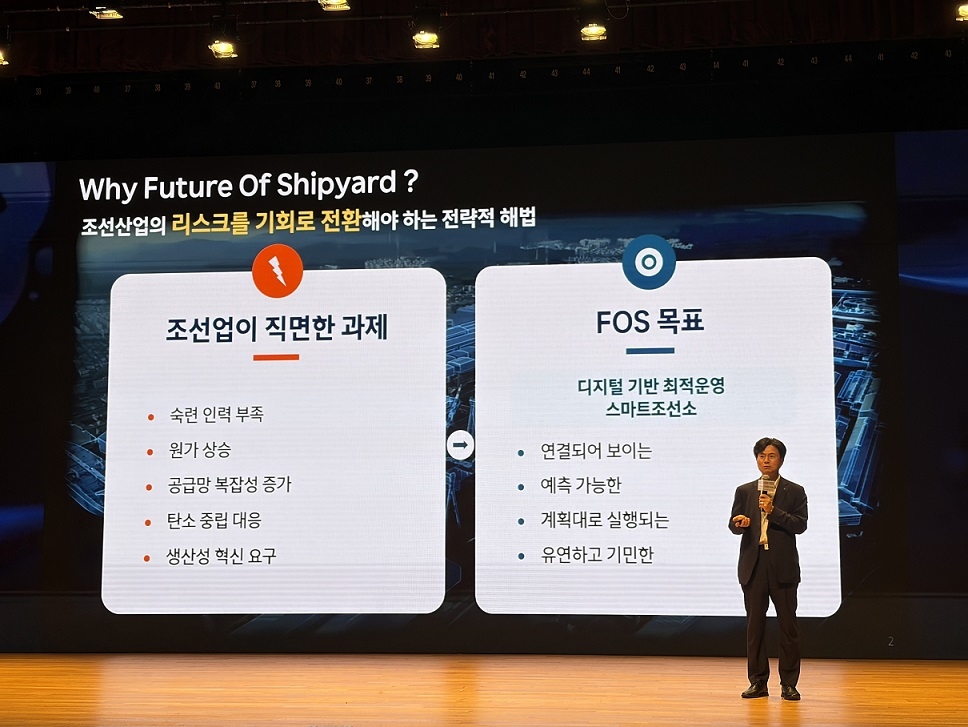
Lee Tae-jin, executive vice president of HD Korea Shipbuilding & Offshore Engineering, made the remarks Tuesday while delivering a presentation titled "AIX for Unstructured Tasks in Heavy Industry: The HD Hyundai Transformation Case" at the opening keynote of the Korea Electronics Show at COEX in Gangnam-gu, Seoul.
Lee stressed that shipbuilding is a labor-intensive industry and said the sector faces mounting challenges — a shortage of skilled workers, rising costs and supply chain disruptions caused by war. "We need to be reborn in a form that looks truly different from what we have done over the past 50 years," he said.
In response to those challenges, HD Korea Shipbuilding & Offshore Engineering is pursuing its "Shipyard of the Future" project, which aims to digitize on-site data, connect and optimize it, and realize an intelligent, autonomous shipyard by 2030.
"When we first conceived the project, we could not imagine how we would ever complete an intelligent, autonomous shipyard — but as time has passed, the picture has been coming together," Lee said. "AI has been a tremendous help." He explained that the company has built a system using the Internet of Things and other technologies to collect field data and monitor production and logistics status on a single platform. Drone- and AI-based yard management is also underway.
"Even when we take photos with drones, a person ultimately had to look at them — but now we are having AI do that looking, identifying which parts destined for which vessel are located where," Lee said. "The goal is to create an environment where we can predict situations, analyze them quickly and make decisions."
To that end, HD Korea Shipbuilding & Offshore Engineering uses platforms from Palantir and Siemens — Palantir to connect data scattered across multiple internal systems, and Siemens to build a platform that integrates 3D design models with production.
Lee particularly emphasized the importance of "ontology" — a framework that maps the relationships between data and business processes. "The most fitting way to describe ontology is as a map of the relationships among the knowledge we hold," he said.
For example, when a production process for a specific vessel is delayed, AI can connect the relevant data to identify which process and block are affected, gauge the extent of the delay, and examine the causes and alternatives. Without connected internal data, he said, obtaining such answers would be extremely difficult.
The company is also pursuing AI-assisted robotic welding. Lee said AI helps detect discrepancies between blueprints and actual components, as well as current positioning, so that robots can locate the precise spot and weld accurately. He added that the company is also envisioning humanoid robots eventually performing work directly on the shipyard floor.
In closing, Lee doubled down on his message that achieving an AI transformation in manufacturing requires changing not just the data infrastructure but the way people work. He highlighted "single source of truth," or SSOT — a model in which design data flows consistently through production, quality control and customer service — as the essential foundation. "Ensuring that one source of truth flows through everything is the most fundamental aspect of how manufacturing must change in the AI era," he said.
keg@heraldcorp.com




