
Samsung Electronics plunges 7.39%, SK hynix 10.09%
Foreign investors post net selling of 4.5 trillion won over 6 consecutive sessions
Index slides to intraday low of 5,911 before recovering; sell-side sidecar triggered
China DRAM advances, AI spending concerns chill sentiment
Fear gauge surges 19%; Kosdaq also falls 1.43%
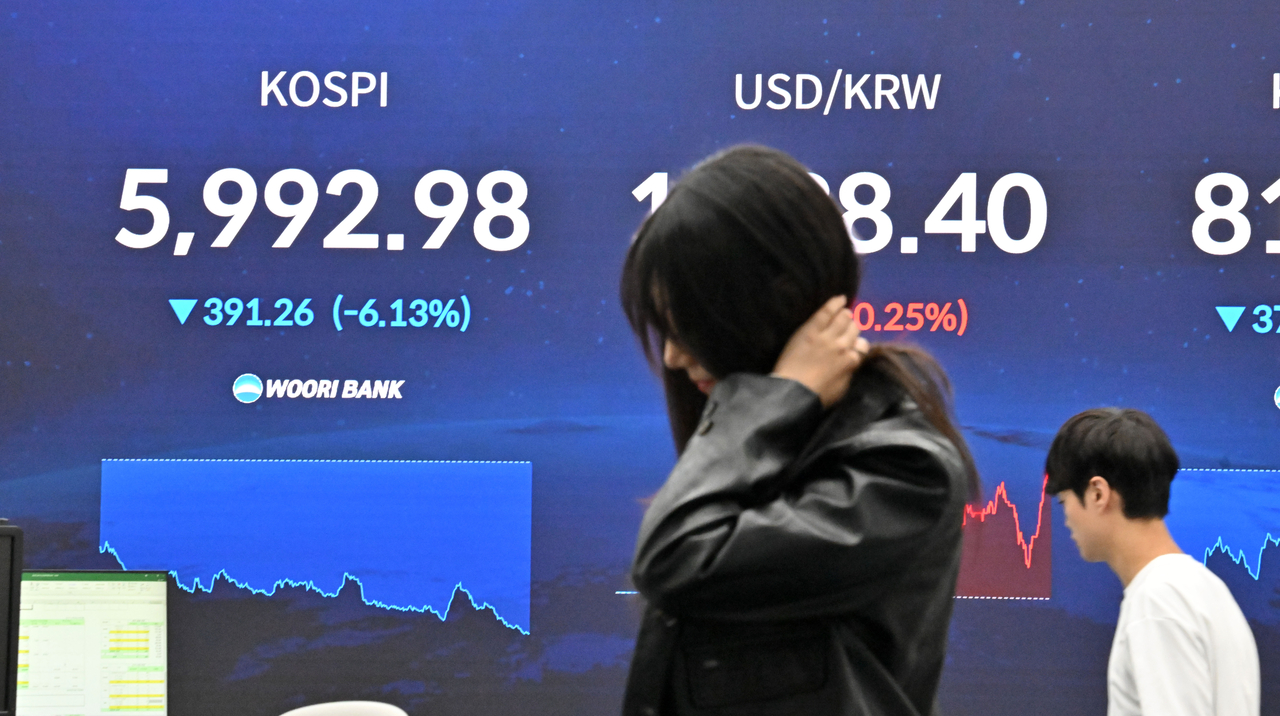
South Korea's stock market took a direct hit Tuesday as news of technological advances by a Chinese memory chip maker compounded concerns over the capital burden facing US semiconductor companies investing in AI.
Samsung Electronics and SK hynix tumbled more than 7 percent and 10 percent, respectively, while foreign investors posted net selling of more than 4.5 trillion won ($3.37 billion), sending the Kospi down more than 5 percent on the day. After sliding to the low 5,900s during the session, the index clawed back some of its losses in the final stretch to narrowly hold the 6,000 line.
The Kospi closed at 6,035.35, down 348.89 points, or 5.46 percent, from Monday, according to Korea Exchange. That puts the index about 36 percent below its all-time intraday high of 9,385.59, set on June 19 this year. Tuesday's decline was the steepest since Aug. 19, when the index fell 5.80 percent.
The index opened down 198.16 points, or 3.10 percent, at 6,186.08 and extended its losses as it slipped below the 6,000 mark. At its worst, the Kospi fell as low as 5,911.11, a drop of 7.41 percent, before recovering above 6,000 by the close.
A sell-side sidecar — a temporary halt on program sell orders — was triggered early in the session. It was the first time such a measure had been activated on the Kospi in roughly two months, since August.
The Kospi fell to levels last seen during the sharp selloffs of July and August. The index's dip below 6,000 during trading was its first since July 31, roughly 10 weeks ago. The Kospi's total market capitalization shrank below 5,000 trillion won as a result.
The VKOSPI, South Korea's equivalent of the fear gauge, leaped 19.15 percent to close at 48.53, briefly touching 51.57 intraday. The index had been trending lower through most of this month, falling from the low 40s to the mid-to-upper 30s, before rebounding to the 40 level on Monday and surging sharply Tuesday.
Foreign investors extended their selling streak on the main board to six consecutive sessions, dragging the index lower. By the close of the regular session, they had posted net selling of 4.53 trillion won — the largest single-session foreign net selling since July 28, when the figure reached 4.53 trillion won. Retail investors and institutions provided some support, posting net buying of 2.23 trillion won and 1.69 trillion won, respectively, limiting further losses.
Overnight trading on Wall Street was relatively subdued due to the Columbus Day holiday, but semiconductor-related stocks weakened — a trend that spilled over into the domestic market Tuesday.
The Dow Jones Industrial Average rose 0.38 percent, while the S&P 500 fell 0.06 percent and the NASDAQ Composite declined 0.44 percent.
Intel fell 3.20 percent, Micron dropped 3.88 percent and Broadcom slid 1.88 percent. SK hynix's American depositary receipts also fell 4.02 percent. The Philadelphia Semiconductor Index declined 2.67 percent.
The moves were partly attributed to reports that Chinese chipmaker CXMT has made new advances in DRAM memory technology and plans to unveil next-generation server products based on that technology before the end of this year.
Comments from executives at Broadcom and Intel warning of the capital burden involved in expanding AI operations also threw cold water on investor sentiment. Broadcom CEO Hock Tan said at an event in Singapore on Monday (local time) that capital would likely be "the biggest constraint" in scaling up AI, according to CNBC.
The domestic market opened with a sharp drop of around 3 percent before losses accelerated rapidly. The index did manage to slow its decline in the latter part of the session, recovering a portion of the day's losses.
The two semiconductor heavyweights could not stem their slide, each falling between 7 and 10 percent. Samsung Electronics closed at 232,000 won, down 7.39 percent from Monday. The share price has fallen a total of 44,000 won, or 16 percent, over the past five sessions. Samsung Electronics opened down about 3 percent and extended its losses during the day, at one point falling as low as 228,000 won, a decline of 8.98 percent.
SK hynix fell 10.09 percent to close at 1.44 million won. The stock has shed a total of 398,000 won, or 22 percent, over the past five sessions. The share opened down roughly 4 percent before steepening its decline, at one point touching 1.43 million won, a drop of 11.21 percent.
The two stocks, whose market capitalizations had each briefly surpassed 2,000 trillion won during this year's semiconductor rally, both closed Tuesday with market caps in the 1,000 trillion won range.
Among other large-cap stocks, SK Square fell 12.91 percent, Samsung Electro-Mechanics dropped 8.34 percent, Hyundai Motor declined 1.56 percent and KB Financial Group slipped 0.25 percent. LG Energy Solution gained 3.02 percent, Samsung Biologics rose 0.42 percent, Kia added 0.19 percent and HD Hyundai Heavy Industries edged up 0.27 percent.
The Kosdaq also fell, closing down 12.16 points, or 1.43 percent, at 837.03. That is roughly 32 percent below this year's intraday high of 1,229.42, reached on April 27. The index opened down 25.50 points, or 3.00 percent, at 823.69 and at one point fell as low as 802.91, a drop of 5.45 percent that threatened the 800 level, before recovering some of its losses.
On the Kosdaq, retail investors were net sellers of 190.8 billion won. Foreign investors and institutions provided upward pressure, posting net buying of 139.8 billion won and 42.9 billion won, respectively.
Alteogen fell 3.02 percent, Ecopro BM dropped 2.08 percent and Rainbow Robotics declined 1.92 percent. Jusung Engineering gained 3.56 percent, Ecopro rose 1.31 percent and Leeno Industrial advanced 1.92 percent.
The won weakened against the dollar amid the foreign investor exodus. As of 3:30 p.m. at the Seoul foreign exchange market, the won was trading at 1,345.1 per dollar, up 10.0 won from Monday's reference rate.

th5@heraldcorp.com




