
![The won-dollar exchange rate, Kospi and Kosdaq index levels are displayed on an electronic board at Hana Bank's headquarters in Jung-gu, Seoul, on Tuesday. [Yonhap]](https://wimg.heraldcorp.com/news/cms/2026/10/13/rcv.YNA.20261013.PYH2026101302810001300_P1.jpg)
The Kospi retreated toward the 6,000 mark Tuesday, entering what analysts described as a brutal supply-demand drought. With the massive buyback firewall erected by Samsung Electronics and SK hynix now dismantled, a wave of aggressive foreign selling hammered the index. As the benchmark approached the psychologically critical 6,000 level and fear spread across the market, experts noted the index had entered a historically oversold zone — but cautioned that simple bargain hunting would not suffice, urging investors to focus instead on earnings sustainability and a diversified sector strategy.
According to Korea Exchange, the Kospi slid to the low 6,000s in early trade Tuesday, its lowest level since July 30, when it closed at 5,593.56. A sell-side sidecar — a temporary halt on program sell orders — was triggered for the first time in roughly two months. Samsung Electronics shares fell to around 230,000 won ($172) and SK hynix dropped to around 1.4 million won.
Analysts pointed to the expiration of the two companies' buyback support as the primary driver of the sharp decline. The Kospi had held in the mid-to-upper 6,000s since SK hynix launched a large-scale buyback on Aug. 20 and Samsung followed on Aug. 24.
The index even surged to 7,003.74 on Oct. 2, the last trading session before Samsung completed its buyback, marking this month's intraday high. Conditions reversed sharply, however, after Samsung's program concluded on Oct. 6.
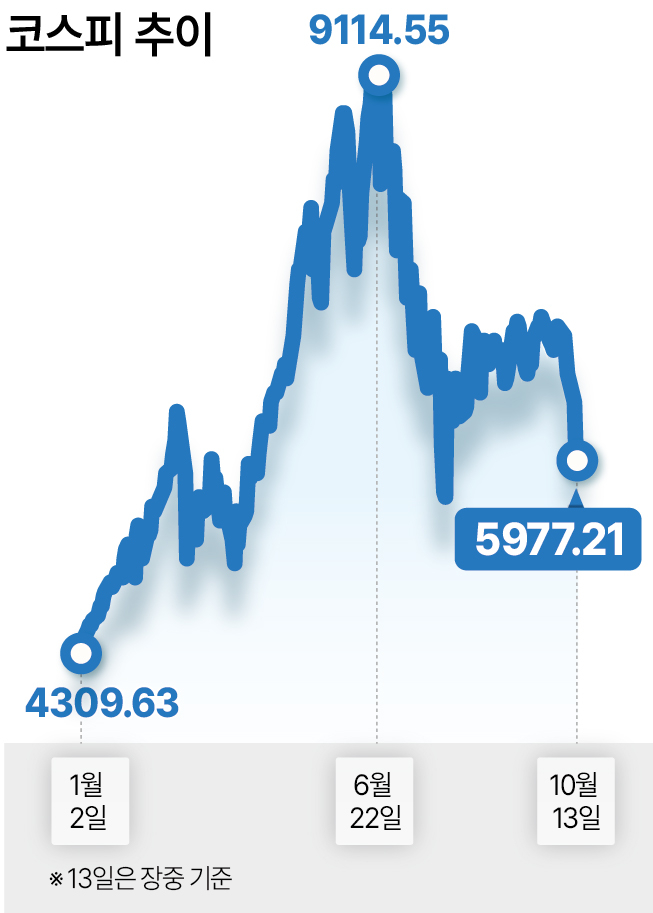
The Kospi has now fallen more than 13 percent over five consecutive losing sessions. Adding to the pressure, SK hynix's 40 trillion won ($29.9 billion) share buyback and cancellation program is set to expire in mid-October, meaning the market's last remaining demand-side buffer is about to disappear.
Record foreign outflows added further fuel to the decline. Foreign investors net sold a cumulative 199.1 trillion won on the main board from Jan. 2 through Monday, and continued selling in early trade Tuesday, pushing their total net sales for the year past 200 trillion won.
Foreign investors concentrated their selling on domestic semiconductor stocks. SK hynix topped the list of most net-sold stocks by foreign investors this year through Monday, with net sales reaching 87.14 trillion won, followed by Samsung Electronics at 86.06 trillion won. Together, the two stocks alone accounted for more than 173 trillion won in foreign net selling.
Hyundai Motor (11.39 trillion won) and SK Square (7.33 trillion won) were also among the most heavily net sold. Retail investors stepped in with 98.23 trillion won in net purchases in an effort to cushion the index, but were unable to absorb the volume of shares being offloaded.
External headwinds compounded the pressure. News emerged Monday on US markets that China's CXMT had made advances in next-generation server memory chip technology, stoking fears of intensifying global competition in the memory chip sector. While US technology stocks posted mixed results, the Korean market — with its outsized exposure to semiconductors — absorbed a disproportionately sharp blow.
Analysts broadly agreed that South Korea's blue-chip stocks have entered a zone of historic undervaluation despite strong earnings, but stressed that careful timing and stock selection are essential.
Yang Hyeon-gyeong, a researcher at iM Securities, said Samsung Electronics' 12-month forward price-to-earnings ratio had fallen to 3.91 times. "Rather than using the PER to time a purchase, what matters is whether the company can sustain high profit levels beyond 2028," she said.
Sector-specific strategies were also put forward. An Ji-seon, a researcher at Eugene Investment & Securities, advised investors to focus on sectors where earnings estimate upgrades have been significant since the start of the year but share prices have not risen commensurately. "Semiconductors, along with energy, insurance, and hotels and leisure, look particularly attractive from a valuation standpoint," she said.
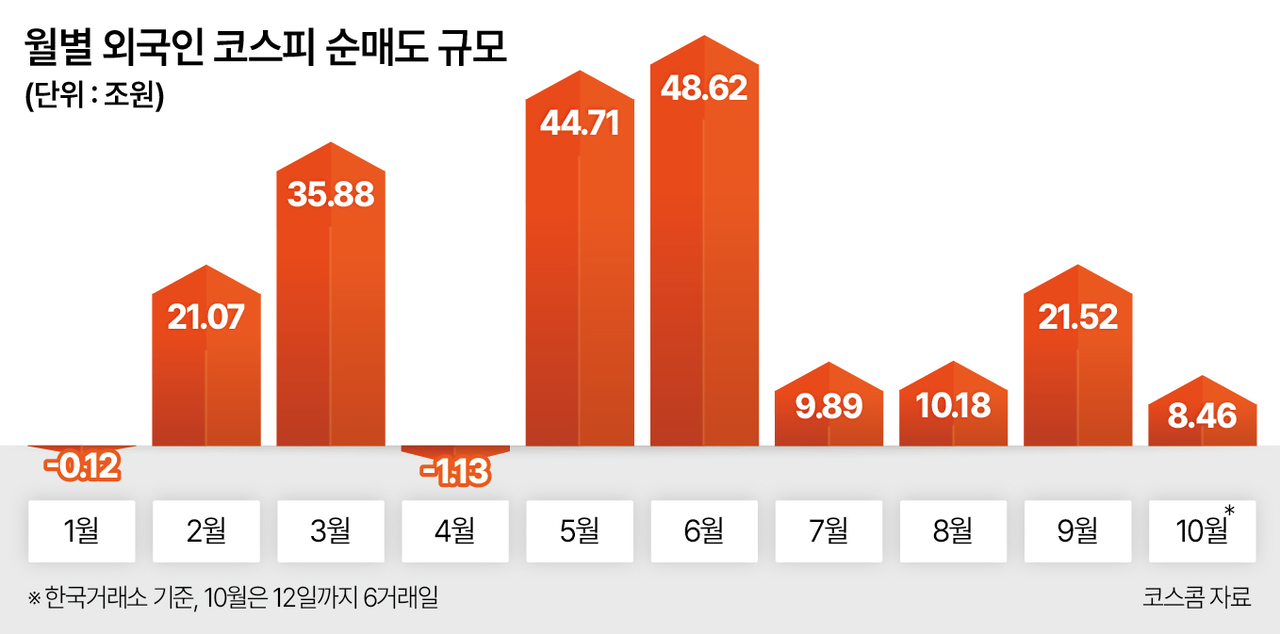
Critics also say a sustained medium-to-long-term Kospi recovery ultimately hinges on a shift in foreign investors' outlook. Kim Yong-gu, a researcher at Yuanta Securities Korea, said foreign investors currently distrust the semiconductor-led earnings momentum that has made South Korea the world's second-strongest market for profit growth, and are continuing to dump shares even at historically low valuation multiples. "For foreign investors to change their view, several conditions must be met: the peak of high inflation, tight monetary policy and elevated interest rate risks must pass; confidence in the continuation of hyperscaler capital expenditure supercycles must improve; earnings growth must be demonstrated through the validation of long-term supply agreements; volume defensibility must be proven through early capacity scale-up and yield improvements; and shareholder returns must become as aggressive as those seen among US big tech companies," he said.
jiyun@heraldcorp.com




