
Job-matching rate under national employment support program falls to 8.9% for youth; counselor caseloads rise
Six-month retention rate for vocational training at general high schools stands at 45%; incentive program also draws calls for reform
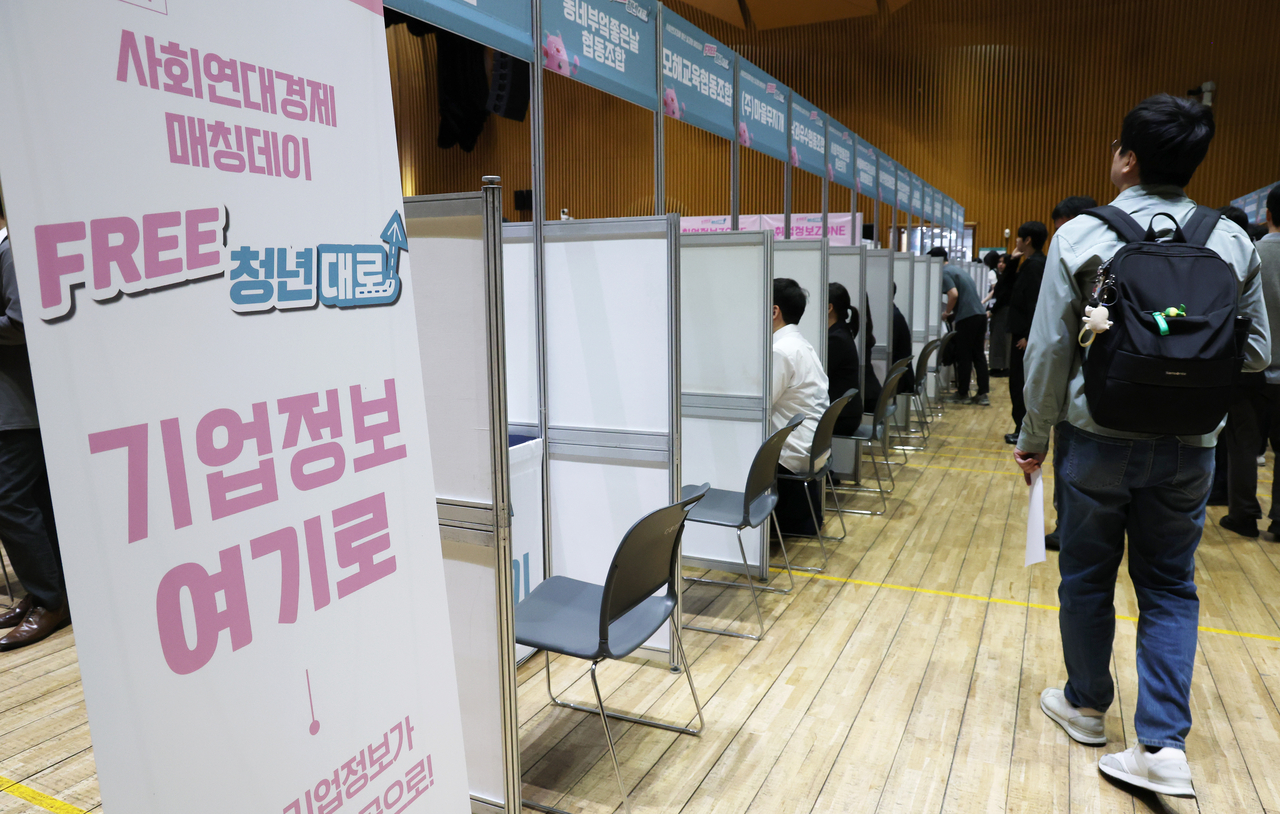
The Ministry of Employment and Labor spent nearly 7.5 trillion won ($5.61 billion) on youth employment projects over the past three years, yet actual outcomes in job placement and retention have remained weak, according to a lawmaker's review of ministry data.
The job-matching rate for youth under the national employment support program fell to a single digit last year, and while a vocational training program for general high school students posted a job placement rate above 70 percent, fewer than half of those who found work stayed employed for six months. Critics say the programs need to be redesigned — not just expanded in budget and enrollment — so that young people can find jobs and hold them.
According to Democratic Party of Korea lawmaker Park Jeong of the National Assembly's Climate, Energy, Environment and Labor Committee, the ministry's youth employment project budget rose from 2.31 trillion won in 2024 to 2.41 trillion won last year and 2.74 trillion won this year. The three-year total reached 7.46 trillion won, with this year's allocation up 18.9 percent from 2024.
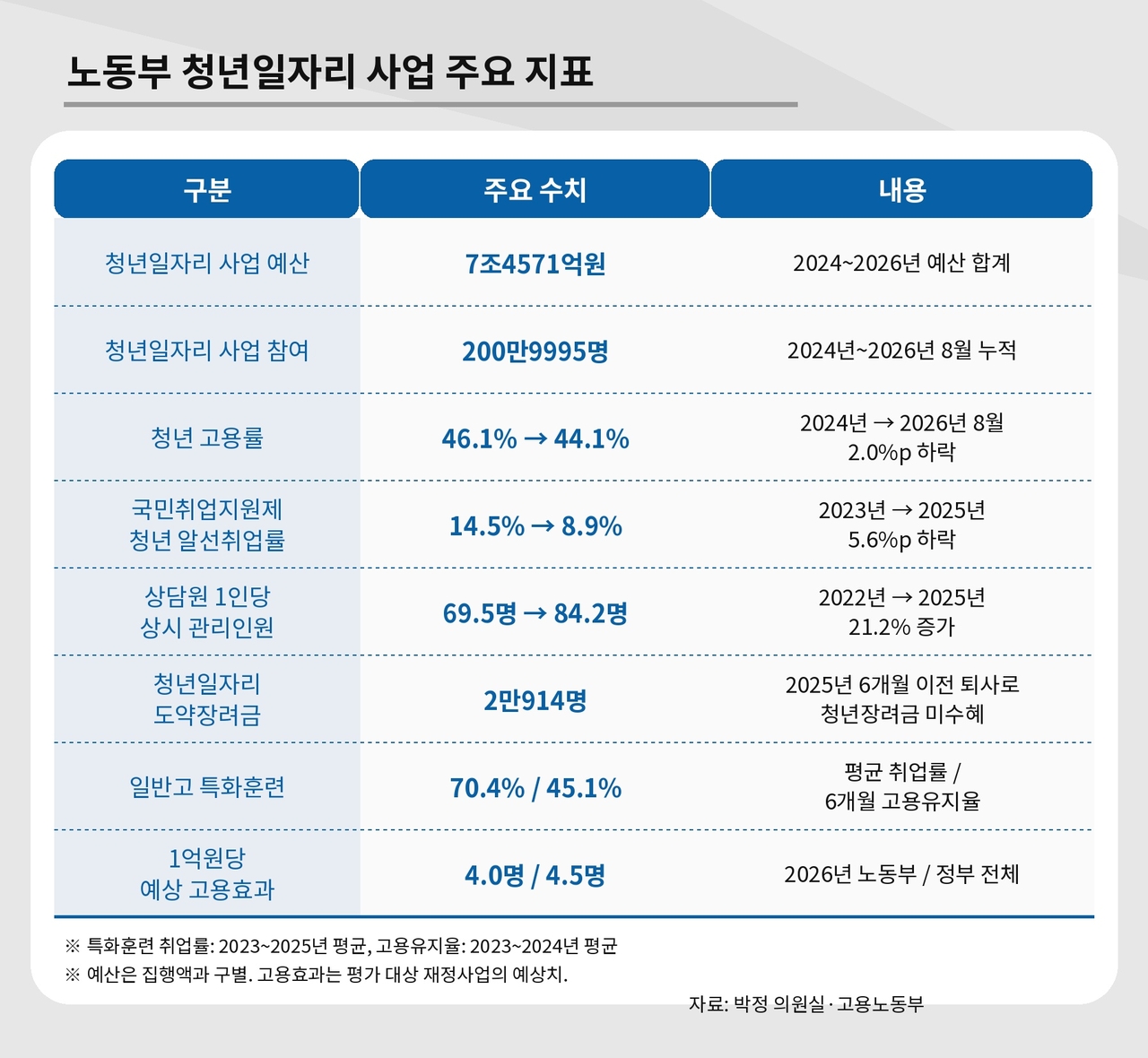
The cumulative number of program participants reached about 2.01 million — 661,434 in 2024, 753,595 last year and 594,966 through August this year. Despite the scale, the youth employment rate slipped from 46.1 percent in 2024 to 45.0 percent last year and 44.1 percent as of August this year. The number of employed young people also fell by 178,000 last year to about 3.578 million.
Individual programs revealed further shortcomings in both job placement and retention.
The National Employment Support Program, which provides job-search services and living allowances to low-income and other vulnerable job seekers, saw its youth job-matching rate drop from 14.5 percent in 2023 to 13.2 percent in 2024 and 8.9 percent last year — a decline of 5.6 percentage points over two years. The simple average from 2022 to 2025 was 12.6 percent.
Youth participants accounted for 72.3 percent of all enrollees in the program, yet the infrastructure supporting job counseling and placement has shrunk. The number of contracted counseling agencies fell 45.7 percent, from 529 in 2022 to 287 this year, while the average caseload per counselor rose 21.2 percent over the same period, from 69.5 participants in 2022 to 84.2 last year.
The Youth Employment Jump Incentive, which supports small and medium-sized enterprises in hiring young workers, also drew calls for reform. Of the 38,803 participating companies last year, 93.3 percent employed fewer than 100 workers. Workplaces with five to 29 employees were the largest group at 60.0 percent, followed by those with 30 to 99 employees at 18.5 percent and those with fewer than five at 14.7 percent. Workplaces with 100 or more employees accounted for just 6.7 percent.
The average number of hires per company was 2.6 in 2024, 2.8 last year and 2.4 through August this year — all below three. Last year, 20,914 young workers left their jobs before the six-month mark and therefore did not receive the incentive payment. Unspent budget also remained significant: 119.2 billion won in 2024 and 72.5 billion won last year, representing 20.1 percent and 9.4 percent of the respective annual budgets.
"The program should be redesigned to concentrate support on companies that offer jobs where young people can work long-term and grow," Park said.
A vocational training program for third-year general high school students preparing to enter the workforce rather than attend university — offered through the national training voucher system — showed particularly weak post-employment retention. The average job placement rate from 2023 to 2025 was 70.4 percent, but the six-month retention rate for the years in which data were available, 2023 and 2024, averaged just 45.1 percent.
That figure compares poorly with other training programs over the same period: the K-Digital Training program posted six-month retention rates of 72.2 percent and 70.0 percent in 2023 and 2024, respectively, while the national key industry vocational training program recorded 66.3 percent and 64.6 percent. The high placement rate for the general high school program has not translated into stable employment.
Training courses were also concentrated in a narrow range of fields. Of the 447 courses offered under the program this year, 58.2 percent fell in beauty and service categories — including cosmetology, baking and barista training, and food service. The share of employed graduates not enrolled in employment insurance hovered around 30 percent each year: 30.6 percent in 2022, 28.4 percent in 2023 and 31.6 percent in 2024.
The projected employment impact of the ministry's fiscal programs also trailed the government-wide average.
In this year's fiscal program employment impact assessment, the ministry's programs were projected to generate 4.0 jobs per 100 million won of budget, below the government-wide average of 4.5. Last year the ministry's figure was 3.5, also below the overall average of 4.2.
In 2022, the ministry's projected impact of 4.8 jobs per 100 million won had exceeded the government-wide average of 3.2. Since then, the government-wide figure has risen while the ministry's has fallen, with the ministry dropping below the average from 2025 onward. However, these figures reflect projected employment effects for the assessed fiscal programs in each year and do not represent actual jobs created.
"Even as the budget and enrollment for youth employment projects have both grown, youth employment indicators have not improved," Park said. "We need to examine whether the Ministry of Employment and Labor's current youth employment policy is working effectively and develop measures with real impact." He added that because these students enter the labor market before university, "policy cannot end at the point of employment — it must cover the full arc from training to hiring to retention."
fact0514@heraldcorp.com




