
We see the world through food. Welcome to Midam, stories worth savoring.
Cooking robots are growing fast and edging toward the home; the global food robotics market is projected to expand from $2.71 billion in 2025 to $14.95 billion by 2034, but concerns are mounting that human-chef cuisine could become a luxury only the wealthy can afford.
![[Getty Images Bank]](https://wimg.heraldcorp.com/news/cms/2026/10/08/news-p.v1.20261008.7e29bc7f20d647beaef1e4cf11c66986_P1.jpg)
"I have failed."
A ramyun-cooking robot installed at a highway rest stop made headlines online after flashing that error message mid-cook. People laughed at the oddly human moment — a machine that was supposed to be infallible, admitting defeat. In footage that circulated widely, the robot turns toward the noodle block that had fallen to the floor, and somehow the gesture reads as pure frustration.
"What should I make today?"
Anyone who has stood in the kitchen, too tired to cook, has probably imagined having a robot take over — even one that fails occasionally. That fantasy may not stay a fantasy much longer. The widespread adoption of home cooking robots could become a reality in the not-too-distant future.
![A home cooking robot developed by Moley Robotics of the United Kingdom. [Moley Robotics]](https://wimg.heraldcorp.com/news/cms/2026/10/08/news-p.v1.20261007.6def431ec844452b8fa70a8eedfbb5e4_P1.jpg)
The home cooking robot under development by Britain's Moley Robotics is perhaps the closest thing to that vision. A pair of robotic arms and hands, modeled on the human form, stand in a kitchen and cook in place of a person. The user selects a menu, and the robot follows the recipe from start to finish. It can prepare more than 50 dishes.
The story of cooking robots begins in 1981, when Japan's Suzumo introduced a machine that shaped sushi rice. The robot divided hand-pressed sushi rice into uniform portions and applied just the right pressure to form each piece. Suzumo still produces sushi automation equipment today, and its current machines can turn out 300 pieces per minute.
![A sushi-making robot produced by Japan's Suzumo in 1981. [Suzumo Machinery]](https://wimg.heraldcorp.com/news/cms/2026/10/08/news-p.v1.20261007.bbbdb15a1158480faf0b6e6f80fcb27f_P1.png)
As AI and robotics advanced through the 2010s, the arm-equipped cooking robots we recognize today began to emerge in earnest. These machines work by repeating a fixed set of pre-programmed movements. Many cooking robots on the market today have yet to move beyond that stage.
That limitation is widely seen as the central challenge the industry must overcome. Cooking involves an enormous number of variables — a tomato that is firmer than usual, a bowl of a different size, or, in the case of baking, shifts in humidity and oven temperature that all affect the final result. Current cooking robots cannot yet respond to such variables on the fly.
![A robot used by Zume Pizza. [Zume Pizza]](https://wimg.heraldcorp.com/news/cms/2026/10/08/news-p.v1.20261008.5efec51180054aada2b3517b22001438_P1.jpg)
Those limitations have translated into real-world business failures. The most prominent example is Zume, a US pizza startup that set out to make pizzas using robots and automation and bake them en route during delivery. The company could not solve the quality problems that came with cooking in a moving vehicle and ultimately abandoned the business model. Chowbotics, maker of the salad robot Sally, drew considerable attention for a time — DoorDash acquired the company in 2021 — but shut the operation down roughly a year later in 2022.
Those problems may be solved sooner than expected, however, as AI technology is advancing at a remarkable pace alongside robotics.
The food robotics market, which includes cooking robots, is expanding rapidly. According to market research firm Fortune Business Insights, the global food robotics market is projected to grow from $2.71 billion in 2025 to $3.28 billion in 2026, reaching $14.95 billion by 2034 — a compound annual growth rate of 20.9 percent between 2026 and 2034.
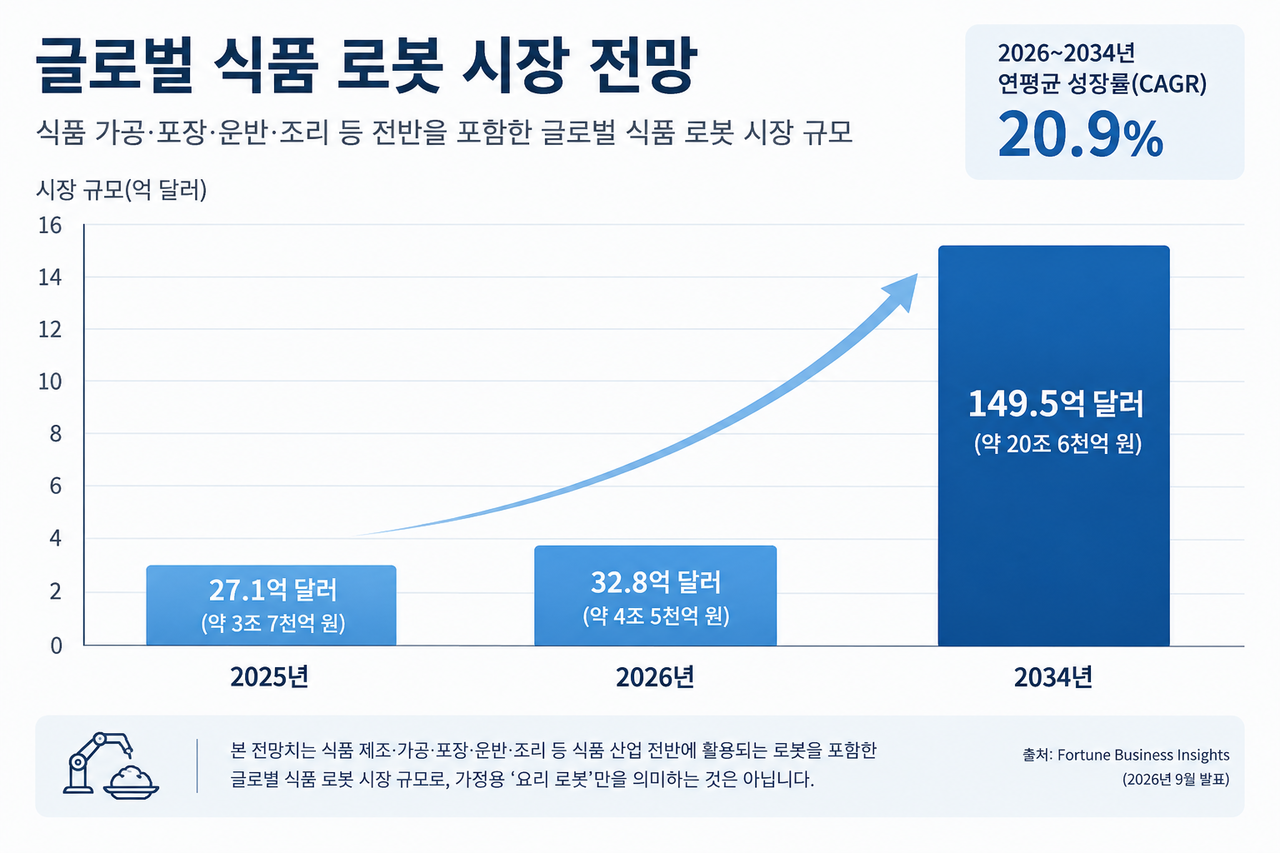
In the future, sensors and cameras will read the size and condition of ingredients, AI will analyze cooking data, and robots will carry out the physical work. A camera might assess the size and color of a potato; AI calculates its moisture content and dimensions; the robot adjusts the frying time accordingly; sensors then check the color and temperature of the finished dish; and if something is off, the system modifies the conditions for the next batch.
In that model, a robot is no longer simply a machine that repeats preset actions — it becomes something closer to a cooking system that reads the state of the food and decides what to do next. Food robotics companies have in fact been moving in exactly that direction, combining AI, vision systems and cooking data rather than relying on basic mechanical programming. Miso Robotics, for its part, is pursuing kitchen automation that draws on Nvidia's robotics platform and AI-based vision technology.
![[Getty Images Bank]](https://wimg.heraldcorp.com/news/cms/2026/10/08/news-p.v1.20261007.3dac5347a45f437c8970262e17e7b601_P1.jpg)
In South Korea, the Korea Food Research Institute has begun developing AI-driven noodle manufacturing technology. The core of the system is an autonomous production chain linking sensors, AI, robots and a digital twin.
Compound sensors measure the quality of dough and noodles in real time; AI analyzes that data to predict quality outcomes and determine optimal operating conditions; robots handle high-precision tasks such as picking up and shaping noodles; and a digital twin — a virtual replica of the actual production floor — monitors and controls the entire process in real time.
Nine institutions from industry, academia and research are participating, with the Korea Food Research Institute at the center. The institute oversees noodle quality analysis and process design, integrating the sensors, AI, robots and digital twin into a single production line. The goals are to cut product loss rates by more than 20 percent through real-time quality control, raise productivity by more than 30 percent through autonomous operation, and bring the overall automation rate of the noodle production process to above 50 percent.
Robot food for the many, human-chef cuisine for the few: the coming culinary divide
![[Getty Images Bank]](https://wimg.heraldcorp.com/news/cms/2026/10/08/news-p.v1.20261008.91748fac2954482cb17e4f30b6f349e3_P1.jpg)
Ironically, the rise of cooking robots may end up drawing a new line in the world of fine dining.
The spread of cooking robots cannot be viewed simply as a technology that replaces human chefs — it also raises the prospect of a culinary divide. Foods that can be automated will become easier to mass-produce and standardize, while dishes that depend on a cook's touch, subtle differences in ingredients, and a chef's experience and creativity may be pushed into an ever more expensive tier.
A well-known chef interviewed recently said the day robots replace cooks will definitely come, and expressed concern that when it does, cuisine made by human chefs could become the exclusive preserve of the wealthy.
"The day robots cook our food will definitely come. Cooking is, in a sense, an emotional domain. There is something irrational about it — something human — that AI will find hard to replicate. Robots won't be able to replace chefs completely. So you could end up with a world where most people eat factory-style food made by robots, while only a small number can afford a meal cooked by a human chef. Fine dining by a chef could become something only the privileged get to enjoy."
![[Getty Images Bank]](https://wimg.heraldcorp.com/news/cms/2026/10/08/news-p.v1.20261008.46aa85a0d7f04b35a69089c041be292b_P1.jpg)
That gap is already showing up in consumer perceptions. A study published in Appetite in 2026 found that restaurants where food was prepared by robots tended to receive lower ratings than those where humans cooked. Notably, the more human-like the robot, the stronger the perception that the technology was trying to replace people.
Ultimately, robot-made food may become the cheaper, faster meal, while food made by a human chef commands a premium built on scarcity and the human touch. Technology could lower the barrier to a decent meal while paradoxically raising the value of food made by human hands — splitting the price and experience of dining into two increasingly distant worlds.
123@heraldcorp.com




