Rental housing sales of 931.3 billion won vs. cost of goods sold of 2.4 trillion won in H1
Repair and maintenance costs approach 1 trillion won as stock grows
Cross-subsidy halt and organizational split deepen LH's fiscal strain
Even as President Lee Jae Myung pushes hard for a government-led expansion of housing supply — including rental units — Korea Land and Housing Corporation's losses from operating rental housing reached approximately 1.5 trillion won ($1.1 billion) in the first half of this year. That compares with losses of just over 800 billion won in the same period of 2022, meaning the deficit has nearly doubled in just four years.
Analysts say the widening losses reflect a structural problem: as the volume of rental housing grows, operating costs — including depreciation, repair and maintenance, and loan interest — rise far faster than rental income. Experts warn that if the government continues to focus solely on expanding supply while ignoring the chronic deficit, LH's financial health will deteriorate and the quality of housing for residents could decline.
According to data on LH's rental housing operating losses submitted to the office of People Power Party lawmaker Kim Jong-yang of the National Assembly's Land, Infrastructure and Transport Committee on Tuesday, LH's rental housing sales in the first half of this year totaled 931.3 billion won, while the cost of goods sold came to 2.4 trillion won. With operating costs running roughly 2.5 times higher than rental income, the gross operating loss reached 1.47 trillion won.
Within the cost of goods sold, repair and maintenance expenses for aging rental units came to 919.1 billion won, approaching 1 trillion won. The remaining costs broke down as follows: depreciation of 812.6 billion won, interest payments of 455.7 billion won, service fees of 121.5 billion won and other expenses of 87.6 billion won.
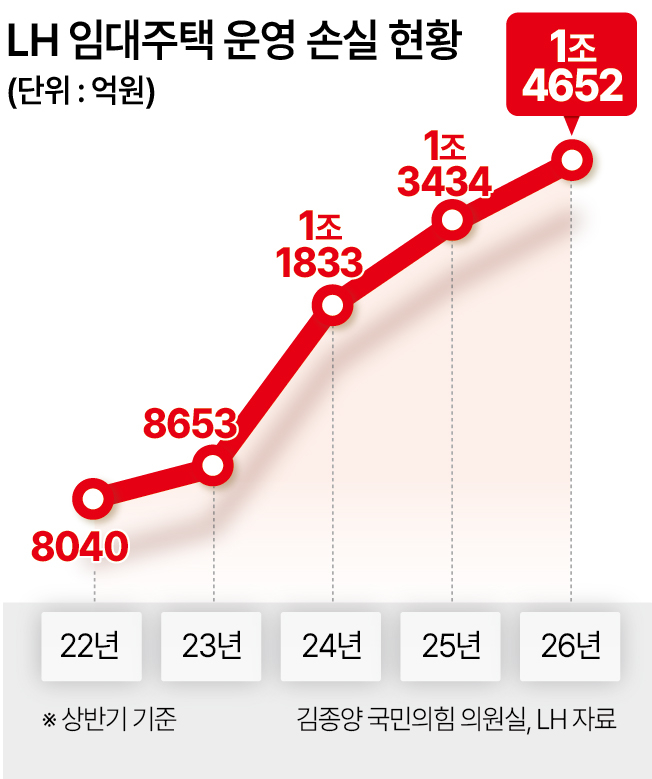
LH's rental housing operations have posted losses every year for the past five years. Compared with the 804 billion won loss recorded in the first half of 2022, the deficit has grown 82.2 percent over five years. On a first-half basis, losses have risen steadily: 804 billion won in 2022, 865.3 billion won in 2023, 1.18 trillion won in 2024, 1.34 trillion won in 2025 and 1.47 trillion won so far this year.
The combined losses from 2022 through 2025 total 9.52 trillion won. Including this year's first-half figure, the cumulative deficit over the past four and a half years has approached 11 trillion won (10.98 trillion won).
"The volume of rental housing we manage has grown since 2022, and in particular the increase in purchased rental units has driven a sharp rise in repair, maintenance and management costs," an LH official said. "Unless rents go up, the structure is such that the deficit inevitably grows alongside the volume."
The concern is that the push to accelerate public housing supply is continuing even as no mechanism exists to offset rental housing losses. The Ministry of Land, Infrastructure and Transport announced a residential stability plan late last month aimed at expanding the stock of long-term public rental housing — units available for 10 years or more — from about 1.931 million households in 2024 to 2.5 million or more by 2030. The plan calls for supplying about 1.188 million public housing units by 2030, of which public rental units — comprising 350,000 construction rentals, 313,000 purchased rentals, 230,000 jeonse rentals and 52,000 privately operated public-support rentals — account for 80 percent of the total, or 945,000 units.
President Lee has also repeatedly expressed his determination to complete large-scale, government-led housing supply ahead of schedule. On Monday, he wrote on his X (formerly Twitter) account that he would "use surplus tax revenue to supply large quantities of long-term public rental housing for young people and the middle class ahead of schedule." In follow-up posts, he described housing construction in Seoul and the greater metropolitan area as "an urgent, important and highly effective policy" that would both address the housing shortage early and stimulate domestic demand. He also said he had instructed LH to guarantee the purchase of unsold units as purchased rentals, to help developers who had received permits but were hesitant to break ground out of concern over pre-sales. He added that he had told the new Minister of Land, Infrastructure and Transport and LH to "devote themselves like mad to early mass supply, staking the nation's fate on it."
Given this situation, experts say the government must first establish a sustainable operating model for rental housing and put in place a well-designed mechanism to offset losses before pressing ahead with a quantitative expansion to accelerate supply.
"The president has told LH to build housing 'like mad,' but the reality is that losses from the rental housing already in operation are snowballing," People Power Party lawmaker Kim said. "If the government keeps pushing volume while leaving the loss structure intact, LH's finances will not hold up — and the bill will ultimately come due in the form of higher taxes and a decline in the quality of housing for residents."
Kim also urged the government to stop offloading the commitment to purchase unsold units onto LH, saying it amounted to "using a public corporation as a backstop for policy failures." He called on the government to establish a sustainable rental operating structure before racing to compete on volume.
Meanwhile, LH's fiscal burden is deepening by the day as the cross-subsidy arrangement — under which losses from rental housing were offset by proceeds from land sales — has become untenable. Shortly after taking office last year, President Lee sharply criticized LH's land sales as "land trafficking" and called for structural reform. With the government now pursuing a plan to split LH into separate development-and-construction and residential-welfare divisions, there is no clear plan for how the operating losses from rental housing will be covered or offset.
hwshin@heraldcorp.com