Ministry of Climate, Environment and Energy picks Chaevi for first public PnC pilot
30 fast chargers to go live late this month
Authentication, charging and payment to proceed automatically once plugged in
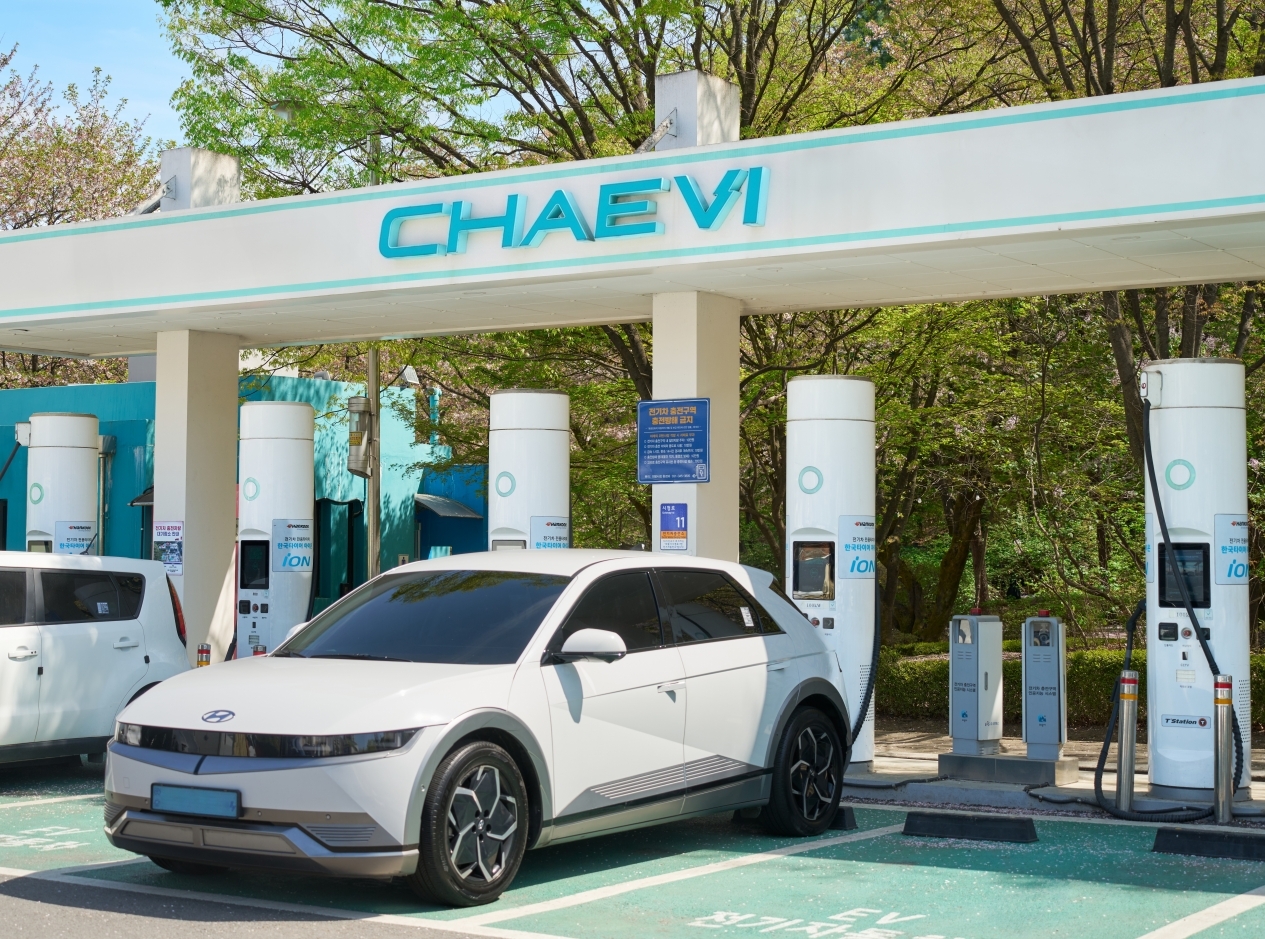
At some public fast-charging stations, electric vehicle drivers will soon be able to start charging and complete payment simply by plugging in the connector — no card tap or on-site payment required. EV charging operator Chaevi announced Tuesday it has been selected as the first pilot operator for the government's plug-and-charge (PnC) service, with a trial set to begin on 30 public fast chargers late this month.
PnC allows an EV and a charger to exchange vehicle identification data and automatically process payment through a pre-registered method. Users can begin charging as soon as they connect the connector, with no separate card authentication or payment steps required.
Currently, using a public fast charger requires multiple steps: selecting a charger, authenticating membership, choosing a charging method and completing payment. The Ministry of Climate, Environment and Energy is pushing to introduce PnC across the public charging network to cut what is now a five-to-six-step process and improve convenience for EV users.
As a first step, Chaevi will apply PnC to 30 fast chargers starting late this month. The company plans to verify that vehicle authentication, charging and payment proceed reliably in real-world conditions, then use the results to expand PnC to additional public fast chargers.
Security is also a key area of evaluation. Because PnC involves automatic exchange of payment-related data between a vehicle and a charger, secure management of authentication credentials is critical.
To address this, Chaevi's chargers are equipped with a hardware security module (HSM) chip — a dedicated chip that protects sensitive authentication data within a separate security enclosure and handles encryption. It shields information passing between the vehicle and charger from external security threats.
PnC services are already operating on private charging networks. Chaevi has offered its own PnC service, called Baro Chaevi, which handles vehicle authentication, charging and payment in sequence from a single connector connection.
The company also has experience collaborating with automakers. In June, it integrated Hyundai Motor Group's PnC service into the Chaevi charging network. The company plans to draw on the automated payment systems and charging station operating experience it has built up for this public charger pilot.
"The competitiveness of charging infrastructure lies not simply in expanding the number of installed units, but in the convenience users actually experience during the charging process and the reliability of the service," Chaevi Chief Executive Choi Young-hoon said. "We will deliver a stable public PnC service based on the PnC technology and field experience Chaevi has accumulated."
Chaevi currently operates about 10,000 fast-charging units and handles the entire charging business in-house — from charger development and manufacturing to installation, operation and after-sales service.
The company has also been expanding into the home charging market alongside its public fast-charging business. On Wednesday, Chaevi and Hyundai Motor jointly launched "My Home Charger," a service that installs a 7-kilowatt home charger for Hyundai and Genesis EV customers. Plans start at 73,500 won ($54) per month on a 36-month contract, after which ownership of the charger transfers to the customer.
kwater@heraldcorp.com