
As AI investment continues to spread, analysts are advising investors to look beyond semiconductors and diversify across a broader range of sectors. The shipbuilding industry, in particular, has drawn attention as a potential major beneficiary of the AI boom.
At Herald Money Festa 2026, held Friday at Dongdaemun Design Plaza in Jung-gu, Seoul, Choi Chang-gyu, head of the ETF consulting division at Mirae Asset Global Investments, took part in a panel discussion titled "Sectors and Investment Strategies to Watch in an Era of Volatile Markets." He said hyperscalers' capital expenditure is expected to reach $1.2 trillion next year, adding that the market should be able to absorb the scale. "Right now, investors need to look not just at semiconductors but at any sector where AI is embedded," he said.
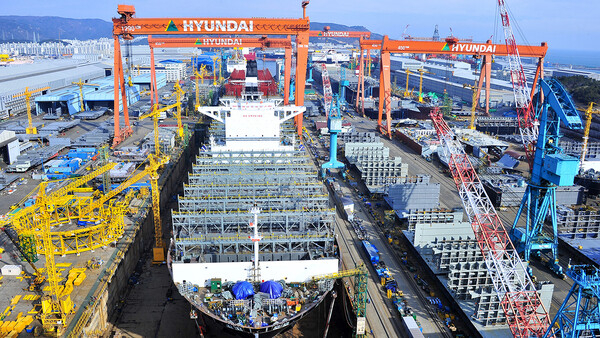
Choi went on to highlight the shipbuilding sector. "Nuclear power, which can address data center energy shortages, and the shipbuilding sector — including Hyundai Heavy Industries and Hanwha Engine, which supply marine engines for use as emergency data center generators — are among the most prominent beneficiaries," he said. His remarks underscored how shipbuilding is gaining recognition as a new AI-linked investment theme, given the industry's growing role in power generation and the increasing use of marine engines as generator engines.
Yeom Seung-hwan, a director at LS Securities, also spoke at Herald Money Festa 2026 on Saturday, arguing that the old rule linking rising interest rates to falling share prices no longer holds in the AI era. "Higher interest rates are a headwind for share prices, but we have entered an age of investment," he said. With the NASDAQ hitting a record high even as US interest rates hover around 5.2 percent, he urged investors to focus less on rates themselves and more on whether economic growth and corporate earnings can outpace the burden of higher borrowing costs.
Semiconductors were by far Yeom's top investment pick. He said the surge in AI data center investment is driving demand for memory chips such as HBM and SSDs, which flows directly into earnings at Samsung Electronics and SK hynix. AI investment next year is projected to reach $1.32 trillion, or about 1,600 trillion won. "AI spending is expected to peak in 2031," Yeom said. "There is no need to worry now about problems that belong in 2028 or 2029."
He added that if the expansion of AI investment translates into real earnings growth, a broader rerating of the Korean stock market could extend beyond semiconductors to power, defense, shipbuilding and robotics.
Power infrastructure was also flagged as a new beneficiary of AI investment. As AI data centers multiply and electricity demand surges, solar power and energy storage systems could serve as near-term solutions to fill the supply gap — faster than nuclear power plants, which take a decade to build.
Yeom also singled out shipbuilding. He pointed to rising demand for engines needed to generate power for data centers, and looked further ahead to the possibility that data centers could eventually expand beyond land to ships or even space. "Data centers could one day move onto ships or into space," he said. "A market connecting shipbuilding with AI could open up."

dlcw@heraldcorp.com




