Analysis of 80,000-plus firms backed by Korea Technology Finance Corporation
CEOs aged 60 or older account for 24.3% of guaranteed firms; 753 long-running companies led by owners 70 or older
Kibo launches M&A succession support program this year, but zero deals closed despite 60 sellers
Experts warn of technology loss and job cuts if no successors found
South Korea's small and medium-sized enterprises are aging at an accelerating pace. The number of companies whose chief executives are 70 or older surged nearly 60 percent over the past four years, even as the overall pool of firms backed by the Korea Technology Finance Corporation shrank. As more business owners approach retirement age, concerns are growing over a so-called "succession cliff" — a scenario in which SMEs fail to find successors, causing accumulated technology and jobs to disappear.
Surge in CEOs aged 70-plus deepens succession cliff fears
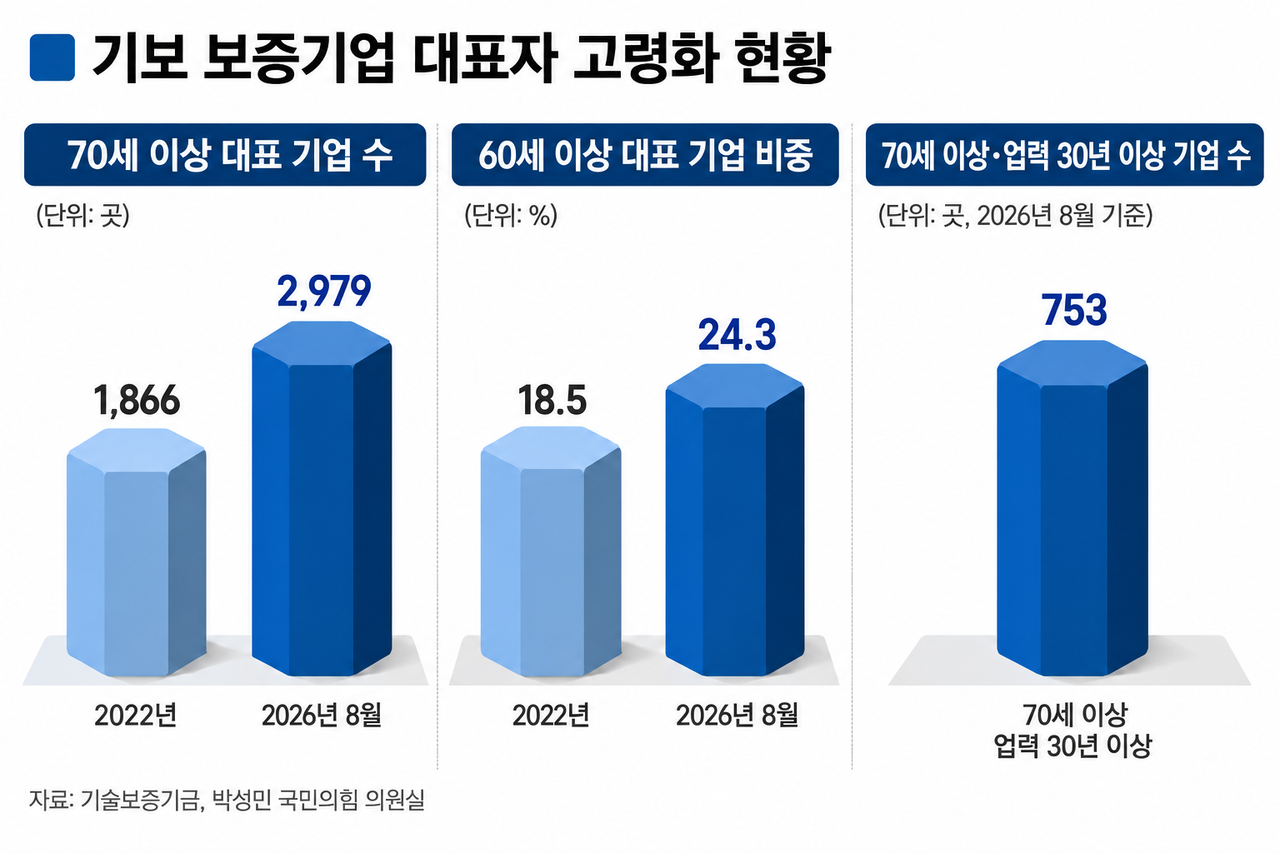
According to Kibo data obtained through the office of People Power Party lawmaker Park Sung-min of the National Assembly's Industry, Trade, Resources, SMEs and Startups Committee, the total number of companies under Kibo's direct guarantee program fell from 84,239 in 2022 to 80,927 as of August this year. Over the same period, the number of firms led by a CEO aged 70 or older rose from 1,866 to 2,979 — a 59.6 percent increase.
The share of guaranteed firms with a CEO aged 70 or older climbed from 2.22 percent in 2022 to 3.68 percent as of August this year, a gain of 1.46 percentage points. Even as the total number of backed firms has declined, the proportion led by elderly executives has consistently grown.
The trend becomes even more pronounced when the threshold is lowered to 60. The number of firms with a CEO aged 60 or older grew 26.0 percent, from 15,588 in 2022 to 19,637 as of August this year, accounting for 24.3 percent of all guaranteed firms. Roughly one in four companies in the Kibo portfolio is run by a CEO aged 60 or older.
Among firms led by elderly executives, a significant number have been in business for decades. As of August this year, 753 companies had a CEO aged 70 or older and had been operating for 30 years or more. Manufacturing firms made up 669 of those, or 88.8 percent — reflecting the concentration of long-established production companies whose owners have spent years accumulating technical expertise on the factory floor.
Long-running firms led by executives in their 60s are also numerous. Companies with a CEO between 60 and 64 and an operating history of 30 years or more numbered 593, while those with a CEO between 65 and 69 numbered 909, bringing the total of firms with a 60-something CEO and at least 30 years in business to 1,502.
The concern is that an aging leadership base could threaten the very survival of these companies. In many SMEs, technology, client relationships and management know-how are concentrated in the founder or chief executive personally. If ownership cannot be passed to family members or a suitable successor cannot be found, even a healthy, well-run business can face closure. In manufacturing particularly, where long-accumulated technical skills and experienced workers are critical assets, a failure to ensure smooth succession could erode industrial competitiveness.
60 firms want to sell, but not a single M&A deal has closed
In response, the government has begun supporting SME succession through third-party mergers and acquisitions for companies that cannot pass ownership within the family. Kibo launched an M&A succession consulting support program in April, recruiting both prospective sellers and buyers. The initiative aims to help companies preserve their technology and workforce through external acquirers, moving beyond the traditional model of handing a business down to one's children.
Yet tangible results have not materialized. According to data Kibo submitted to Park's office, 60 companies have applied as prospective sellers and 43 as prospective buyers, but not a single M&A match or completed deal has been recorded. There have also been no guarantee-backed transactions related to business succession M&A.
Of the 60 firms seeking to sell, 43 — or 71.7 percent — are led by a CEO aged 60 or older, including eight with a CEO aged 70 or older. While demand from aging business owners to exit is evident, connecting them with actual buyers has proved elusive. Kibo said M&A transactions typically take more than a year to complete, given the negotiations and contracting procedures involved.
Manufacturing firms account for 41 of the 60 prospective sellers, or 68.3 percent. By years in operation, 19 have been running for between 20 and 30 years and six for 30 years or more, putting the total of firms with at least 20 years of history at 25. The figures suggest that succession demand among long-established manufacturing companies and other SMEs is becoming a concrete reality.
Legislative progress at the National Assembly has also stalled. People Power Party lawmaker Lee Cheol-gyu introduced a bill in April to prevent management disruptions at SMEs caused by the absence of successors — formally titled the Special Act on Supporting Business Succession to Strengthen Management Continuity. The bill covers the identification and cultivation of third-party successors, M&A brokerage and post-succession management stabilization, but it remains pending before the Assembly's industry and SME committee.
Experts say that if suitable buyers cannot be found in time as elderly owners near retirement, management vacuums will emerge. They argue that support must go beyond simply recruiting sellers and buyers to encompass business valuation, acquirer identification and deal completion.
"The succession cliff threatens not just businesses but the technology and jobs that SMEs carry," Park said. "We must strengthen third-party succession support, including M&A, so that competitive companies do not shut down simply because there is no one to take over."
boo@heraldcorp.com