Re-elected for a second term, District Mayor Kim Kyung-ho marks 100 days in office with pledges on housing redevelopment, youth policy and integrity in public administration
Gwangjin-gu in Seoul will kick off its long-awaited Dong Seoul Terminal modernization project in earnest next year. The overhaul, centered on the area around Gangbyeon Station, is expected to dramatically improve traffic conditions by relocating the terminal underground, enhance access to the Han River and draw large-scale commercial facilities that could give the local economy a significant boost.
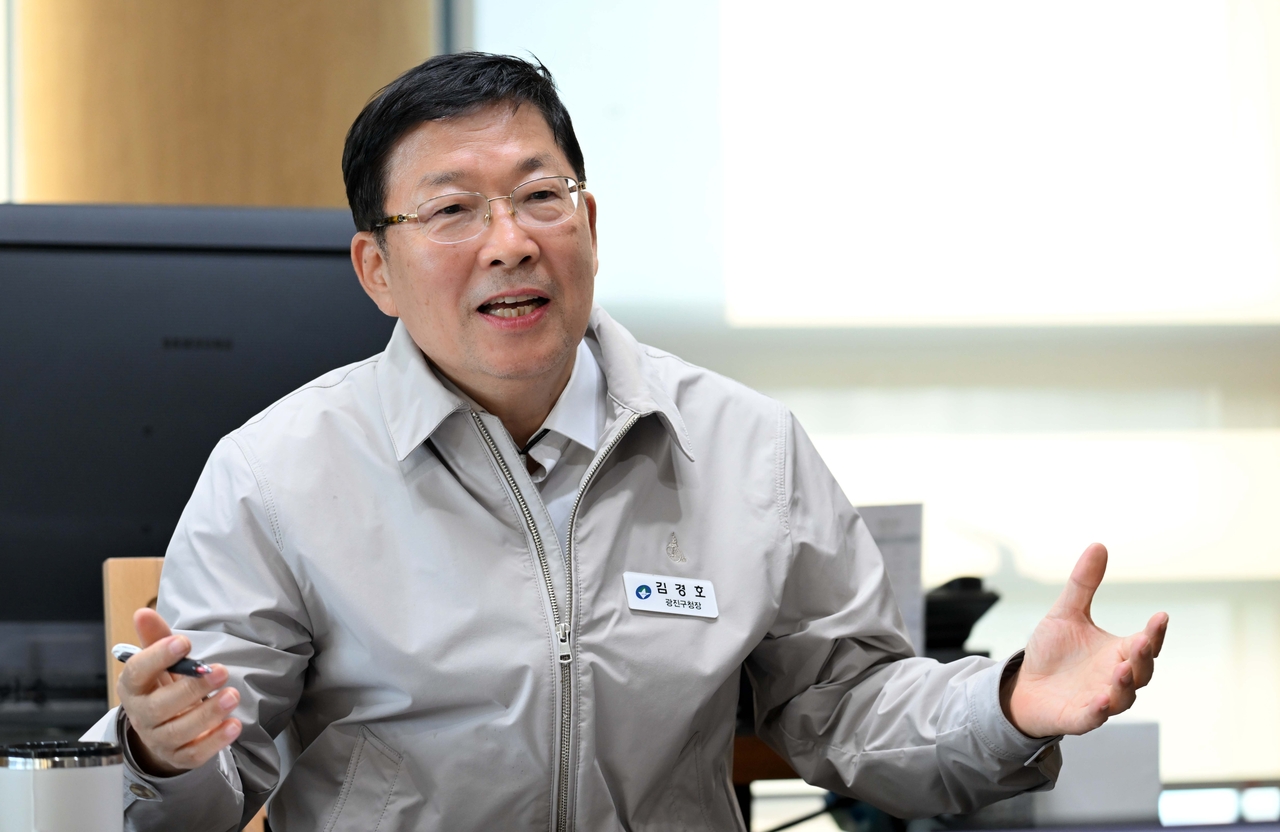
District Mayor Kim Kyung-ho, who won re-election to a second term, said he intends to turn the next four years into a period when residents can actually feel the changes set in motion during his first term. The Herald Business sat down with Kim at the district office on Wednesday — one day before he marked 100 days in his second term — to hear his vision for Gwangjin-gu. The following is an edited transcript of the interview.
— You are marking 100 days into your second term. What are your thoughts as a re-elected district mayor?
▶ I am deeply grateful to the residents of Gwangjin-gu for giving me another opportunity to serve. The joy of re-election is great, but what weighs on me more is the responsibility to carry forward the changes we started over the past four years and see Gwangjin's development through to completion. Rather than rushing to unveil new projects, I spent the first 100 days setting the right direction for this term and laying the groundwork to keep the promises I made to residents. If my first term was about opening the path to change and building the foundation for growth, I see this term as the time to turn that change into results that residents can feel. Now it is time to move into full execution.
— You chose a residential redevelopment plan as the first document you signed in your second term. In what direction will you pursue housing redevelopment?
▶ The principles guiding residential redevelopment this term are clear: accelerate the pace, reduce conflict and increase the value that flows back to residents. Improving the residential environment is the issue residents care about most and a core challenge that will determine Gwangjin's future competitiveness. At present, 73 redevelopment and reconstruction projects — including Moa Town initiatives — are under way across the district. To manage this, Gwangjin-gu has established a new Housing Bureau made up of three divisions: the Housing Administration Division, the Housing Projects Division and the Moa Housing Division. It is rare for a district to have built such a systematic organization dedicated to residential redevelopment. There is already a concrete example of what faster redevelopment can look like. The Hanyang Yeonlib complex in Jayang-dong, the first project under Seoul's Moa Housing program, was completed just two and a half years after breaking ground, and residents moved in last month. I visited and met with the residents — both original occupants and newcomers — and all of them expressed satisfaction.
— The Dong Seoul Terminal modernization project is moving forward. What changes will this bring to the area?
▶ Dong Seoul Terminal has long served as the gateway to northeastern Seoul, but aging facilities, traffic congestion, exhaust fumes and noise have caused significant inconvenience for users and nearby residents alike. This modernization project is not simply about replacing an old terminal with a new one. It is about connecting Gangbyeon Station, the terminal and the Han River into a single integrated space — transforming the urban fabric and living environment of the entire area. Traffic conditions will see the most immediate improvement: a new underground direct-access ramp connecting to the Gangbyeon Expressway will streamline bus routes, and a regional bus transfer hub will ease congestion on surrounding streets. The economic impact is also expected to be substantial. The development is planned as a 39-story complex scheduled for completion in 2031, and will house E-mart's headquarters, entertainment companies, a Starfield mall and other large-scale shopping, mixed-use commercial and office facilities. The project will create a wide range of jobs, and the increased foot traffic and consumer spending are expected to ripple out to surrounding businesses, injecting new energy into the local economy. I am confident that Dong Seoul Terminal will be reborn as a new growth hub for northeastern Seoul and a defining landmark along the Han River.
— Gwangjin-gu has a high proportion of young residents. What youth policies will you prioritize this term?
▶ Gwangjin-gu has the third-highest share of young residents among Seoul's autonomous districts. Rather than offering piecemeal, short-term support, we are pursuing a comprehensive policy that links housing, employment, future skills, culture and mental health so that young people can study, work and settle stably in Gwangjin. Helping young residents put down roots requires addressing housing and jobs together. To that end, we expanded the Gwangjin Youth Monthly Rent Support program from 83 recipients to 150 this year, providing up to 200,000 won ($149) per month for up to 12 months to ease the burden of housing costs. For unemployed young people, we offer up to 150,000 won per person toward language and certification exam fees — covering TOEIC and other language tests, national technical qualification exams, the Korean History Proficiency Test and nationally recognized private certification exams, regardless of whether the applicant passes. In addition, we plan to subsidize generative AI service subscription costs of up to 50,000 won per person to help young residents close the digital divide and strengthen their employability. We continue to listen to young people through on-site district mayor sessions, youth administrative intern meetings, the Gwangjin Youth Network and a university student policy planning group, and we incorporate their feedback into district administration on an ongoing basis.
— What do you emphasize in your administration to raise Gwangjin-gu's integrity rating?
▶ I think of integrity and kindness as two sides of the same coin. Integrity is the most fundamental value in public administration — it builds residents' trust in government and gives public servants a sense of pride in their work. Throughout more than 30 years in public service, I have always placed integrity first among the virtues of a public official. No matter how strictly one follows the rules, if you fail to explain decisions clearly and treat residents with courtesy, it is hard for them to trust the administration. Conversely, even the most courteous service cannot earn genuine trust if the work is not handled fairly and transparently. True trustworthy administration is only complete when integrity — fair and transparent decision-making — is paired with kindness, meaning explanations that residents can actually understand. Residents have been telling us that district office staff have become friendlier and faster. These efforts paid off: in 2022, the first year of my first term, Gwangjin-gu achieved an overall integrity rating of Grade 2, and from 2023 through 2025 we recorded Grade 1 for three consecutive years. Among 709 public institutions nationwide, only two have maintained a Grade 1 rating for three or more consecutive years.
ikson@heraldcorp.com