K-Stay Expo 2026 opens at DDP on Friday
Over 40 companies and organizations set up booths
Home-sharing pitched as answer to hotel shortage
Policy reforms, regional expansion among key topics
![Key attendees pose for a photo at the opening ceremony of K-Stay Expo 2026 at Dongdaemun Design Plaza in Seoul on Friday. From left: Park Jun-su, head of LG Uplus's IB Foreign Products Team; Seo Won-seok, president of the Korea Tourism Academic Society; Seo Ga-yeon, Airbnb Korea country manager; Lee Jae-jeong, chair of the National Assembly's Culture, Sports and Tourism Committee; Chae Bo-young, chair of the Korea Minbak Industry Association; and Kim Geun-su, head of Cesco's Corporate Consulting Division. [Airbnb]](https://wimg.heraldcorp.com/news/cms/2026/10/09/news-p.v1.20261009.0a6ba35865db4aa596b2e1a7ed5ffea9_P1.jpg)
South Korea's first short-term rental expo drew nearly 8,000 pre-registrants, signaling strong market interest, as participants called for faster regulatory reform to keep pace with shifting travel trends.
K-Stay Expo 2026, organized by the Korea Minbak Industry Association and sponsored by Airbnb, opened Friday at Dongdaemun Design Plaza in Seoul and runs through Saturday. The two-day event was designed to take stock of the home-sharing industry's growth alongside rising inbound tourism and to give prospective hosts and existing operators access to reliable information and practical know-how.
![Airbnb Korea Country Manager Seo Ga-yeon delivers a congratulatory address at the opening ceremony of K-Stay Expo 2026. [Airbnb]](https://wimg.heraldcorp.com/news/cms/2026/10/09/news-p.v1.20261009.a69feac91329400d932c0f4864ad0ba9_P1.jpg)
The opening ceremony drew prominent figures from politics, academia and industry, including Lee Jae-jeong, chair of the National Assembly's Culture, Sports and Tourism Committee, as well as Seo Won-seok of the Korea Tourism Academic Society, Airbnb Korea Country Manager Seo Ga-yeon, and representatives from Cesco, LG Uplus and Ohouse.
In his congratulatory remarks, Lee said accommodation has evolved beyond a simple place to stay into a way for visitors to experience local culture, people and communities. "The regulatory system has not kept up with the pace of change," he said. "It is the National Assembly's role to reconcile the interests of existing industries while reforming the system to meet new tourism demands."
Lee added that existing short-term rental capacity falls far short of what will be needed for next year's major events, citing World Youth Day, the 2027 Chungcheong Summer Universiade and Phenomenon, a global K-pop festival. "I hope this expo becomes a forum where those leading K-tourism can pool their wisdom, and the National Assembly will play its part on the institutional side," he said.
![Visitors browse the exhibition floor at K-Stay Expo 2026. [Airbnb]](https://wimg.heraldcorp.com/news/cms/2026/10/09/news-p.v1.20261009.9ea518d5a9d943a3ad73661d475097a7_P1.jpg)
Despite falling during a holiday stretch running from Hangul Day through the weekend, the expo's opening day drew crowds of visitors seeking information on starting a short-term rental business. A survey conducted by the Korea Minbak Industry Association in August found that among respondents who had looked into starting a short-term rental, 46 percent cited a lack of quality startup information and 64 percent said they found it difficult to assess the reliability of available information.
![Lee Jae-jeong, chair of the National Assembly's Culture, Sports and Tourism Committee, delivers a congratulatory address at the opening ceremony of K-Stay Expo 2026. [Airbnb]](https://wimg.heraldcorp.com/news/cms/2026/10/09/news-p.v1.20261009.254eefbc441e4f1da9a7eba421567eeb_P1.jpg)
More than 40 companies and organizations set up booths covering a wide range of fields — accommodation operations, tax services, commercial district analysis and interior design — and offered one-on-one consultations on everything from finding properties to marketing and space styling.
Korea Minbak Industry Association Chair Chae Bo-young said in her opening remarks that seeing more than 5,000 hosts and prospective operators, along with over 40 companies and organizations, gathered in one place more than a decade after the association's founding made clear that home-sharing had established itself as a full industry ecosystem. "I hope this expo becomes a turning point for building the next stage of growth for our home-sharing industry together," she said.
Representatives from private accommodation platforms also stressed the importance of in-person hospitality and the need to build a healthy industry ecosystem, noting that lasting trust requires not only deregulation but also responsible management by hosts.
![Airbnb Korea Country Manager Seo Ga-yeon delivers a congratulatory address at the opening ceremony of K-Stay Expo 2026. [Airbnb]](https://wimg.heraldcorp.com/news/cms/2026/10/09/news-p.v1.20261009.7d2f6b9378ee412fb19b97cfb3cb4aae_P1.jpg)
Airbnb Korea Country Manager Seo said walking through the expo floor — with booths covering interior design, home appliances, pest control, tax services and cleaning — made clear how deeply the home-sharing ecosystem has woven itself into everyday life. "As we prepare for an era of 40 million inbound visitors, the hospitality of hosts is the most powerful driver of Korean tourism and the front line of people-to-people diplomacy," she said.
![National Assembly Culture, Sports and Tourism Committee Chair Lee Jae-jeong (right) and Airbnb Korea Country Manager Seo Ga-yeon (left) tour the exhibition booths at K-Stay Expo 2026. [Airbnb]](https://wimg.heraldcorp.com/news/cms/2026/10/09/news-p.v1.20261009.2a3cae881c324b4ca1d357490c22e8e4_P1.jpg)
The first session after the opening ceremony, titled "Home-sharing: What changes lie ahead?", examined how short-term rentals could help offset a shortage of hotel rooms in Seoul relative to surging inbound tourist numbers. Panelists said hosts must manage noise and waste complaints rigorously and work to coexist with local communities. They also called for expanding regulatory sandbox pilot programs — currently concentrated in Seoul and Busan — to regional hubs, which would broaden the scope of domestic guests permitted to stay in short-term rentals.
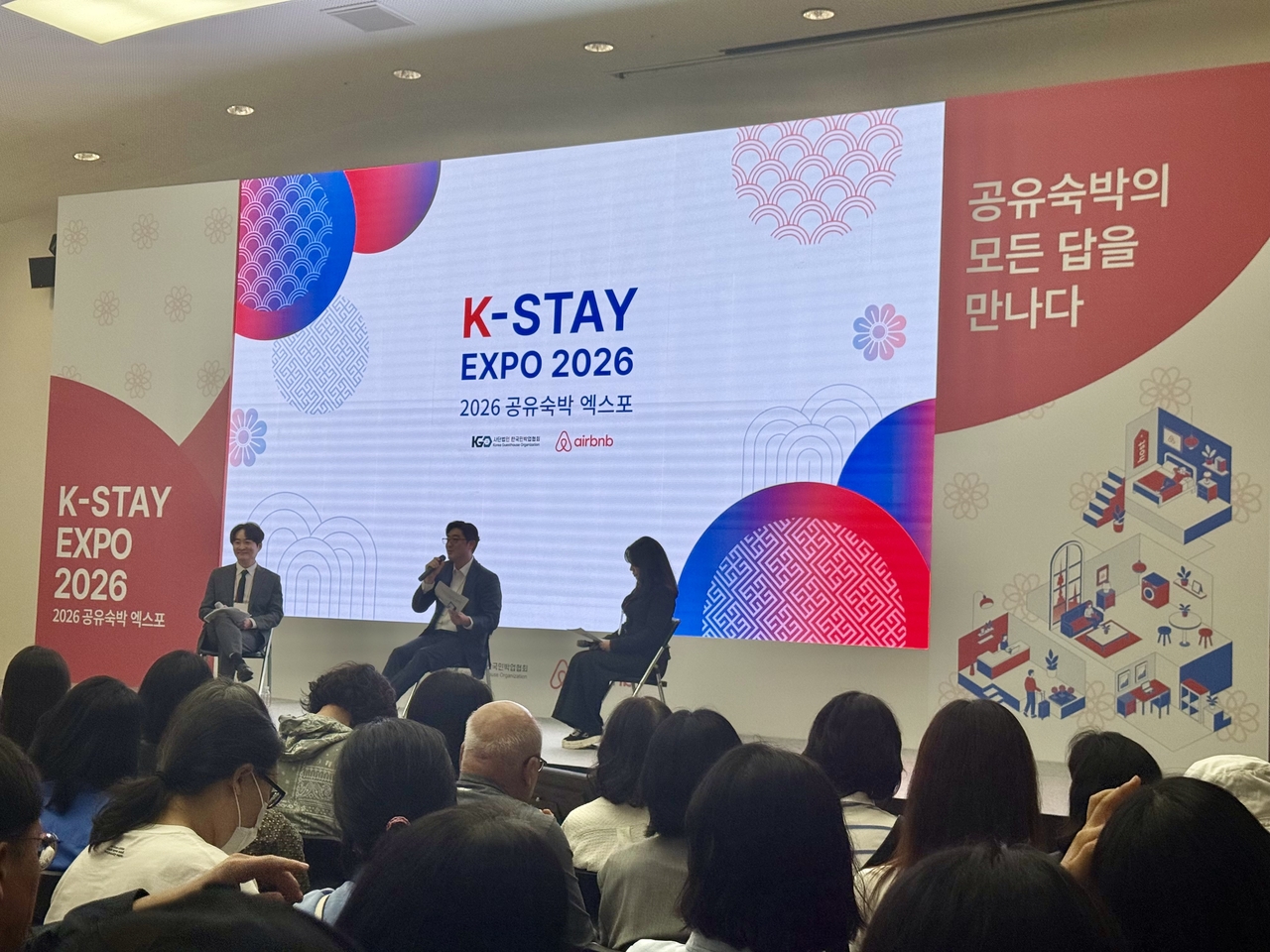
Korea Tourism Academic Society President Seo Won-seok, who moderated the session, said home-sharing serves as critical infrastructure for energizing local economies and absorbing inbound tourists, but its positive contributions and economic impact tend to be underestimated. "I will make sure the voices from the field reach the National Assembly and the government so that hosts can sustain their businesses and the tourism industry can take the next leap forward," he said.
![Visitors line up to enter K-Stay Expo 2026. [Airbnb]](https://wimg.heraldcorp.com/news/cms/2026/10/09/news-p.v1.20261009.639755e8fa19472a8fd3e0fd3deb7afa_P1.jpg)
On Saturday, the expo's second day, sessions will include a host boot camp along with presentations by working hosts sharing practical tips on finding properties, operating hanok guesthouses and launching hostel businesses. The Korea Minbak Industry Association said it plans to use the expo as a springboard to continue working with key partners, including Airbnb, to provide reliable information, channel industry voices into policy and support the broader growth of the home-sharing sector.
terry@heraldcorp.com