NowNSurvey polls 1,002 people on Hangul Day
4 in 10 find youth slang and abbreviations uncomfortable
54.3% say neologisms are fun but should be used in moderation
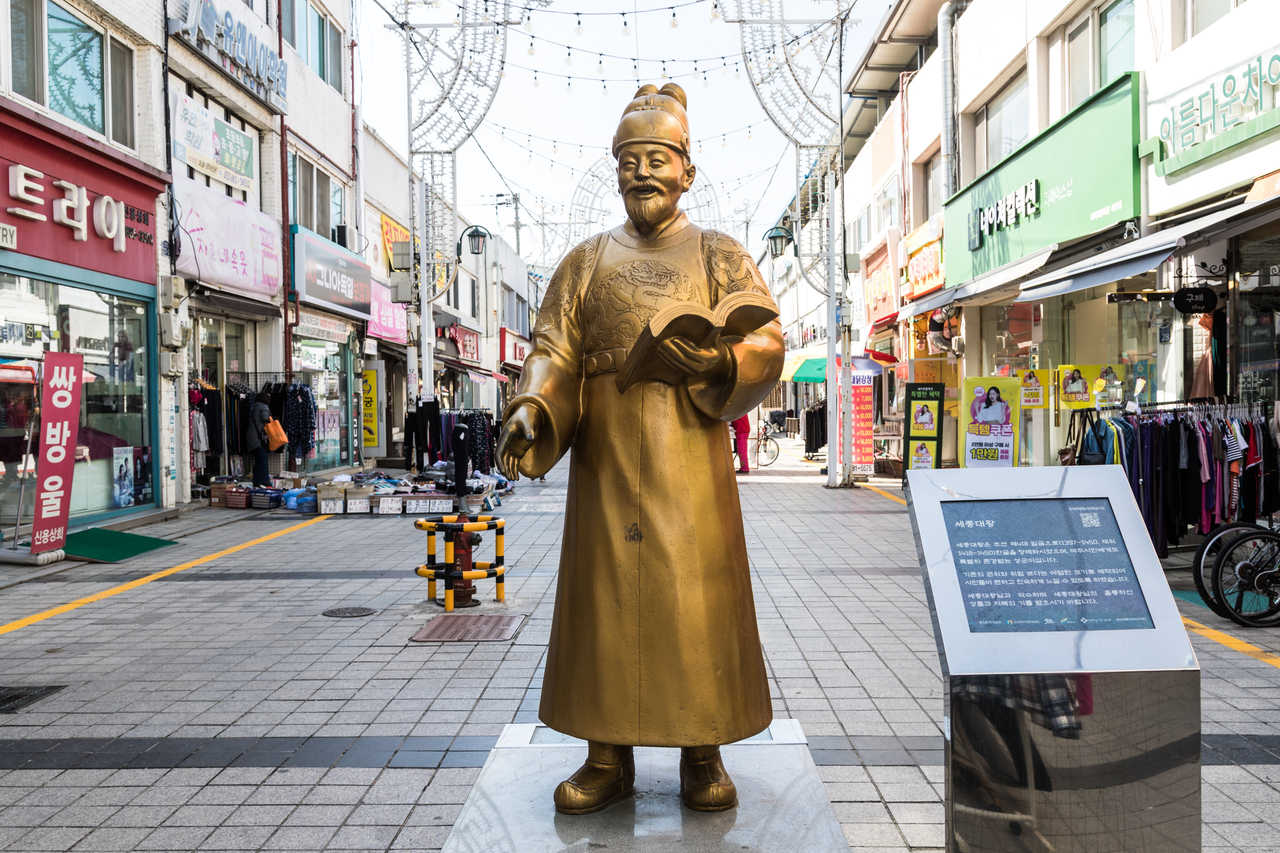
Koreans across multiple generations share a common view on youth slang: enjoy it in small doses, but try to hold back.
Survey firm NowNSurvey said Friday it conducted an online poll of 1,002 adults aged 19 and older nationwide just before Hangul Day, presenting respondents with 20 Korean neologisms — including "gat-saeng" (living one's best productive life), "aljalddalkkalsен" (a shorthand for doing something just right), and "lucky vicky" (an expression of good fortune) — and asking them to select all the terms they knew. On average, respondents said they recognized 9.1 of the 20 terms, with a median of eight.
The result was notably high given that respondents aged 40 and older made up nearly two-thirds of the sample.
On the question of neologism use, 54.3% of respondents chose "they're fun, but excessive use should be avoided" — the top response across every age group.
The average number of terms recognized fell steadily with age: those in their 20s or younger knew 14.6 on average, followed by 11.5 for those in their 30s, 9.1 for those in their 40s, 7.2 for those in their 50s, and 4.5 for those aged 60 and older — a gap of 10.1 terms between the youngest and oldest groups. Women recognized more terms on average (11.3) than men (7.6), and that gap held across all age groups.
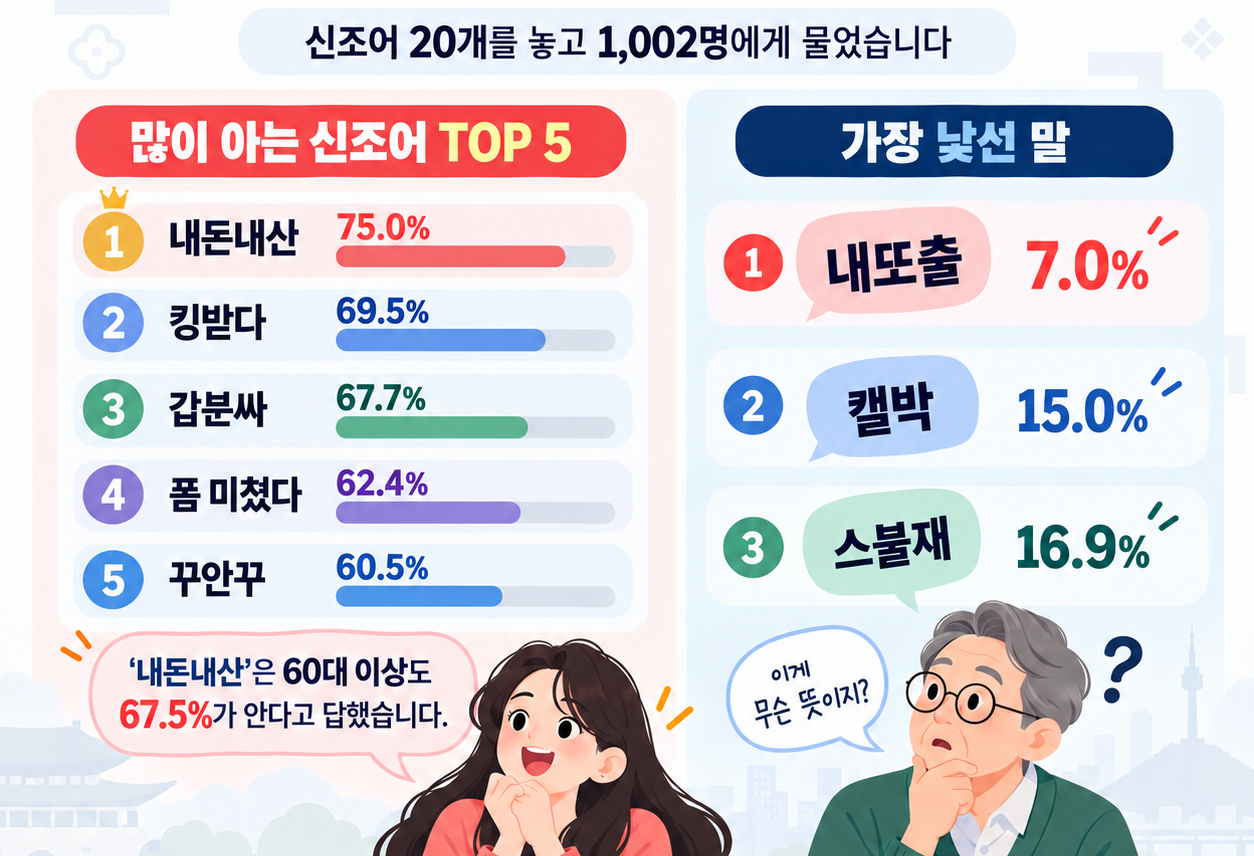
The most widely recognized term was "naedonnaesan" — meaning a purchase made with one's own money, often used in product reviews to signal no sponsorship — at 75.0%, followed by "king-batda" (to feel intensely annoyed, 69.5%), "gapbunssa" (an abrupt mood kill, 67.7%), "pom michyeotda" (incredible form or performance, 62.4%), and "kkuankku" (effortlessly stylish, 60.5%). Even among respondents aged 60 and older, 67.5% said they knew "naedonnaesan." At the other end, "naettochul" (yet another day at the office, 7.0%), "kaelbaek" (adding an event to one's calendar, 15.0%), and "seubuljae" (a situation one brought upon oneself, 16.9%) had the lowest recognition rates.
The widest generational gap belonged to "jeommechu" — short for "recommend a lunch menu" — where 80.2% of those in their 20s or younger recognized it compared with just 6.6% of those aged 60 and older, a gap of 73.6 percentage points. Large gaps also appeared for "eoktен" (70.9 percentage points), "aljalddalkkalsен" (69.9 percentage points), "lucky vicky" (67.3 percentage points), and "ounwan" (a completed workout, 65.0 percentage points). Across all 20 terms surveyed, recognition was highest among those in their 20s or younger and lowest among those aged 60 and older.
Beyond the top response, 18.6% said neologisms are "negative because they make communication between generations harder," 13.3% said they "should simply be used as appropriate to the situation," and 10.1% said they are "positive as a natural evolution of language."
The share viewing neologisms negatively varied sharply by age — 7.9% among those in their 20s or younger versus 33.1% among those aged 60 and older. Familiarity also mattered: 28.3% of respondents who recognized five or fewer terms said they viewed neologisms negatively, compared with just 6.1% of those who recognized 16 or more.
When asked what they found most uncomfortable in everyday language, respondents most often cited "youth neologisms and abbreviations" at 39.6%, followed by "internet and social media memes and trending expressions" at 14.3%. Some 11.6% said nothing in particular bothered them. Discomfort with neologisms and abbreviations was highest among those aged 60 and older at 54.3%, and lowest among those in their 20s or younger at 18.8%.
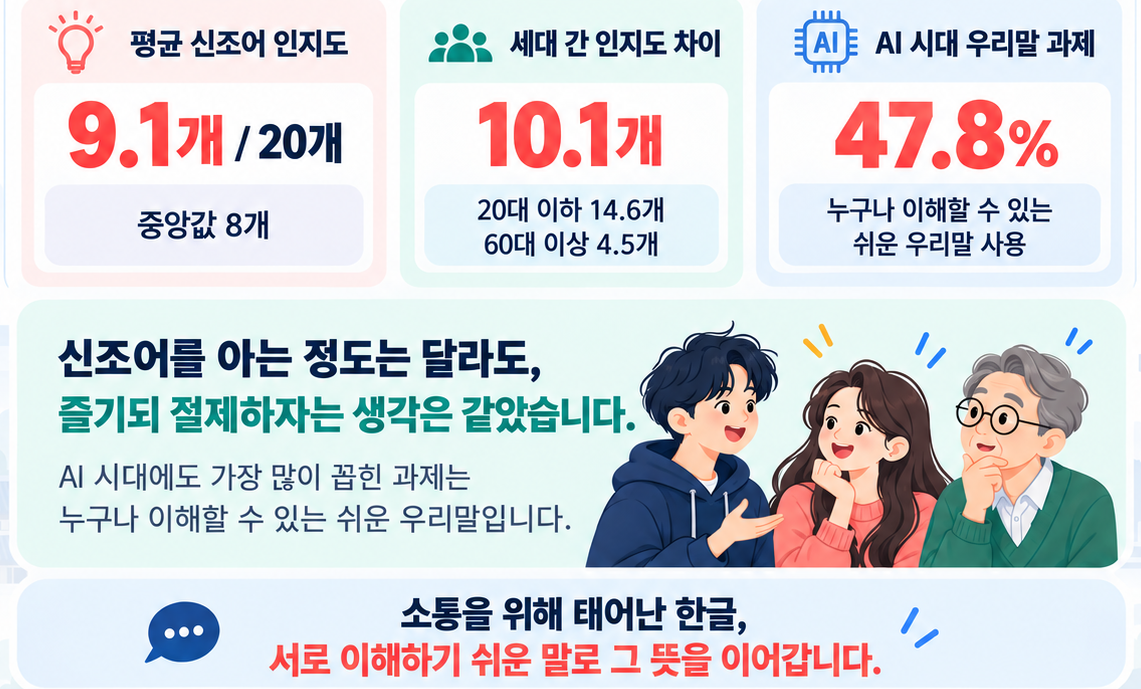
Asked what matters most for Korean-language use in the age of AI, respondents ranked "using plain Korean that anyone can easily understand" first at 47.8%, followed by "accurate spelling and grammar" at 24.2%, "understanding neologisms suited to the new era" at 12.7%, and "reducing excessive use of English and foreign loanwords" at 9.1%. Among those aged 60 and older, 62.3% chose plain Korean as the top priority, while among those in their 20s or younger, accurate spelling and grammar (35.6%) edged out plain Korean (28.7%).
"The generational gap in neologism awareness was wide, but the shared belief — enjoy the slang, yet exercise restraint — cut across every generation," a NowNSurvey official said. "We hope this Hangul Day becomes an occasion to reflect on the spirit of hangul, which was created for communication."
The survey sample comprised 586 men (58.5%) and 416 women (41.5%). By age group, 101 respondents were in their 20s or younger, 254 in their 30s, 259 in their 40s, 237 in their 50s, and 151 aged 60 and older.
abc@heraldcorp.com