Pivots from pure EV to HEV and EREV
US market share hits record 12.9%
China repositioned as local development hub
Robots targeted as mass-production industry by 2028
Assets up 37%, sales up 59%, headcount up 21%
Strategy stays nimble as the group grows larger
![Hyundai Motor Group Chairman Euisun Chung speaks at the GV90 World Premiere held at the Palace of Fine Arts in San Francisco on Aug. 19 (local time). [Genesis]](https://wimg.heraldcorp.com/news/cms/2026/10/08/news-p.v1.20260820.c427160f349f4c58931e204a6cf4fcd5_P1.jpg)
"Innovation can only be realized when we boldly change the way we work and break the mold."
That was the message Hyundai Motor Group Chairman Euisun Chung delivered to employees at this year's New Year's gathering. As Chung marks the sixth anniversary of his chairmanship on Wednesday, one word captures the defining thread of his leadership: flexibility. He has consistently pushed the group to adapt its working methods to shifts in markets and technology — and, when necessary, to adjust the pace of its business.
Chung had been championing a "flexible corporate culture" since his days as vice chairman in 2019, industry sources said. In his 2023 New Year's address, he urged employees to "make flexible ways of working a part of daily life," warning that "a culture that stops changing is easily corrupted."
Shortly after taking the helm in October 2020, he placed the group's transformation from an automaker into a smart mobility solutions company at the center of its agenda.
That goal remains intact. But over six years, the environment surrounding Hyundai Motor Group has changed far faster than anticipated. The group has navigated the COVID-19 pandemic, a semiconductor supply crunch, a slowdown in electric vehicle demand, a withdrawal from the Russian market, rising protectionism led by the United States, and the rapid ascent of Chinese rivals — one challenge after another. Through it all, Chung's strategy has evolved away from defending a single answer and toward expanding the group's options in step with the market.
HEV and EREV over EV dogma, localization in China: strategy over stubbornness
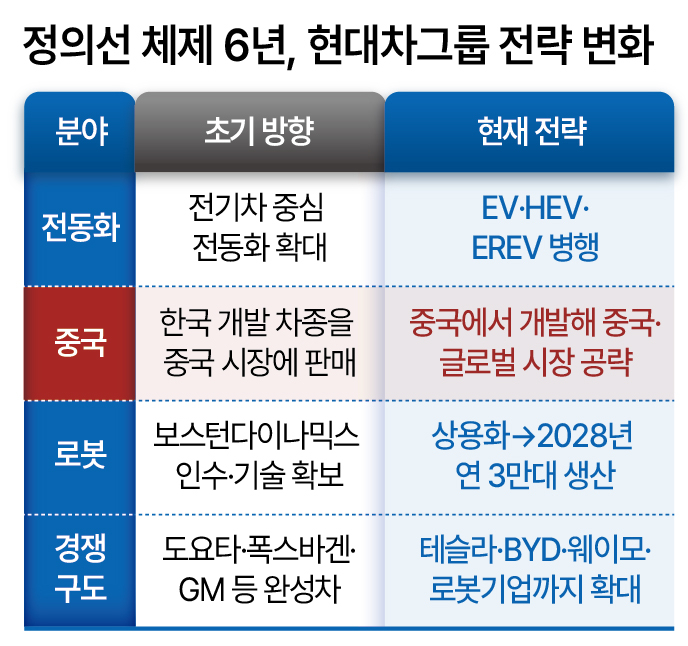
The electrification strategy is the clearest example. While some global automakers pressed ahead with an all-in EV approach, Hyundai Motor Group moved early to build up its hybrid lineup alongside electric vehicles, hedging against a demand lull. Even as EV investment continued, the group rapidly expanded its hybrid lineup and production capacity once the slowdown materialized, and added extended-range electric vehicles as yet another option.
While Hyundai Motor Group moved nimbly under Chung's direction, rivals that were slow to respond to the EV demand slowdown found themselves facing deteriorating earnings and restructuring. Volkswagen Group's operating profit fell 53 percent last year from the year before and is expected to drop more than 65 percent this year. The German automaker is also weighing a reduction of 100,000 jobs and the closure of four factories in Germany. Ford posted an operating loss of $4.8 billion in its EV business last year, while Honda, burdened by mounting EV investment costs, halted development of three North American EV models this year and shifted its focus back to expanding its hybrid lineup.
![Chairman Euisun Chung visits Hyundai Motor's Brazil factory in July to review vehicles with employees. [Hyundai Motor]](https://wimg.heraldcorp.com/news/cms/2026/10/08/news-p.v1.20260915.38144444ebc147d99d1a98caf83d1aa1_P1.jpeg)
Hyundai Motor and Kia ranked third in US monthly market share for two consecutive months in July and August, hitting a record high of 12.9 percent in August. Their combined share for the January–August period reached 11.8 percent, narrowing the gap with third-ranked Ford — at 12.2 percent — to just 0.4 percentage points.
In China, the group has moved away from its previous practice of deploying global models in the local market, adopting a new strategy this year framed as "in China, for China, toward the world." The idea is to develop vehicles tailored to Chinese consumer tastes locally, then leverage that work into global competitiveness.
Hyundai Motor and BAIC Motor agreed to jointly invest 8 billion yuan ($1.19 billion) in Beijing Hyundai and launch 20 new models over the next five years — effectively redefining China as a hub for electric vehicle and software development.
After cars, robots: building a second mass-production industry
Chung's flexible leadership comes into sharpest focus beyond the traditional automotive business.
When Hyundai Motor Group acquired Boston Dynamics in 2021, the move was met with skepticism — why would a car company buy a robotics firm? At CES in January this year, the group provided its answer, formally declaring its ambition to become a "physical AI company." The humanoid robot Atlas, in particular, has become the symbol of a strategy to cultivate robotics as a new growth engine alongside automobiles.
![Hyundai Motor Group Chairman Euisun Chung speaks at Kia's 80th anniversary ceremony held at Kia Vision Square in Yongin, Gyeonggi Province, last December. [Hyundai Motor Group]](https://wimg.heraldcorp.com/news/cms/2026/10/08/news-p.v1.20251209.09e2fb224eb743619b0c93edb3629e16_P1.jpg)
The group is also accelerating local production. Starting in 2028, Hyundai Motor Group plans to establish a robot manufacturing system in the United States with an annual capacity of 30,000 units. The plan calls for validating robots first at the group's own manufacturing sites, then channeling the accumulated data and mass-production experience into product improvements and external sales.
A bigger group, a wider battlefield — and flexibility matters more than ever
Markets are watching Chung's flexible leadership with more anticipation than anxiety. The competitive landscape has expanded well beyond traditional automakers such as Toyota, Volkswagen and General Motors to encompass robotaxis, AI and robotics. The group supplies Ioniq 5 vehicles for robotaxi use to Waymo, Google's autonomous driving subsidiary, while its humanoid ambitions draw comparisons with Tesla, Figure AI and Agility Robotics. As the group's business scope widens, the boundaries between competition and cooperation have grown more complex.
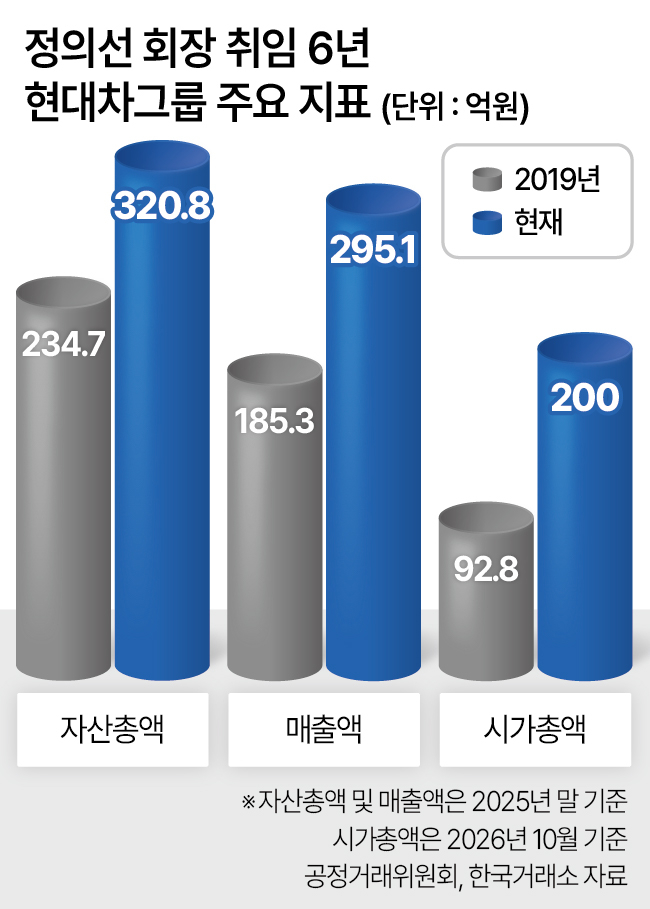
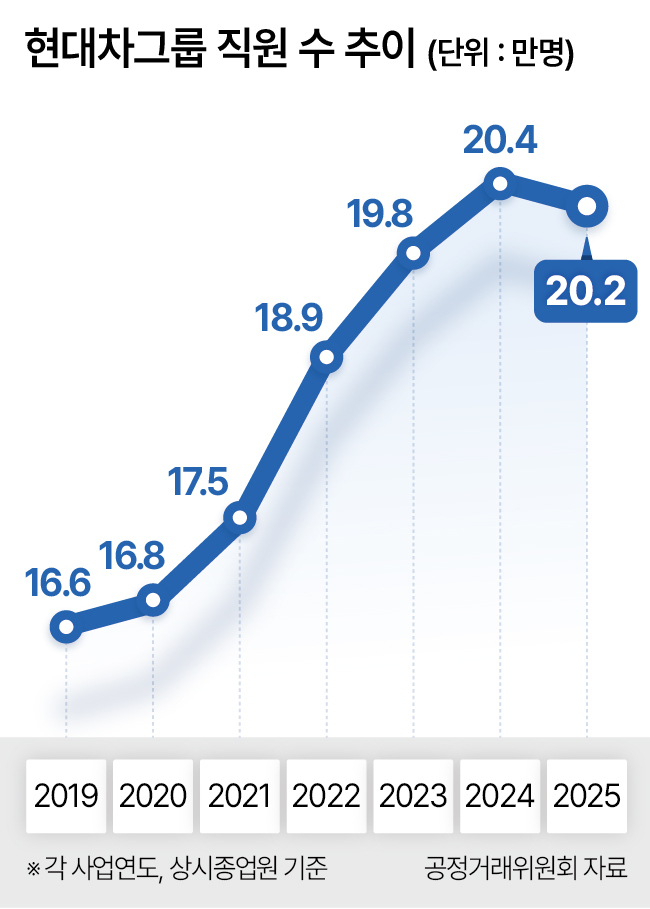
The group's scale has also grown considerably since Chung took office. Total assets rose 37 percent, from 235 trillion won ($175 billion) in 2019 to 321 trillion won last year, while sales climbed 59 percent over the same period, from 185 trillion won to 295 trillion won. The workforce expanded 21 percent, from 166,000 to 202,000 employees, and market capitalization now stands at around 200 trillion won — more than double its earlier level.
![Hyundai Motor Group Chairman Euisun Chung and Nvidia CEO Jensen Huang pose for a photo with a quadruped security robot (left) and the mobile robot platform MobED after a meeting at Hyundai Motor's headquarters in Seocho-gu, Seoul, on June 8. [Yonhap]](https://wimg.heraldcorp.com/news/cms/2026/10/08/rcv.YNA.20260608.PYH2026060816880001300_P1.jpg)
The larger the group grows, the harder it becomes to change course quickly — yet Chung has pursued a first-mover posture while refusing to cling to existing strategies when market conditions shift.
Outside observers have taken note. Nvidia CEO Jensen Huang, during a visit to Hyundai Motor Group in June, said: "This is Hyundai's moment. When everything you have built and your expertise combines with AI, explosive change will follow."
kwater@heraldcorp.com