Gulf oil exports recover to 81% of pre-war levels
Crude at 91%, but refined products stuck at 60%
Tanker rates from Middle East to Asia top $1.2 million a day
'Bottleneck has shifted from crude supply to transport and refining'
![Oil tankers transit the Strait of Hormuz. [Reuters]](https://wimg.heraldcorp.com/news/cms/2026/10/08/news-p.v1.20260812.7c8bd03096e5460594460ea15fedd815_P1.jpg)
Middle East crude exports, choked off by the Iran war, are recovering quickly. Gulf oil producers have pushed combined crude and petroleum product shipments back above 80% of pre-war levels, with crude alone surpassing 90%.
Yet international oil prices remain around $100 a barrel. The problem is no longer a shortage of crude in the ground — it is the soaring cost of moving it safely and refining it into gasoline, diesel and jet fuel. Analysts say the Iran war has shifted the global oil market's bottleneck from crude supply to transportation and refining.
According to Reuters on Tuesday (local time), Gulf producers excluding Iran — Saudi Arabia, the UAE, Kuwait, Qatar, Oman, Bahrain and Iraq — exported an average of 19.2 million barrels per day of crude, condensate and refined products in September.
That is 81% of the 23.6 million barrels per day averaged in the year before the war began on Feb. 28.
Crude and condensate exports in particular have recovered to 91% of pre-war levels. Fears that a Strait of Hormuz blockade would trigger a global crude shortage have eased as producers found new shipping routes and lifted export volumes faster than expected.
Saudi Arabia's rebound has been especially sharp. Its crude and condensate exports jumped from roughly 2.4 million barrels per day in August to 6.6 million barrels per day in September — a gain of 4.2 million barrels per day. Rising exports from the UAE and Iraq offset much of the shortfall from other Gulf producers.
Crude flows through the Strait of Hormuz are also picking up. According to market research firm Kpler, crude passing through the strait as of Sept. 26 stood at a seven-day moving average of 14.2 million barrels per day, recovering to roughly 80% of pre-war levels.
![Diesel prices are climbing steeply in the United States, where the fuel is a staple for working-class drivers. A gas station in Encinitas, California, displays its diesel prices. [Reuters]](https://wimg.heraldcorp.com/news/cms/2026/10/08/news-p.v1.20260921.5fd105c2227040329b6549b7874e4fcf_P1.jpg)
But oil prices have not normalized as quickly as shipment volumes. Brent crude, which traded around $70 a barrel before the war, has remained near $100 in recent weeks.
One of the biggest reasons is a surge in shipping costs.
With tankers transiting the Strait of Hormuz coming under attack, the traditional model — large crude carriers sailing directly from Gulf producers to Asia — has become untenable.
In its place, "shuttle transport" has spread: a tanker carries crude out of the Strait of Hormuz into the Gulf of Oman, where the cargo is transferred to another vessel before continuing to Asia.
Tying up multiple ships for a single cargo delivery has deepened a global shortage of large tankers. Asian refiners buying crude from the United States, South America and West Africa instead of the Middle East have also lengthened average voyage distances.
As a result, freight rates for very large crude carriers (VLCCs) on the Middle East-to-Asia route have recently topped $1.2 million per day — roughly 40 times the approximately $30,000 per day recorded in January.
Shipping costs as a share of the delivered price of crude have risen from about 3% before the war to roughly 27% today.
Some analysts warn that the shipping crunch could worsen in the short term as more crude moves through the Strait of Hormuz. If export volumes increase before traditional routes are fully restored, demand for shuttle tankers will rise in tandem.
Saudi Arabia is also mobilizing its overland pipeline network to reduce dependence on the Hormuz route.
The East-West Pipeline, which carries crude from Saudi Arabia's eastern oil fields to the Red Sea port of Yanbu, has become a key artery. Saudi Energy Minister Prince Abdulaziz bin Salman said Tuesday that throughput on the pipeline had risen to 5.8 million barrels per day.
About 4 million barrels per day — roughly 4% of global crude supply — are now being rerouted through the pipeline.
But that bypass is not safe either. The East-West Pipeline was knocked offline last month after a drone strike before being brought back into service. Even after crude reaches the Red Sea, it must pass through the Bab el-Mandeb strait, where it faces attack from Yemen's Houthi forces.
Avoid Hormuz and the Red Sea awaits; take the Red Sea and the Houthis are waiting.
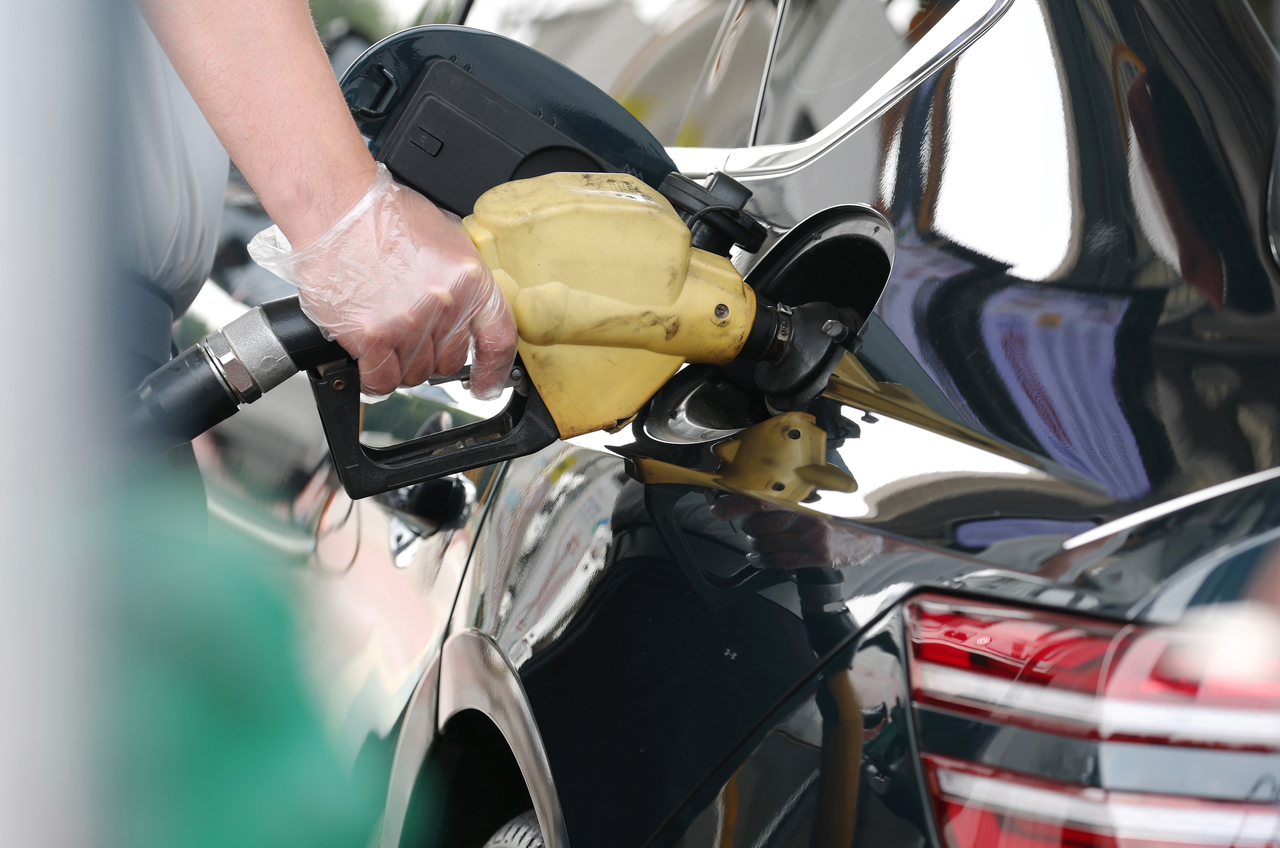
The bigger problem, however, lies not with crude but with refined products such as diesel and jet fuel.
While Gulf crude and condensate exports have recovered to 91% of pre-war levels, exports of refined products and liquefied petroleum gas (LPG) remain at roughly 60% of the pre-war daily average of 7.3 million barrels.
Disruptions at Middle Eastern refineries, compounded by damage to Russian refining facilities from Ukrainian strikes, have shaken global refined-product supply chains simultaneously.
Diesel is a particular concern: it powers trucks, ships, farm equipment and factories across virtually every sector of the economy, meaning price increases there can ripple through to broader inflation.
Russell Hardy, CEO of Vitol, the world's largest independent oil trader, said the Middle East is currently producing about 12 million barrels per day of crude and 2 million barrels per day of refined products.
Hardy said the market's problem has shifted from a crude shortage to a refined-products and shipping crisis as crude supply recovers. He added that the supply shortfall in refined products could persist through winter.
That concern is part of why the G7 agreed to release 100 million barrels of crude and diesel from strategic reserves. Critics note, however, that releasing stockpiles cannot quickly repair damaged refineries or conjure additional tankers.
The war has also prompted calls within the global oil industry to rethink the "just-in-time" supply model built up over decades.
TotalEnergies CEO Patrick Pouyanné and other senior energy industry executives have argued that investment must be expanded in alternative export routes — such as a pipeline linking Iraq to Syria and the UAE's Fujairah port — to reduce dependence on chokepoints like the Strait of Hormuz and the Bab el-Mandeb.
Debriefing: The Korea Herald's international desk breaks down the hidden stories behind the hottest global issues. Leave your questions in the comments.
sjy@heraldcorp.com