Intel Foundry executive vice president
100 days in: 'Happy to be back home'
Visits US, Malaysia and Vietnam sites in sweeping tour
Focused on scaling EMIB-T and hybrid bonding production
Intel bets on Lee to rebuild foundry, challenge Samsung
![Intel CEO Lip-Bu Tan (left) and Lee Suk-hee, executive vice president of Intel Foundry. [Lip-Bu Tan's social media]](https://wimg.heraldcorp.com/news/cms/2026/10/08/news-p.v1.20261008.fd55b39566284105b3a8a16e8ce20a61_P1.jpg)
Lee Suk-hee, executive vice president of Intel Foundry, said he confirmed the division's strong capabilities during a sweeping tour of global sites in his first 100 days back at the company.
Overseeing Intel's advanced packaging business and leading the foundry's rebuilding effort, Lee expressed excitement about the opportunities ahead — a confidence that has drawn attention to the emerging rivalry with Samsung Electronics' foundry division.
Lee marked the 100-day milestone with a post on his social media account Wednesday.
"I'm really happy to be back home," he wrote, adding that he had spent time with teams around the world. "I've been deeply impressed by the outstanding capabilities and passion for technology that our employees have shown."
He said he visited advanced packaging research and development sites in Arizona contributing to next-generation computing technology, and met with local foundry management in Malaysia, where he toured Intel's latest advanced packaging facility, Pelican.
In Oregon, he suited up in a cleanroom outfit to walk through a hybrid bonding production line, and reunited with longtime friends and colleagues from his earlier days in Intel's technology development organization.
Lee said he plans to visit Intel facilities in New Mexico and Vietnam in the near future, signaling a continued push to survey the company's global footprint. Intel operates advanced packaging facilities in New Mexico and semiconductor assembly and test facilities in Ho Chi Minh City.
"I will focus on leading the team while also learning from them, and on earning the trust of our customers and partners," he said. "I'm very excited about the opportunities that lie ahead of us."
![Lee Suk-hee, executive vice president of Intel Foundry. [Lee Suk-hee's social media]](https://wimg.heraldcorp.com/news/cms/2026/10/08/news-p.v1.20261008.cbfa9788d2e54c4f97f2f1183d408177_P1.png)
Lee worked at Intel as an engineer from 2000 to 2010. He joined SK hynix as an executive vice president in 2013 and served as its president and CEO from 2018 to 2022, leading SK Group's semiconductor business.
During his tenure at SK hynix, he spearheaded the acquisition of Intel's NAND flash memory business for 10 trillion won ($7.47 billion), a deal that renewed attention to his ties with Intel. The company SK hynix established after acquiring that business — Solidigm — is now being discussed as a candidate for a NASDAQ listing.
Lee also served as CEO of SK On, leading SK Group's battery business from 2023 until May this year. His return to Intel drew wide attention after he resigned and officially rejoined the company in June.
Intel CEO Lip-Bu Tan described Lee as "an executive who achieved great success as CEO of SK hynix," saying he would oversee the development of Intel's advanced packaging technology and drive new system integration projects.
In his 100-day reflection, Lee confirmed the mandate himself. "CEO Lip-Bu Tan brought me back to accelerate the scaling of advanced packaging technologies, including EMIB-T and hybrid bonding," he wrote. "That is what I am focused on right now."
Intel's EMIB-T — short for Embedded Multi-die Interconnect Bridge with Through-Silicon Via — is a 2.5D next-generation packaging technology positioned as a rival to TSMC's CoWoS-L, the Taiwanese chipmaker's own 2.5D packaging solution.
The technology improves on the original EMIB by inserting through-silicon vias to enhance power efficiency and signal performance. Google is expected to adopt EMIB-T in its next-generation AI accelerator, the Tensor Processing Unit, in the second half of next year.
![An Intel foundry facility under construction in New Albany, Ohio. [Intel Foundry's social media]](https://wimg.heraldcorp.com/news/cms/2026/10/08/news-p.v1.20261008.1c7382a19a824d6790bf9c373529b796_P1.jpg)
Intel re-entered the foundry market in 2021 with a pledge to rebuild the business, setting a goal of surpassing Samsung Electronics to become the world's second-largest foundry by 2030.
Backed by the Trump administration's America-first industrial policy, Intel is competing with Samsung Electronics for orders from major US fabless chip designers, including Nvidia, Tesla and Apple.
In May, reports emerged that Apple had held talks with both Samsung Electronics and Intel over outsourcing production of the main processor for the iPhone.
To sharpen its foundry competitiveness, Intel brought in Lee, the former SK hynix president, as executive vice president of its foundry division, with a focus on strengthening advanced packaging capabilities.
Intel Foundry announced last October that it had begun mass production on its 18A (1.8-nanometer-class) process — ahead of both Samsung Electronics and TSMC — and is now pushing to enter the leading-edge 14A (1.4-nanometer) process, targeting mass production by 2028.
Samsung Electronics plans to enter the 1.4-nanometer node in 2029, while TSMC has set a target of beginning mass production at that node in 2028.
Intel has also emerged as a threat to Samsung Electronics after agreeing to supply its 14A process for Elon Musk's large-scale semiconductor factory initiative, known as the Terafab project.
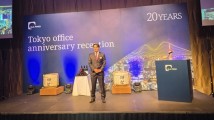
Intel CEO Lip-Bu Tan, in an interview with Bloomberg ahead of a ceremony in Tokyo on Wednesday marking Intel's 50th anniversary in Japan, said the company would continue its participation in the Terafab project, emphasizing the partnership remains firmly in place.
joze@heraldcorp.com