Gyeonggi apartment jeonse deals: 10,659 of 22,913 in September
Jeonse share down 7 percentage points from 53.5% in January
Guri tumbles from 70% to 53% as monthly-rent shift picks up pace
![A view of the transit-oriented area around Guri Station in Gyeonggi Province. [Herald DB]](https://wimg.heraldcorp.com/news/cms/2026/10/08/news-p.v1.20260630.1dda91ca57d84392969782d9178d9155_P1.jpg)
With Land Minister Hong Ji-sun describing the disappearance of jeonse — South Korea's lump-sum deposit rental system — as a "megatrend," the share of jeonse transactions among apartment rentals in Gyeonggi Province has now fallen below 50%, following a similar decline in Seoul. Analysts say the shift reflects a supply shortage that has pushed Seoul's jeonse crunch into the wider metropolitan area, compounding a trend in which tenants priced out by soaring jeonse deposits are either switching to monthly-rent arrangements or buying homes outright as a last resort.
According to the Gyeonggi Real Estate Portal, a total of 22,913 apartment lease transactions were recorded in Gyeonggi Province last month, of which 10,659 were jeonse deals. That put the jeonse share at roughly 46.5%, down 7 percentage points from 53.5% in January — a drop over just eight months. After holding in the 50-percent range for most of this year, the jeonse share in Gyeonggi apartments slid from 51.5% in June and July to 50.2% in August and then to 46.5% last month.
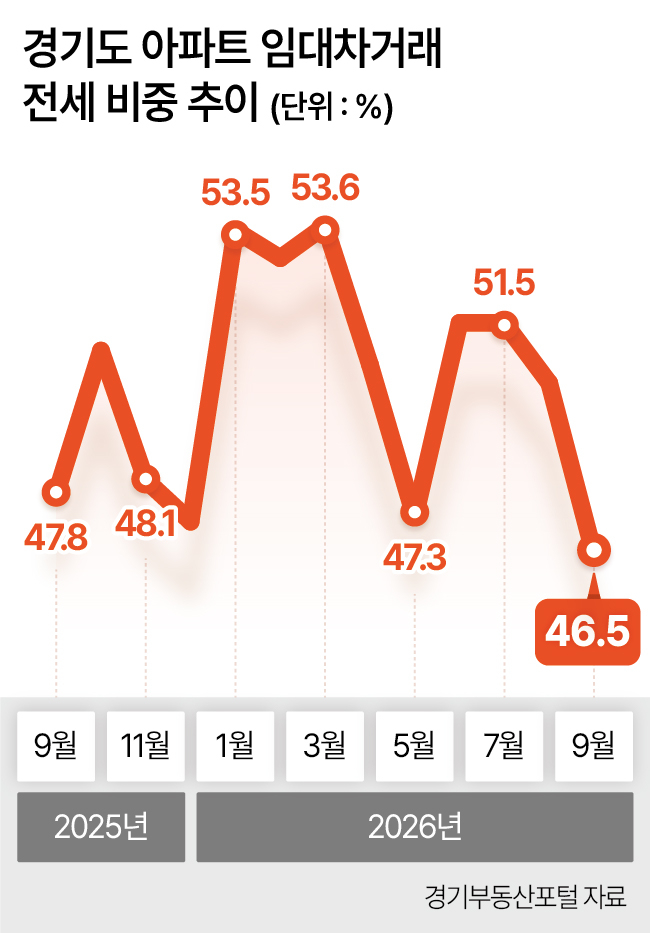
Breaking the figures down by district, 18 cities and counties in Gyeonggi Province recorded a jeonse share below 50% last month, up from 12 in January.
The steepest declines were seen in Hwaseong and Guri, both designated as land transaction permit zones subject to owner-occupancy requirements in July. The jeonse share in Hwaseong — home to the Dongtan new town — plunged from 49.9% in January to 26.1% last month, meaning roughly one in four apartment lease deals there was a jeonse contract. Guri's share shrank from 69.5% to 52.7% over the same period.
Goyang, a high-demand residential city centered on the Ilsan district, saw its jeonse share fall more than 10 percentage points, from 59.4% to 49.1%. Gwacheon, which had a jeonse share of 56.7% in January, dropped to 45.3%. Cities in northern Gyeonggi Province — including Pocheon, Dongducheon and Uijeongbu — also saw their jeonse shares fall sharply below 50%.
The rapid erosion of the jeonse share across Gyeonggi Province is largely attributed to jeonse demand spilling over from Seoul. Tighter jeonse loan regulations introduced since late last year, combined with higher interest rates that have raised borrowing costs, have accelerated the shift toward monthly-rent and semi-jeonse arrangements. Rising jeonse deposits have also pushed more tenants to buy smaller apartments outright, further reshaping the metropolitan rental market away from its traditional jeonse-centered structure.
Ko Jun-seok, a professor at Yonsei University's Sangnam School of Management, said several factors are shrinking the supply of jeonse listings in Gyeonggi Province, including the expansion of land transaction permit zones, heavier taxes on non-resident single-homeowners, and the loss of benefits following the deregistration of rental business operators. "As jeonse listings dry up, tenants have no choice but to move to monthly rent or push further out to the suburbs, deepening housing insecurity," he said.
Available jeonse listings in Gyeonggi Province have indeed been falling sharply. According to Asil, a real estate big data platform, Gyeonggi apartment jeonse listings stood at 12,639 on Thursday, down 36.7% from 19,975 a year earlier. The volume of jeonse transactions also fell, dropping from 15,796 in September last year to 10,659 last month — a decline of more than 5,000 deals.
The government has characterized the trend as an unavoidable structural shift in the rental market. Land Minister Hong said at a National Assembly audit of the Ministry of Land, Infrastructure and Transport on Wednesday that "the disappearance of jeonse is a megatrend," citing the rise of single-person households and the lingering fallout from jeonse fraud. President Lee Jae Myung made a similar observation at a press conference in June, calling jeonse "a form of private finance unique to South Korea that is now fading away" and saying the decline in jeonse supply is a natural part of a normalization process.
Market observers, however, warn that a vicious cycle is taking hold — rental instability drives distressed home purchases, which in turn reduces jeonse supply — and are calling on the government to reconsider regulations that are accelerating the depletion of jeonse listings.
"The shift from jeonse to monthly rent that we are seeing in the market today is a phenomenon occurring within a framework of regulation," Ko said. "In areas with strong rental and end-user demand, policymakers need to take another look at three key factors: the registered rental business system, the treatment of non-resident single-homeowners, and the land transaction permit system."
hwshin@heraldcorp.com