Finance committee sparks debate over single-stock leveraged ETFs
PPP raises equity concerns over government's mega projects
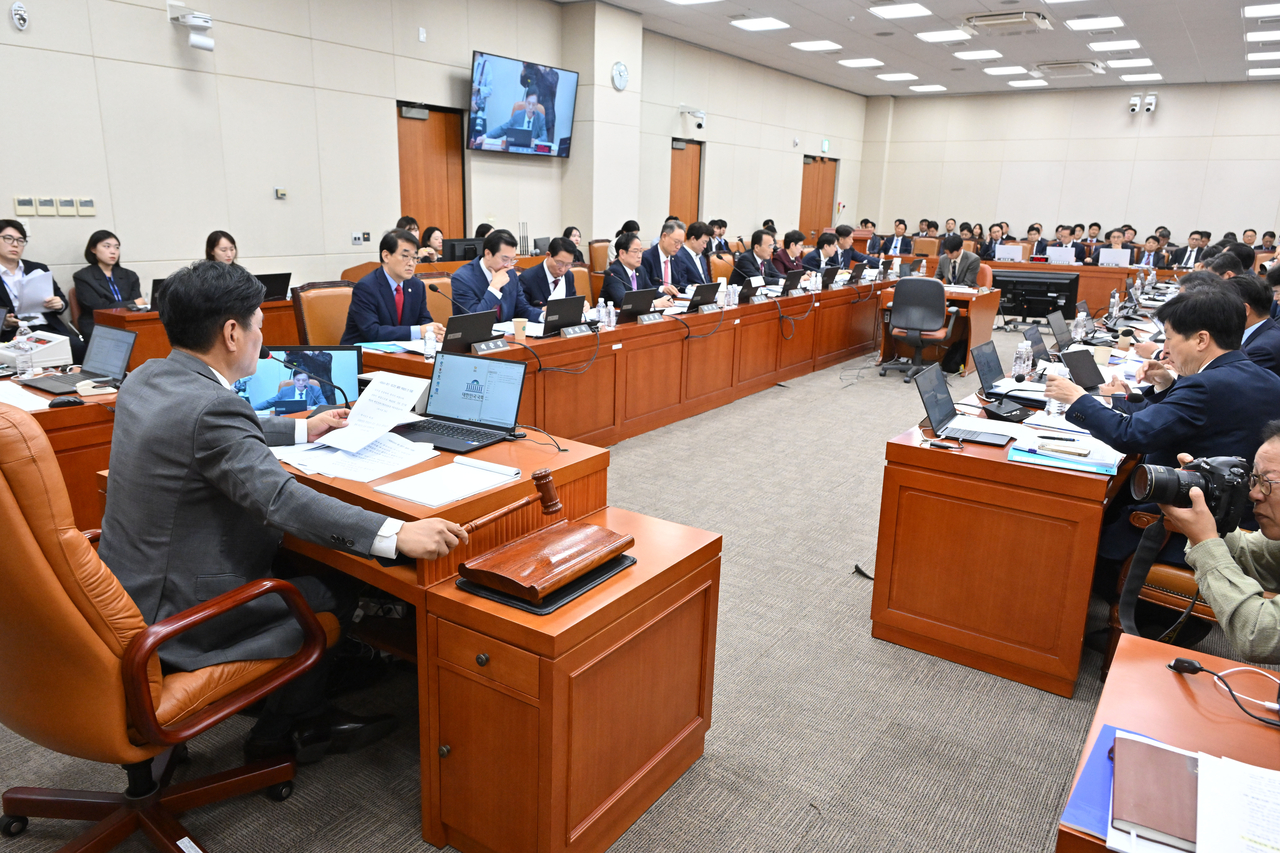
Ruling and opposition parties clashed across multiple standing committees Tuesday as the second year of the Lee Jae Myung administration's national audit got under way. Disputes ranged from the introduction of single-stock leveraged exchange-traded funds to a government investment project targeting the United States and the administration's three flagship mega projects.
At the Finance and Economy Planning Committee's audit of the Ministry of Economy and Finance, the controversy over single-stock leveraged ETFs emerged as a central flashpoint.
The People Power Party argued that officials involved in reviewing the products should be held accountable. Rep. Bae Jun-young, who leads the PPP's side on the committee, said Finance Minister Lee Hyeong-il and Vice Minister Kwon Dae-young were "key figures" who had attended a meeting at Cheong Wa Dae on Jan. 13 chaired by former policy chief Kim Yong-beom — serving at the time as vice minister of the Ministry of Economy and Finance and vice chairman of the FSC, respectively — and had subsequently reviewed the ETF introduction alongside executives from major brokerages and asset management firms.
The Democratic Party pushed back, arguing that single-stock leveraged ETFs were a matter for the Political Affairs Committee or the Administration and Governance Committee rather than the Finance and Economy Planning Committee.
Rep. Oh Gi-hyeong of the Democratic Party, who leads his party's side on the committee, said financial regulatory issues such as those surrounding single-stock leveraged ETFs would more naturally fall under the Political Affairs Committee, which handles oversight of financial markets and financial products related to industry promotion.
Both parties also pressed the government over its recently unveiled US investment project, questioning the specificity of the plan and the prospects for recovering the funds. Concerns were raised that the initiative was moving forward before its targets and structure had been sufficiently defined.
Democratic Party Rep. Jeong Seong-ho said it made no sense for the government to wait for requests from the American side before conducting its own review. "We are the investors," he said. "We need to be prepared on multiple fronts — how much we can actually invest, whether we can genuinely recover the funds, and how much loss we would have to absorb if the risks materialize."
PPP Rep. Lim Yi-ja also raised concerns about process and due diligence. "The problem is that these three US investment projects were presented as diplomatic achievements before the public and the National Assembly had a chance to properly scrutinize them, and it looks as though execution will follow immediately," she said. "Sending money without a demand contract, promising advance payments for a nuclear power plant project that has not even been finalized, and having the United States announce a project still under review as a confirmed investment — that is not strategy. It is a commitment made without any process."
At the Industry, Trade, Resources, SMEs and Startups Committee, opposition lawmakers kept up pressure over the government's three mega projects, with questions about the equitable distribution of budgets across regions and the feasibility of the initiatives.
PPP Rep. Jo Ji-yeon raised the issue of regional budget equity, noting that the Honam semiconductor project had been allocated 1.5 trillion won ($1.1 billion) — nearly 50 percent of the total mega project budget — while the Daegyeong region received just 14.84 billion won, or roughly 0.48 percent of the total.
PPP Rep. Yun Han-hong questioned the feasibility of the Honam semiconductor project. He said Samsung and SK hynix had submitted assessment reports to the government concluding that the project was not viable due to inadequate power supply, water resources and workforce. "Yet the government is ignoring that and pressing ahead," he said.
mp1256@heraldcorp.com