'Defectors risked their lives to find freedom'
'9 in 10 virtual asset hacks traced to North Korea — world-class capability'
Lawmaker urges government to abandon policy of deference toward Pyongyang
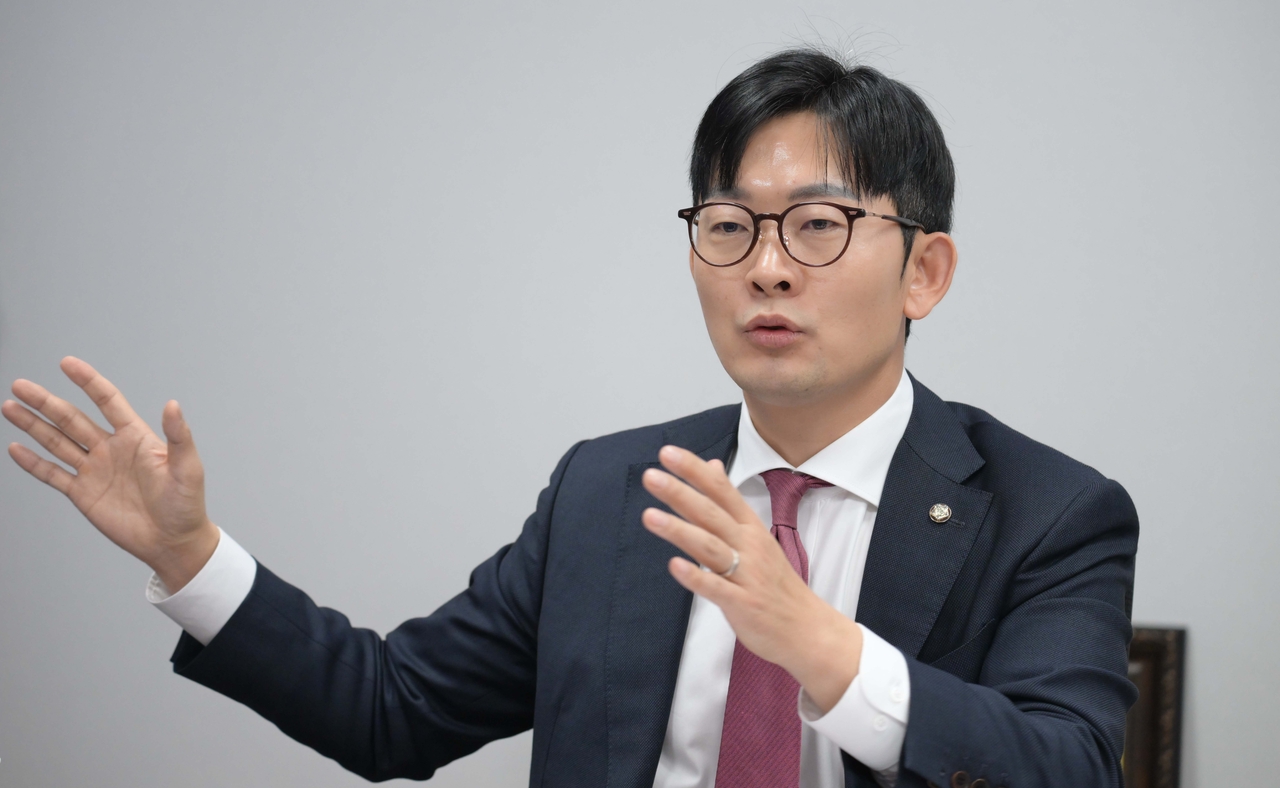
People Power Party lawmaker Park Chung-kwon sharply criticized Unification Minister Jeong Dong-young's proposal to replace the term "defector" with "north-bound people," saying the minister is trying to erase the history and identity of people who risked their lives to escape North Korea's dictatorship and find freedom.
"The Ministry of Foreign Affairs said the name change could undermine the persuasiveness of the non-refoulement principle, and the Ministry of Justice flagged possible confusion with North Hamgyong Province residents — yet the Unification Ministry is charging ahead on its own," Park said in an interview at the National Assembly Members' Office Building on Thursday.
Earlier that morning, Park had confronted Minister Jeong directly at a plenary session of the National Assembly's Foreign Affairs and Unification Committee. "Minister 'Bukdong-young,' why does the term need to be changed? Why is it acceptable to call me a 'north-bound person'?" Park demanded. Democratic Party lawmaker Lee Gi-heon fired back, asking, "Then can we call you 'Tal-chung-kwon'?" — prompting a heated exchange between the ruling and opposition parties.
Park was born in 1986 in Hamhung, South Hamgyong Province, and graduated from a North Korean gifted-student school before completing a degree at Kim Jong-un University of National Defense. He later worked at a munitions factory producing warheads for intercontinental ballistic missiles. After defecting in 2009, he earned master's and doctoral degrees at Seoul National University and spent seven years as a researcher at Hyundai Steel. He entered politics in 2023 after the People Power Party recruited him, winning a proportional-representation seat in the 22nd National Assembly.
In the interview, Park said North Korea's cyber capabilities have now reached the world's highest tier — and that South Korea's response has not kept pace. "Last year, there were 18,951 attempted cyberattacks targeting our military, the highest figure in the past five years," he said. "This year, an estimated 89 percent of global virtual asset hacking losses are believed to be the work of North Korea-linked organizations."
Drawing on his own education in the North, Park said the purpose of Pyongyang's cyberattacks has shifted. "At Kim Jong-un University, all students studied computer engineering through their second year regardless of major — and the very first chapter was hacking," he said. "The stated goal of hacking in that course was to neutralize US carrier strike groups. Now it has been repurposed as a funding stream to evade sanctions."
He added that North Korea has moved away from training generalist hackers and now develops specialists deployed unit by unit. "The weapons built with stolen capital ultimately become a threat to us, yet I see no one in the government with the awareness or the will to stop it," Park said.
Park also called on the government to change course on its North Korea policy. "Rather than responding firmly to Pyongyang's provocations, the government is busy reading North Korea's mood," he said. "Submitting to North Korea is not peace."
"True peace means making North Korea unable to even contemplate provocation," he added. "The government must first abandon its policy of submission toward the North."
mp1256@heraldcorp.com
raining@heraldcorp.com