Collaboration with four organizations
Full-cycle recycling system for waste banners
70% of 6,000 tons generated annually ends up in landfills or incinerators
Depolymerization technology to convert waste into raw material for new banners
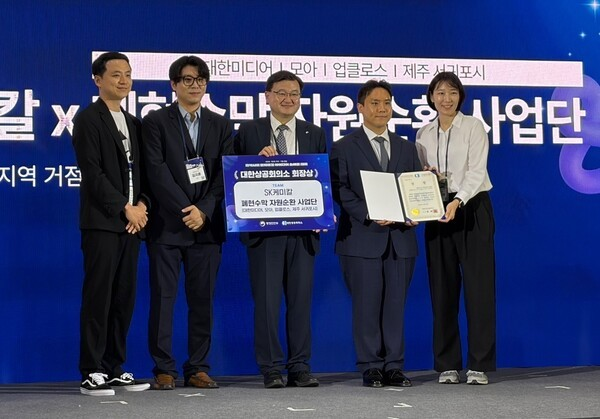
SK Chemicals announced Tuesday that it has formed a waste banner resource circulation consortium with MOA, Daehan Media, Upclose and the resource circulation team of Seogwipo City on Jeju Island.
The collaboration was prompted by a "waste banner processing and circular economy" challenge proposed at the Social Value Festa, an event co-hosted by the Korea Chamber of Commerce and Industry and the Ministry of Interior and Safety.
The four participating organizations will each handle collection of discarded banners in their respective regions and will work with SK Chemicals to build a full-cycle system — from recycling and product manufacturing to retail — drawing on each partner's expertise in preprocessing, distribution and sales.
MOA and Daehan Media will handle collection in the Gyeongsang provinces, Upclose will cover the Honam region, and Seogwipo City will be responsible for Jeju Island.
Upclose, which has experience operating collection and sorting systems through self-sufficiency centers, will also pursue local job creation by linking the project to employment of self-sufficiency program participants and workers with disabilities.
Collected banners will be sent to MOA, which specializes in preprocessing, where they will be processed into a form and quality suitable for chemical recycling. SK Chemicals will then apply its depolymerization technology to convert the material into raw feedstock, which will be remade into banner fabric.
Daehan Media will serve as the production partner for the chemically recycled banner fabric and will supply it to regions across the country through its nationwide sales network.
Seogwipo City plans to work alongside the consortium to reform relevant regulations so that the entire process — from collection to the reuse of chemically recycled banners — can be completed within the city.
SK Chemicals estimates that more than 1,000 tons of waste banners are generated annually across the Yeongnam, Honam and Jeju regions participating in the project.
The company also expects that establishing a regional waste banner resource circulation system will significantly reduce the volume sent to landfills or incinerators.
According to the Ministry of Climate, Environment and Energy, about 6,000 tons of waste banners are generated nationwide each year, with roughly 70 percent ending up in landfills or incinerators.
SK Chemicals' initiative is significant for creating a sustainable circular structure for waste banners through depolymerization technology.
Depolymerization breaks down waste plastics to the molecular level and reconverts them into raw material for repolymerization.
Unlike physical recycling methods, which can only process high-quality feedstock such as clear PET bottles, depolymerization makes it easier to recover value from a wide range of waste plastics, including fibrous materials like discarded banners.
keg@heraldcorp.com