MOU signed with US firm LGL for SMR-powered PCTC on Korea-US route
Joint review of port regulations and operating conditions in both countries
Feasibility of commercial service to be verified
Hyundai Glovis is moving to assess whether a small modular reactor-powered pure car and truck carrier could realistically operate between South Korea and the United States. Having secured approval-in-principle for the concept design of an SMR-powered vessel in June, the company is now turning its attention to the port regulations and operating conditions required for actual commercial service.
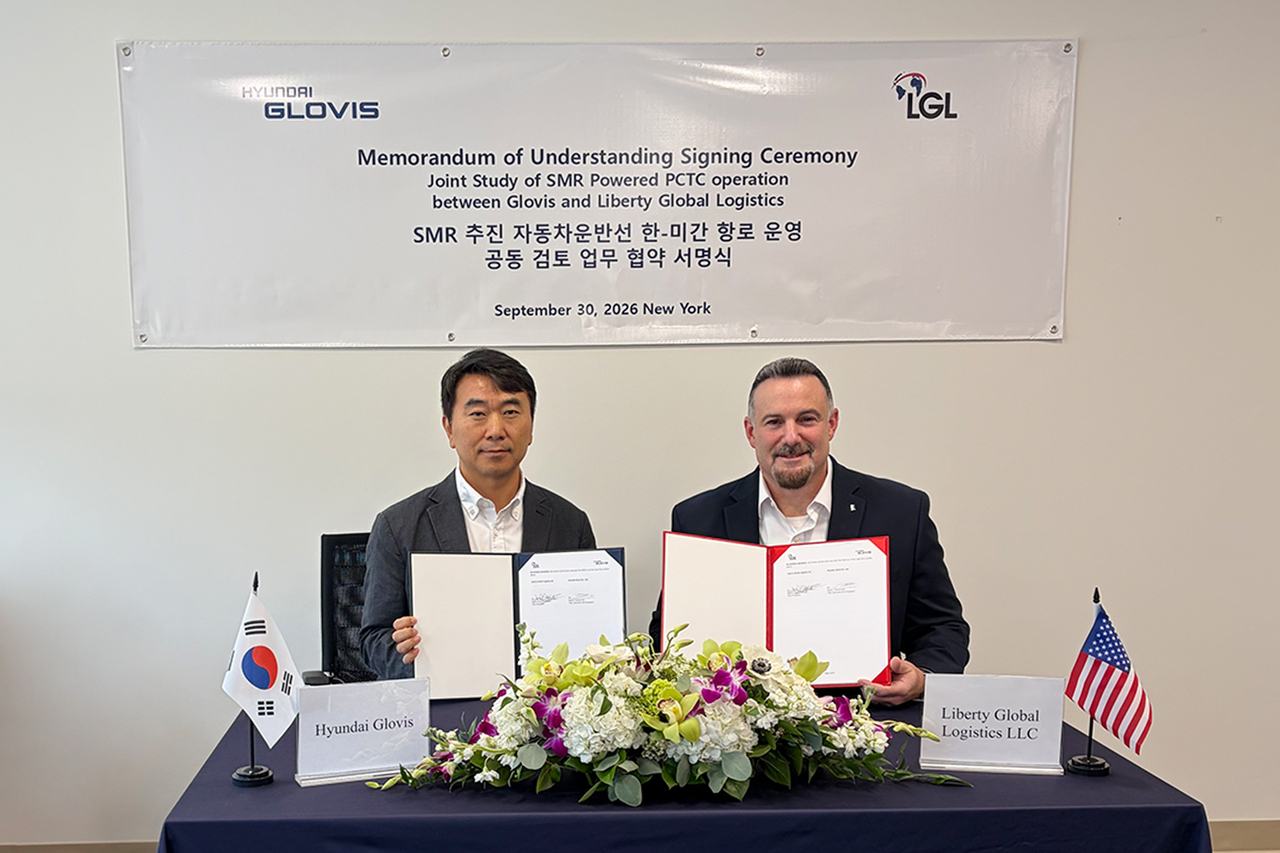
Hyundai Glovis announced Tuesday that it had signed an MOU with US logistics and shipping firm Liberty Global Logistics (LGL) for the joint review of operating an SMR-powered car carrier on the Korea-US route.
The signing ceremony was held Wednesday (local time) at LGL's headquarters in Jericho, New York. Executive Vice President and Hyundai Glovis Logistics Business Division Head Kim Tae-woo and LGL President David R. Minetti were among those in attendance.
LGL is a shipping and international multimodal transport company that handles automobiles, heavy equipment, oversized cargo and project freight. The company also provides cargo transport services for the US Department of Defense and the US military.
The vessel the two companies are examining would use an SMR as its propulsion source in place of conventional marine fuel. An SMR is a reactor built in modular form at a smaller size and output than a conventional large-scale nuclear reactor.
Applied to a ship, the technology is expected to sharply reduce carbon emissions during voyages and allow extended operation without refueling. Eliminating the large fuel tanks and some exhaust-related equipment required on conventional vessels could also free up additional cargo space.
However, turning the concept into a nuclear-powered merchant vessel that actually sails the open seas involves far more than technology — port entry, safety regulations and international conventions all present challenges that must be resolved.
That is precisely where Hyundai Glovis and LGL have focused this collaboration. Hyundai Glovis will examine South Korean port characteristics, the domestic regulatory regime and operating conditions, while LGL analyzes the relevant US regulatory system and port and operating environment.
The partners will also jointly assess whether such a vessel could actually be built and put into service. Questions under review include which country to register the ship in, which body would certify its safety, and how commercial operations would be structured.
Hyundai Glovis had already cleared the first technical hurdle. In June, at the Posidonia international shipping exhibition held in Athens, Greece, the company received approval-in-principle (AiP) from Lloyd's Register (LR) of the United Kingdom for the concept design of an SMR-powered car carrier.
Approval-in-principle is a process in which a classification society reviews whether the concept design of a new vessel or technology not yet built is feasible against international rules and safety standards. It does not constitute approval to build or operate an actual ship, but it confirms the technical viability of an early-stage design.
The South Korean government is also pursuing next-generation vessel development that combines nuclear and shipbuilding and marine technology. Alongside the development of an innovative SMR, nuclear propulsion for ships is being examined as one candidate technology for the future shipbuilding industry.
Hyundai Glovis is not focused solely on SMR technology; it is pursuing a parallel strategy of gradually reducing carbon emissions across its fleet. The company is introducing LNG dual-fuel car carriers that emit less carbon than conventional vessels, while expanding its longer-term research to cover zero-carbon propulsion technologies.
"Having established the technical feasibility of an SMR-powered PCTC, we plan to use this collaboration to verify the various conditions needed for the vessel's actual commercial operation," a Hyundai Glovis official said. The official added that the company is "preparing for the future shipping market by expanding our scope to next-generation zero-carbon vessel technologies, following our proactive introduction of the world's largest LNG dual-fuel PCTCs."
kwater@heraldcorp.com