Areas where average ATM distance exceeds 2km grow from 10 to 17 in four years, all in rural counties
Ongjin-gun residents travel 18.3 times farther than those in Seoul's Gwangjin-gu
Central banks abroad deploy ATMs directly; experts say cash access must be treated as public infrastructure
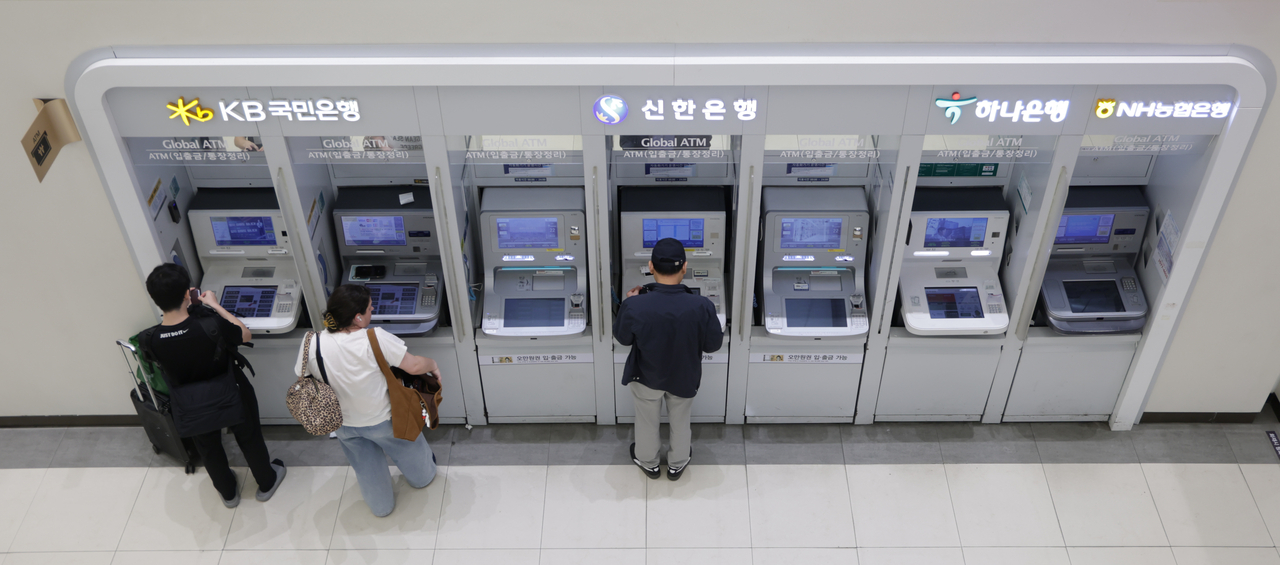
In Seoul, the nearest ATM is just 154 meters away on average. In Incheon's Ongjin-gun, residents must travel an average of 2.8 kilometers to reach one. As bank branches and cash machines disappear across the country, withdrawing money has become an expedition for rural residents — and the gap in cash access between cities and the countryside keeps widening.
An analysis of data obtained from the Korea Financial Telecommunications and Clearings Institute by Democratic Party of Korea lawmaker Jeong Tae-ho, a member of the National Assembly's fiscal and economic planning committee, showed Monday that the number of cities, counties and districts where the average distance to an ATM exceeds 2 kilometers grew from 10 in 2022 to 17 this year. All 17 are rural counties.
The area with the longest average ATM distance was Ongjin-gun, an archipelago county in Incheon, at 2,822 meters. It was followed by South Jeolla Province's Sinan-gun at 2,735 meters, North Gyeongsang Province's Yeongyang-gun at 2,629 meters and North Jeolla Province's Jinan-gun at 2,604 meters.
The distances rural residents must travel to reach an ATM have been growing steadily. Ongjin-gun's average access distance increased by 663 meters over four years. North Jeolla Province's Muju-gun, Jangsu-gun and Imsil-gun, along with North Chungcheong Province's Danyang-gun, each saw distances grow by about 550 meters over the same period.
There were 34 counties and districts where more than half of all residents live more than 1 kilometer from the nearest ATM — and every one of them was a rural county. In Sinan-gun, 74.4 percent of residents live more than 1 kilometer from an ATM. Jinan-gun followed at 67.5 percent, Daegu's Gunwi-gun at 67.2 percent and North Gyeongsang Province's Bonghwa-gun at 64.9 percent.
The urban-rural divide was stark. Seoul's Gwangjin-gu and Jungnang-gu had the shortest average ATM distances in the country, each at 153.8 meters. The average distance Ongjin-gun residents must travel to reach an ATM was 18.3 times that of Gwangjin-gu.
There were 27 cities, counties and districts where no resident lives more than 1 kilometer from an ATM. Seoul accounted for 16 of them, Busan for seven, and Daegu and Incheon for two each.
The disparity in ATM density per unit area was even more pronounced. Seoul's Jung-gu had 83.0 ATMs per square kilometer, and Busan's Jung-gu had 70.3. By contrast, North Gyeongsang Province's Yeongyang-gun had just 0.038 machines per square kilometer — roughly 1/2,180th the density of Seoul's Jung-gu.
In terms of the rate of ATM decline, cities fared no better than rural areas. But when a single machine disappears, residents in rural areas feel the impact far more acutely.
Over the past four years, the number of ATMs per square kilometer fell 13.2 percent in Seoul and 8.5 percent in Gangwon Province. Seoul's decline rate was steeper, yet its average ATM access distance grew by only 6.3 meters, while Gangwon's grew by 31.4 meters. In densely covered cities, removing one machine still leaves others nearby. In rural areas with sparse coverage, a single withdrawal can open a significant gap in financial access.
The Bank of Korea's 2025 survey on currency-handling operations, submitted to lawmaker Jeong, confirmed the rural ATM decline. At the end of last year, 20 financial institutions operated a combined 43,018 ATMs — a 2.9 percent drop from a year earlier, driven in part by branch closures.
Rural ATMs fell 3.6 percent over the same period, outpacing the 3.0 percent decline in major cities. ATMs installed in rural areas accounted for just 8.1 percent of all financial-institution machines.
The three non-bank ATM operators also saw their combined fleet shrink by 1.6 percent to 55,318 machines over the year. Among those, rural machines fell 2.9 percent — a steeper drop than the overall rate.
The Bank of Korea said non-bank ATM operators, responding to falling profitability, have been scaling back operations primarily in smaller cities and rural areas with low usage. Private-sector cost-cutting — pulling machines first from low-traffic locations — is translating directly into financial exclusion for rural residents.
"There is a risk that cash access will become even more constrained for financially underserved areas such as rural communities and for groups that rely heavily on cash," the Bank of Korea warned.
Cash use continues to decline as card payments and mobile payment services spread. Among three convenience store chains that responded to a Bank of Korea survey, the share of sales paid in cash fell from an average of 16.4 percent in 2023 to 13.8 percent last year. At hypermarkets and department stores, cash accounted for just 5.2 percent and 4.0 percent of sales, respectively.
Yet observers note that a decline in cash use does not eliminate the need for cash access. In rural communities, where many residents struggle with digital banking or depend heavily on cash, ATMs cannot be treated purely as a matter of private-sector profitability.
Abroad, cash access is increasingly treated as public infrastructure, with central banks and governments stepping in directly. Austria's central bank became the first in the world to begin deploying its own ATMs in July last year, after 17.4 percent of the population was found to live more than 2 kilometers from the nearest machine.
Austria plans to install up to 120 ATMs over two years in communities of 500 or more people that have no bank branch or ATM and where the nearest machine is more than 2 kilometers away on average.
Switzerland adopted a government proposal in March this year, by a 73 percent vote in a national referendum, to enshrine the guarantee of cash supply and use in its constitution. Sweden's parliament approved legislation in May limiting retailers' ability to refuse cash payments at grocery stores and pharmacies, and allowing the government to set a maximum distance residents must travel to access cash services.
"As ATM closures concentrate in rural areas, the gap in cash access between regions is widening," lawmaker Jeong said. "Other countries are treating cash access as a public issue and responding proactively. The Bank of Korea must take a more active role in ensuring cash access for vulnerable areas such as rural communities."
attom@heraldcorp.com