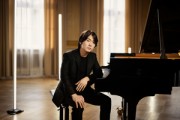
Performance at the 2026 ACC X Music Festival
Turning sorrow into dopamine — a space of liberation
An electronic musician's monologue on shedding wounds and grief
'I want music to be something I do simply because I love it'
![Kirara [Provided by X Music Festival]](https://wimg.heraldcorp.com/news/cms/2026/10/04/news-p.v1.20261004.71225678a0984db08826aa6eec17415e_P1.jpg)
Silence breaks, and a crystalline melody steps forward. Beneath an overcast Seoul sky, a clean, precise synthesizer tone rounds itself along the Han River. Where did it all begin? Crossing each bridge, a whirring sound grazes the ear — something between wind and machine, the distant swell of a crowd's chant spreading like a stain.
"Yes, sick Seoul… this tender Seoul… the anguish of a nation lost, the rebellion of our youth without a country — this is what it looks like."
Those lines from "Sick Seoul," a poem by Oh Jang-hwan written just after Korea's liberation, flow across the screen like a river current. When the rounded dome of the National Assembly building catches the eye, it overlaps with the memory of young people filling the streets, K-pop light sticks in hand. "Rebellion, rebellion — how exhilarating this is."
Kirara does not let go easily. She tucks clear keyboard tones and the percussive burst of wind into her pocket and builds layer upon layer. In the brief pause where the sound catches its breath, the metallic rhythm of a pungmul percussion troupe wedges its way in. The energy of nongak and the pulse of electronic music interlock organically — they coexist without blurring into each other, without harming each other. They collide in turns and build toward a gradual explosion.
"It's not a fifty-fifty mix of nongak and techno. It's more like maratang. The reason maratang tastes good is that the water and oil stay nicely separated."
"Sick Seoul" — an audiovisual collaboration between Kirara and visual artist Jeong Eun-young — was performed Thursday at the 2026 ACC X Music Festival. The sound Kirara wove around the wounds of a city that marched through the streets during the Dec. 3 emergency martial law declaration rang out in Gwangju, at the Asia Culture Center, a venue increasingly known as a "mecca of techno." Across the festival's four-day run, Kirara headlined two sets and led one masterclass, making her the face of this year's event.
Speaking with The Herald Business recently, Kirara said the ACC stage "has become a genuinely hip destination among experimental and conceptual electronic musicians, ever since techno acts started appearing there, beginning with Ryoji Ikeda." She laughed, adding, "The moment I got the offer, my eyes honestly lit up."
![Kirara [Kirara official website]](https://wimg.heraldcorp.com/news/cms/2026/10/04/news-p.v1.20261004.4f5b8aab3e34472fbe070f56871c7286_P1.png)
'The han of being transgender is over… just being alive is what matters'
"I don't knead two different worlds together like dough. The grammar is a quick in-and-out — B follows A in rapid succession."
"Sick Seoul" is the latest work from Kirara and Jeong Eun-young, a collaboration now a decade in the making. The two first met in 2016 on "Byeoncheok Pantaji" (Irregular Fantasy), a production in which a gay men's choir provided the chorus for a work examining traditional Korean women's theater through a feminist lens — and for which Kirara composed the music.
It was Kirara's music that gave this portrait of Seoul after the martial law declaration its fresh sensibility. Kirara described the central concept of the work as "juxtaposition" — placing people and musical elements with their own distinct qualities side by side, exactly as they are.
For this project, she wove together different genres and different sounds. "It was about juxtaposing loud and quiet to maximize contrast," she said. The pairing of nongak and techno is particularly striking. "Nongak and techno are both loud music — sounds that excite people and trigger dopamine," Kirara said. "The kkwaenggwari, which jolts everyone awake, has the power to elevate people. The two sounds share a lot physically: BPM, instrumentation, the distribution of low and high frequencies. I never thought of them as far apart just because one is traditional and the other modern."
The festival stage was a chance to show "what Kirara does best" — a space where everything she has built over the years converged, and where audiences could see and hear all of it through Sunday, or even through Monday.
This year marks her 13th year since her debut. She entered the world of electronic music in middle school, listening to Clazziquai, and began making music around the same time. She is, in the truest sense, a bedroom musician — she makes music on a computer beside her bed, in the most comfortable space she knows.
Many labels follow her: two Korean Music Awards trophies (2017 and 2026), pioneer of a new electronic music, transgender woman. The descriptors explain her and, at the same time, confine her. Kirara refuses to be pinned to any single one.
![Kirara [Provided by Kami International]](https://wimg.heraldcorp.com/news/cms/2026/10/04/news-p.v1.20261004.f2281e55391441308163a374245d3006_P1.jpg)
"I'm really done talking about the han of being transgender. Honestly, I don't even have that han anymore."
It was not an unexpected declaration — perhaps even a natural conclusion. Kirara's discography has always begun with her and the relationships she has formed. Her third album, "Sarah" (2018), grew out of grief over losing someone close and carried words of comfort addressed to transgender people. The B-side "Rain Dance" sampled "Tteong Bin Georieseo" (On an Empty Street, 1990) by 015B, transporting the isolation of standing before a payphone into a dance in a downpour. Not looking away from sorrow, making the body move even in the most desperate moments — that is how Kirara has borne the weight of life, and it is the original form of her music: dancing while crying.
2019 was a deep, dark valley. When the Hongdae area was roiling with debates over gender identity, she reflected that her own identity had been "used too much by this side and that side." Worn out by people, she left Hongdae for Yeongjongdo. Now, she says, "being in a quiet, rural neighborhood makes me incredibly happy."
Out of that stillness came "4" (2021). Through that album, Kirara inscribed into music the deprivation and rage she had felt living as a transgender woman. Only after pouring out the anger could she finally breathe. "Exactly one year after releasing the fourth album, the energy of that album drained away," she said.
Since her debut, Kirara has carried the catchphrase "Kirara is pretty and strong." Her performances open the same way: "Kirara is pretty and strong. And you are dancing." She distilled her identity and musical direction into a single sentence and consistently explained herself through it. "I had cleverly hidden the meaning that this music was made by a transgender person, and quietly enjoyed that on my own," she said. "Now I've come to dislike that attitude — and the paradox in that phrase." Back then, she said, she was forcing herself to be "pretty."
"I deliberately made pink artwork. I wanted my work to be what I couldn't be myself. Color doesn't matter to me anymore — whether it's pink, blue or bright red. Honestly, what's the point of becoming pretty at thirty-five? What matters is just living."
Her fifth album, "Kirara" (2025), is a record from "an entirely different place." It carries no message, no identity statement, no declaration. For the first time, she made what she calls "music without a message." It was not a renunciation of her identity — rather, it was her first work made after deciding she would no longer sustain music for the purpose of explaining it. "I felt healthier around the time I sensed I needed to let go of my preoccupations," she said. "I wanted to insist that that good state was Kirara's true self." The album earned her a second Korean Music Award.
![Kirara [Kirara official website]](https://wimg.heraldcorp.com/news/cms/2026/10/04/news-p.v1.20261004.85f2ca7d94db42c491c5253f4aab51ce_P1.png)
'I did it because I could' — not a hero, but a reference
At the 2017 Korean Music Awards ceremony, Kirara became the first transgender recipient in the event's history. A word she had not spoken in public before came out on the official stage. Last February, when she said at the podium that "an album made by a transgender person is this year's electronic album," the applause and cheers swelled. Some called it courage — but Kirara shook her head at that, too.
"It wasn't so much that I wanted to say it — it was that I could. I probably would have wanted to say that word at any point. My parents had more or less given up on me, and I was earning my own money, so I thought there was nothing left to be cautious about. I had nothing to lose, so I said it when I could."
There was a time she wanted to stand at the front lines defending minority rights, a time she wanted to raise her voice for people like herself. Looking back on her mid-twenties, about a decade ago, Kirara said she was "someone protesting in the streets back then" — living, she put it, "with the attitude of someone sitting in the back row of a late-night debate show." Around that time she also ran a Daum online cafe for LGBTQ youth with 40,000 to 50,000 members. Things are a little different now. "Being someone's role model is a weight I don't deserve," she said. Even if others see her as a hero, "I don't agree with that either," she added. Her wish is simply to be not a role model but "a reference — proof that a life like this exists."
"Just as there are transgender musicians, I hope there will be more transgender lawyers, chefs and financial commentators. I've spent my life trying not to wear a mask — not to live as one gender at school and another in society. I hope transgender people in Korea walk out of the closet, build resilience and grow in numbers."
![Kirara [Provided by Kami International]](https://wimg.heraldcorp.com/news/cms/2026/10/04/news-p.v1.20261004.09adc534066147618c49926e4fe9a57e_P1.jpg)
What she wants is not "one symbol" but "a hundred ordinary people" — stories of transgender people living with their identity as incidental rather than central: not a film where a transgender character dies tragically, but an ordinary drama series where someone cries over a bowl of gukbap thinking of their mother, or a film where a transgender character plays the villain.
Hers has been a life and a music thrown in with everything she had — days that demanded struggle, days that demanded solidarity. "Until now, the message always came before the music," she reflects. Now she no longer defines herself as "pretty and strong" Kirara. She simply is Kirara.
Kirara works on music four to five days a week on a nine-to-six schedule, like an office worker clocking in and out. A single album takes about nine months on average. Her sixth album will soon enter that process. New music is expected in the winter of next year or the spring of the year after.
Kirara says she wants to be "a person who matters even without making music" — she dreams of "a life with a yard, a dog, coffee brewing, and when boredom strikes, putting on a turntable and composing music like a hermit sage." Her immediate plan is to make music purely for music's sake, music as art. She said she wants to make "music as brilliant as Daft Punk's — artistically accomplished yet making people dance on instinct" — and through it, to be nominated in the general category at the Korean Music Awards, crossing genre lines.
"It's no longer a question of whether I make music or not. Now it's a question of whether I use music as a means to a better life, or as an end in itself. I used to make music to become a better person. Now I want to be someone who makes music simply because they love it."
shee@heraldcorp.com