
Available units jumped by 5,408 in two months following August tax reform announcement
Elderly long-term holders in Gangnam 3 districts continue to list homes to cut tax burden
![A property listings board at a real estate agency in Seoul. [Yonhap]](https://wimg.heraldcorp.com/news/cms/2026/10/03/rcv.YNA.20261001.PYH2026100119760001300_P1.jpg)
The number of apartments listed for sale in Seoul's three Gangnam-area districts — Gangnam-gu, Seocho-gu and Songpa-gu — has risen by more than 10,000 units compared with a year ago, as homeowners rush to list properties to reduce their tax burden following the government's August tax reform proposal. Seoul apartment sale prices have climbed for 86 consecutive weeks, surpassing the all-time record set during the Moon Jae-in administration, but industry watchers say a deepening price correction in the Gangnam area could slow the broader pace of gains across the capital.
According to real estate data platform Asil, combined apartment listings in the three districts stood at 27,590 units as of Thursday, up nearly 10,000 from 17,528 a year earlier. By district, Gangnam-gu rose from 7,392 to 11,682 units, Seocho-gu from 6,098 to 9,555, and Songpa-gu from 4,038 to 6,353.
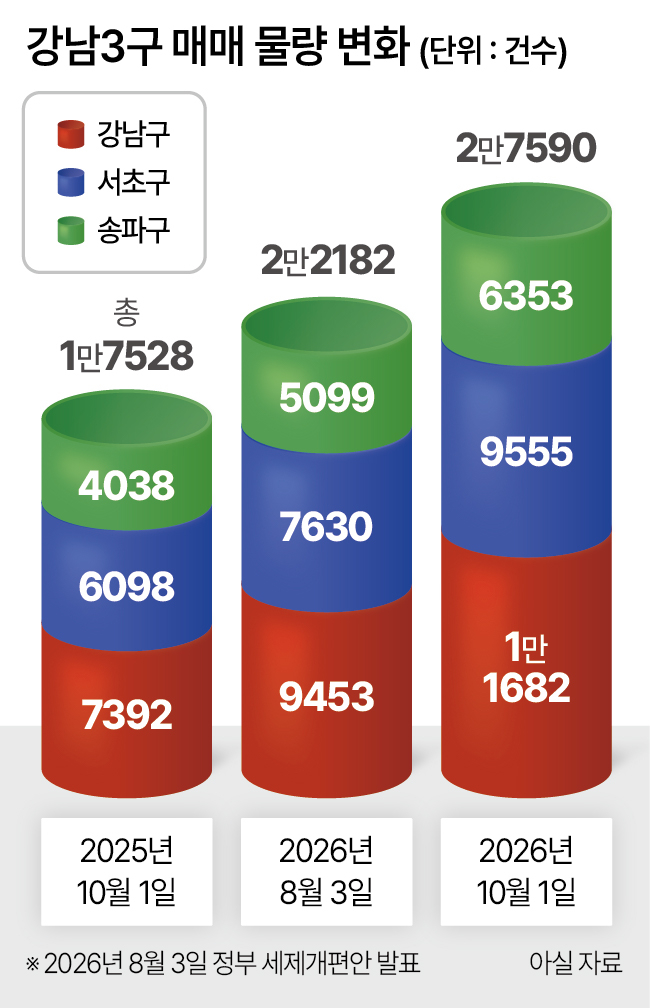
Compared with Aug. 3, when the tax reform plan was announced, listings across the three districts surged about 24 percent — or 5,408 units — in two months. Seocho-gu recorded the steepest increase, climbing 25.2 percent from 7,630 to 9,555 units. Songpa-gu rose 24.6 percent from 5,099 to 6,353, and Gangnam-gu gained 23.6 percent from 9,453 to 11,682.
Yoon Su-min, a senior real estate specialist at NH NongHyup Bank, said the Gangnam area has a high proportion of elderly long-term holders who are listing to realize profits and avoid capital gains tax bills that could run into the hundreds of millions of won. "However, since no one can be certain when the bottom will come, the standoff between sellers and buyers will continue," Yoon said.
![Apartment buildings in Seoul as seen from Namsan. [Yonhap]](https://wimg.heraldcorp.com/news/cms/2026/10/03/rcv.YNA.20260927.PYH2026092708100001300_P1.jpg)
Actual transactions, however, are shrinking under the weight of uncertainty over the tax reform plan, rising US government bond yields and concerns about a prolonged high-interest-rate environment. According to the Seoul Metropolitan Government, new applications for land transaction permits for Seoul apartments stood at 3,012 in August — the lowest monthly figure since the city-wide land transaction permit system was introduced last October, and the fourth consecutive monthly decline.
As listings — including distressed sales — pile up across the three districts, prices in the Gangnam area have begun to fall, diverging from the upward trend seen in outlying areas dominated by mid- to low-priced apartments. According to the Korea Real Estate Board, Gangnam-gu, Seocho-gu and Songpa-gu posted weekly price declines of 0.56 percent, 0.33 percent and 0.19 percent, respectively, in the fourth week of September, based on figures as of Monday. Seocho-gu's rate of decline eased from the previous week's 0.37 percent, but Gangnam-gu and Songpa-gu saw their drops widen from 0.42 percent and 0.14 percent the week before.
Industry experts say the three districts carry such a large share of Seoul's total real estate market capitalization that an accelerating decline there could drag down the overall rate of price gains across the capital. Songpa-gu had already turned negative in the first week of September, slipping 0.02 percent, and Yongsan-gu also fell 0.01 percent in the fourth week — its first decline in 22 weeks since April 27.
Nam Hyeok-woo, a real estate researcher at Woori Bank, said "policy uncertainty" remains a key drag, citing unresolved questions over whether the tax reform will reduce the long-term holding deduction rate and cap the long-term residency income deduction — changes that would shift tax benefits toward owner-occupiers. "With investment sentiment also dampened by rising interest rates, the slowdown in transactions and the trend of price weakness in these areas could persist for now," Nam said.
Some potential sellers have held off on listing while waiting to see the final direction of the tax reform, raising the possibility of additional supply hitting the market through year-end. "A sharp increase in listings is itself a factor that puts downward pressure on the market," Nam said. "At the same time, in an environment of policy uncertainty and lending regulations, it will not be easy for demand to absorb that supply quickly — so we may see a cycle where distressed listings keep emerging even after earlier ones are absorbed."
hope@heraldcorp.com




