Policy forum on urban rail free-ride system calls for government support; survey finds 41.7% back central government funding
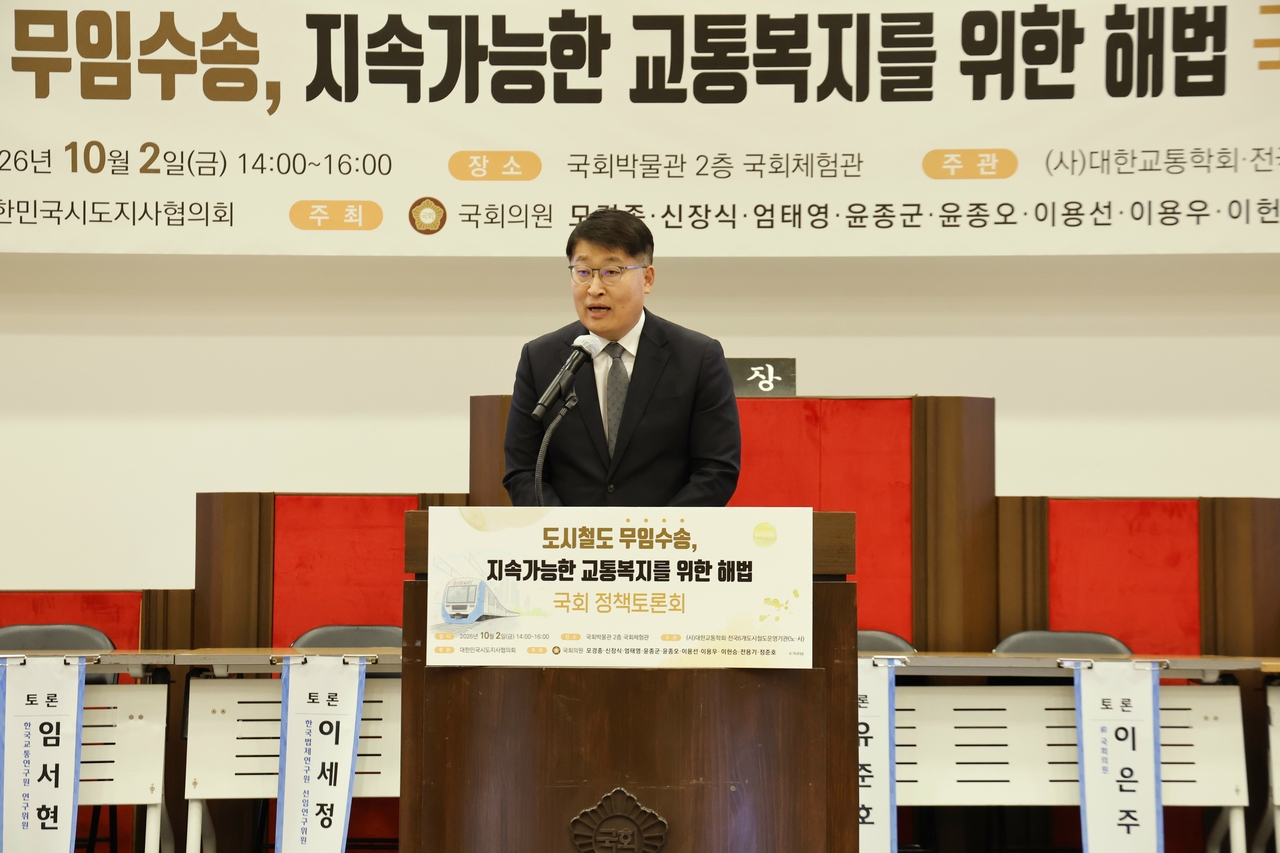
As the urban rail free-ride system — originally launched as a state-led welfare policy — buckles under hundreds of billions of won in annual losses, experts gathered Friday to debate how to keep it afloat.
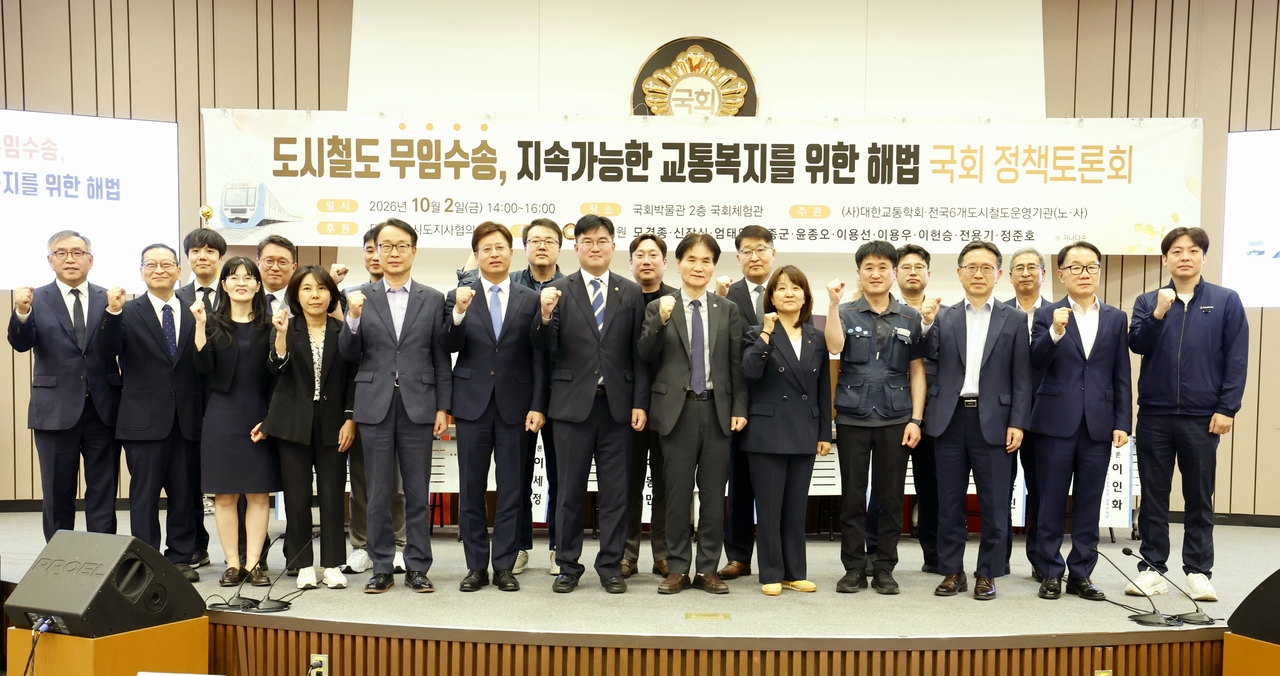
Seoul Metro co-hosted a National Assembly policy forum on sustainable solutions for the urban rail free-ride system at the National Assembly Museum in Yeouido, Seoul, together with the Korean Society of Transportation and the labor and management sides of six urban rail operators nationwide.
The forum was convened to reassess the social value of the free-ride system amid a surge in fare-exempt passengers as South Korea enters a super-aged society, and to discuss building a national fiscal support framework for the stable operation of urban rail and sustainable transportation welfare.
Park Young-hoon, a professor at Ajou University who delivered the keynote, analyzed the current state of the free-ride system and its projected fiscal impact, and outlined a policy direction for sustainable operations.
According to Park, the six urban rail operators nationwide face a sharp rise in net losses as fare-paying ridership stagnates due to population decline while the number of fare-exempt elderly passengers grows. Net losses across the six operators stood at 1.49 trillion won ($1.09 billion) last year and are projected to climb to 1.91 trillion won by 2030 and balloon to 3.15 trillion won by 2050.
According to population projections from the Ministry of Statistics, the elderly population share in the six cities served by urban rail — Seoul, Busan, Daejeon, Daegu, Incheon and Gwangju — is forecast to reach 25 percent by 2030, 33.2 percent by 2040 and 38.5 percent by 2050.
"Stopgap capital injections by local governments, as under the current arrangement, will not be enough to prevent operators from falling into complete capital insolvency," Park said. "The key to securing the sustainability of the free-ride system lies in resolving the mismatch between who implements the policy and who bears the cost."
The keynote also presented the results of a survey of 2,000 adults aged 19 and older nationwide, conducted by the Korean Society of Transportation.
The survey found that 41.7 percent of respondents — the largest share — said the central government should bear the cost of operating the free-ride system. Local governments came next at 31.9 percent, followed by urban rail operators at 9.0 percent and general fare-paying passengers at 7.1 percent, confirming broad public support for a stronger fiscal role for the central government.
On willingness to shoulder additional costs, respondents said they would accept a surcharge of 252 won per trip or an additional annual tax burden of 11,723 won ($9) per person.
The panel discussion was moderated by Lee Dong-min, acting president of the Korean Society of Transportation, and included panelists representing academia, local governments and operators: Kim Yong-jin, a professor at Inha University; Yoo Jun-ho, policy director at the National Association of Governors; Lee Se-jung, a senior research fellow at the Korea Legislation Research Institute; and former Assembly member Lee Eun-ju.
Participants agreed that the financial sustainability of urban rail operators and the guarantee of universal mobility rights for citizens must be balanced, and shared the view that fiscal support from the government — as the body responsible for implementing the policy — is necessary.
They discussed a range of measures, including establishing a legal basis for fiscal support for free-ride services, setting clear principles for cost-sharing among the central government, local governments and operators, and building an institutional framework for calculating, evaluating and settling eligible costs.
"This forum confirmed the strong will and broad consensus across all sectors toward making the free-ride system sustainable," said Lee Se-jung of the Korea Legislation Research Institute. "The time has come to move beyond discussion and translate that into policy decisions and concrete institutional reform at the National Assembly and government level."
Former Assembly member Lee Eun-ju said national subsidies for free-ride costs should not be seen as preferential treatment for specific regions or operators, but as fair compensation for carrying out a universal welfare policy designed by the state. "The government must take responsible ownership of the costs of public services it has mandated, and ensure that operators have the financial foundation to deliver safety and public service," she said.
Under national laws including the Welfare of Older Persons Act, urban rail operators are legally required to provide 100 percent fare exemptions. Unlike the national rail system, however, no law exists to compensate urban rail operators for the cost of those exemptions. A bill to amend the Urban Railroad Act — which would require the state or the party responsible for the policy to cover costs arising from public service obligations — is currently pending before the 22nd National Assembly.
Seoul Metro President Kim Tae-kyun said the company plans to bring the forum's recommendations to the National Assembly and the government on an ongoing basis, together with urban rail operators across the country. "We hope the National Assembly and the government will recognize compensation for free-ride losses not as a simple deficit bailout but as a public investment in national value creation, and move to establish a stable cost-sharing framework," Kim said.
The forum also included an interim progress report on a joint research project commissioned by the six urban rail operators nationwide to develop sustainable solutions for the free-ride system. Labor and management representatives from the six operators reviewed progress on key tasks, including an analysis of the social value and cost-benefit ratio of free-ride services and a comparative review of public service obligation regimes for public transit at home and abroad. The final report is scheduled for late October.
seouldream01@heraldcorp.com