The time lag in capacity expansion persists even as AI reshapes memory demand
Long-term contracts may cushion downturns, but future demand remains the key variable
CSIS flags overinvestment risk and price collapse as chipmakers race to expand
Editor's note: Chip Chip Fab Fab is a series that explores the semiconductor industry driving the AI era — in depth and in plain language. The name links the "chip" at the heart of the AI revolution with the "fab" that makes it, and echoes the rhythmic chug of a train to capture the industry's relentless forward march. The series unpacks complex technology in accessible terms while tracing the deeper currents behind the headlines, following the present and future of the semiconductors powering the AI age.
![In 2006, Samsung Electronics became the first company in the world to develop a 50-nanometer 1-gigabit DDR2 DRAM chip. Market forecasts at the time pointed to steep growth — but two years later, DRAM prices collapsed and a wave of manufacturers went bankrupt. [Samsung Electronics Newsroom]](https://wimg.heraldcorp.com/news/cms/2026/10/02/news-p.v1.20261002.6ff4d94070bf4abbb17fd7bccc8eae4d_P1.png)
"SK Group has been going around to certain lawmakers' offices asking whether it might be able to pull back or slow things down."
Welcome to Chip Chip Fab Fab. Today we look at concerns over memory semiconductor factory expansion. Those were the words Min Hyung-bae, former mayor of the Jeonnam-Gwangju integrated special city, shared at an economic forum lecture hosted by the Gwangju Chamber of Commerce and Industry on Wednesday. As the remarks spread, questions surfaced about whether SK hynix might be reconsidering or slowing its investment.
The Jeonnam-Gwangju integrated special city moved quickly to contain the fallout, saying Min's comments were meant "to emphasize that the local community must pull together to ensure concerns about investment in the Honam region do not become reality." The city added that "SK hynix is actively communicating with the city and continuing consultations on the Honam semiconductor cluster, and has stated that its position on proceeding with the investment remains unchanged."
While the city drew a clear line against any talk of a pullout, the episode raises a question worth examining: the very factories being built today to ease a current supply shortage could become the source of an oversupply problem years down the road. That concern was among the loudest voices raised when plans for the Honam semiconductor cluster were first announced.
'This time is different' — but the expansion lag remains
AI has reshaped demand, yet the oversupply risk has not gone away
![A mobile DRAM chip released by Qimonda in 2006. [Qimonda]](https://wimg.heraldcorp.com/news/cms/2026/10/02/news-p.v1.20261002.08b4d0f32e9a46f8ac8d9f7ac7ad9cf0_P1.png)
A US think tank has now added its voice to those concerns, warning that the aggressive capacity race among the three major memory chipmakers could trigger a prolonged oversupply. While AI has sent memory demand surging, the structural risk — large-scale investment flooding the market with supply after a time lag, sending prices into a sharp decline — has not been eliminated, the analysis found.
The warning comes from a report titled "Beyond the Memory Cycle," recently published by the Center for Strategic and International Studies (CSIS). CSIS cautioned that "the investment needed to address today's shortage may ultimately recreate the conditions for the industry's next oversupply."
The report was written by Sujai Shivakumar, director and senior fellow of CSIS's Renewing American Innovation program; Charles Wessner, a non-resident senior adviser at CSIS and research professor at Georgetown University who collaborated on semiconductor policy reports with figures including Intel co-founder Gordon Moore; and Thomas Howell, an international trade attorney specializing in the semiconductor industry who spent more than 40 years representing US semiconductor companies and associations and was involved in US-Japan semiconductor trade disputes, the founding of Sematech, and trade disputes with China.
The authors warned that if AI demand growth slows while Samsung Electronics, SK hynix, Micron and Chinese chipmakers are all simultaneously expanding capacity, "the result could be a replay of the 2008 memory chicken game — oversupply and fierce price competition."
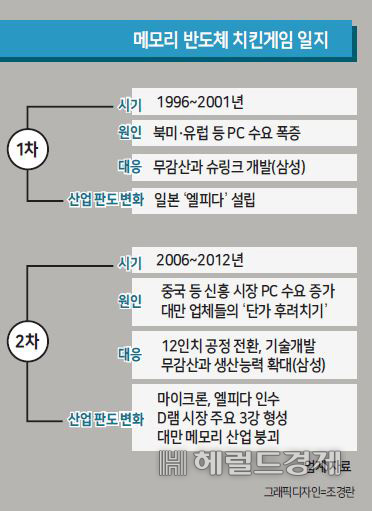
Let us go back about 20 years. The memory semiconductor market in 2008 experienced a supply glut and price collapse even as optimistic growth forecasts prevailed. As late as early 2008, the industry expected continued expansion — yet DRAM spot prices fell 50 percent from January through December, and DRAM makers collectively posted $7 billion in losses.
Even so, no one stopped their production lines or cut output. In the memory industry, where fixed costs are enormous, there is constant pressure to maintain high utilization rates to bring down per-unit costs — even when prices are falling. With multiple companies simultaneously maximizing production in the belief that the market would keep growing, oversupply ultimately drove prices down further.
![[SK hynix Newsroom]](https://wimg.heraldcorp.com/news/cms/2026/10/02/news-p.v1.20261002.13ee0380dedd4a598a61870880d1f2cb_P1.png)
The memory semiconductor chicken game ended brutally. The 2008 global financial crisis compounded the damage: Germany's Qimonda, one of Europe's leading DRAM producers, went bankrupt in 2009; Japan's Elpida followed in 2012; and Taiwan's ProMOS went through liquidation. The survivors were Samsung Electronics, SK hynix and Micron.
To avoid a repeat of that "Squid Game," the three major memory chipmakers have all been emphasizing long-term agreements, or LTAs. The approach involves locking in precise demand commitments from customers in advance and incorporating those figures into production and investment plans. For memory companies, it offers a two-for-one benefit: better demand forecasting reduces the risk of overproduction, while also easing the inventory burden.
That structural shift is why SK Group Chairman Chey Tae-won, in a Bloomberg TV interview following SK hynix's American depositary receipt listing on NASDAQ, stressed that the business "is no longer cyclical" and that the structure has clearly changed. SK hynix CEO Kwak Noh-jung made a similar point at a press briefing after the groundbreaking ceremony for the company's Indiana fab, saying that "even if a downturn comes, it will be a gradual decline or something close to flat — not a sharp drop."
CSIS pushed back directly against that view. The report acknowledged that AI has changed the type of memory demand and shifted production priorities — with the market moving from commodity DRAM to HBM, transforming competition from a price-and-scale contest into one centered on technology and customer qualification.
But the structural cycle observed in past memory chicken games — prices rising on demand growth and supply delays, then tipping into oversupply as expansion races ahead — has not changed, the report argued. Building a new memory fab still requires roughly $15 billion to $20 billion and takes two to three or more years just to construct. Even in an oligopolistic market dominated by a handful of players, supply rigidity and fierce competition prevent the market from stabilizing, CSIS said.
"The investment triggered by high prices during a shortage period may arrive on the market when demand has already shifted," CSIS said. "Fabs that have absorbed enormous fixed costs must maintain high output after coming online to bring down per-unit costs, making it difficult for supply to contract quickly even when prices fall."
The outcome changes, however, if the underlying assumptions change. CSIS emphasized that if AI demand continues to grow at its current pace, new capacity could be absorbed without major disruption. "Whether oversupply materializes depends on the combination of demand growth and the pace of capacity expansion," the report said.
Investment pours into HBM — leaving a gap China is ready to fill
The retreat from commodity memory opens a door for Chinese chipmakers
![Global DRAM market share from the second quarter of 2025 through the second quarter of 2026 [Counterpoint Research]](https://wimg.heraldcorp.com/news/cms/2026/10/02/news-p.v1.20261002.312199aaba5c4f229b6349e1793faf41_P1.png)
The problem is that despite these concerns, chipmakers cannot afford to slow fab expansion. HBM currently commands the highest prices and the strongest sales. Because HBM stacks DRAM layers, concentrating production on HBM from the same wafer input structurally reduces commodity DRAM output.
That contraction in commodity DRAM and NAND supply could hand China a new opportunity. CSIS warned that "China's additional capacity could relieve some of the global commodity memory shortage, but it also raises the risk of future oversupply, price declines, dumping and trade friction." Chinese memory chipmaker CXMT has already captured a 10 percent share of global DRAM sales revenue, making it the fourth-largest player behind the three major memory makers.
The concern extends beyond HBM. Memory chips are not used only in AI data centers — commodity DRAM also goes into automobiles, telecommunications equipment, industrial systems, medical devices and defense applications. CSIS noted that "the more capacity the three major chipmakers devote to HBM and AI-optimized memory, the larger the role low-cost Chinese suppliers can play in meeting commodity DRAM demand."
The report went further, warning that "if this expansion follows the overinvestment patterns familiar to the industry, it could produce another cycle of excess capacity, dumping and price collapse — while simultaneously expanding China's influence over the supply of memory components that, though commoditized, remain strategically important."
Will building more fabs in America be enough?
Subsidies meant to strengthen supply chains could fuel the next oversupply
![Micron completed the first concrete pour at its Clay megafab construction site in New York state in August. The ceremony was attended by US Commerce Secretary Howard Lutnick (fifth from left) and Micron CEO Sanjay Mehrotra (sixth from left), among others. [Micron social media]](https://wimg.heraldcorp.com/news/cms/2026/10/02/news-p.v1.20260811.bcb707b4513d4973972a567a1e49913e_P1.jpg)
From the US perspective, two major concerns stand out. The first is supply chain resilience. CSIS noted that "much of the manufacturing, stacking, packaging, yield optimization and customer qualification capacity needed for commercial HBM production is concentrated in Asia," and that "even if total supply increases, the geographic concentration the US is worried about does not automatically resolve itself."
That concern is part of why pressure has been mounting on Korean memory chipmakers to produce commodity DRAM inside the United States as well. CSIS stressed that "even if overall production rises as new investment concentrates on HBM and server memory, supply constraints for commodity memory may persist," and that rather than expanding capacity indiscriminately to ease shortages, policymakers should "target the bottlenecks in the specific products and processes that are actually needed."
CSIS also raised concerns about oversupply, urging that government support and private investment be coordinated "to expand supply without simply subsidizing the next oversupply cycle."
Not building fabs means missing immediate demand and ceding ground to China. But expanding purely on the strength of today's boom risks a flood of supply hitting the market years from now. Can long-term agreements finally end memory's own Squid Game? The industry's confidence that "this time is different" will not be tested during the current boom — it will be tested when the new fabs come fully online. Whether the industry has this time managed to see the future clearly remains to be seen.
go@heraldcorp.com