Of 101 dispatch requests last year, only 34 resulted in actual patient transfers — a 64% abort rate. All 41 air ambulance pilots nationwide are in their 50s or older. Experts say Incheon's emergency air transport system is overdue for a generational overhaul.
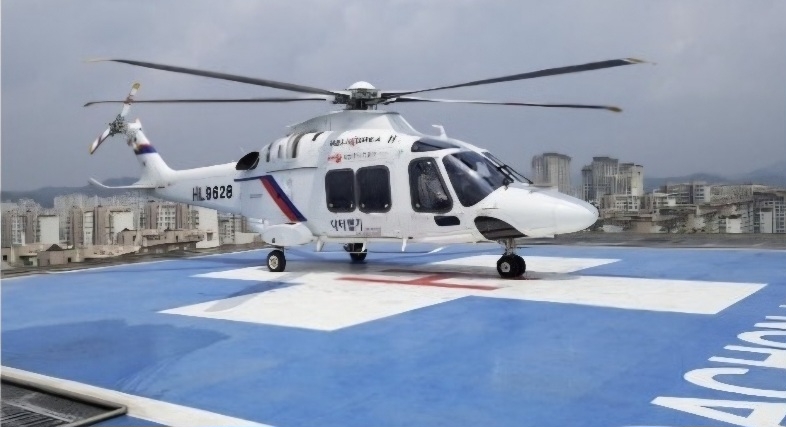
Incheon's air ambulance helicopters — the city's lifeline for critically ill patients — failed to complete more than six in 10 dispatch requests last year, raising serious questions about the program's real-world effectiveness.
All 41 air ambulance pilots nationwide are aged 50 or older, and Incheon's high abort rate has deepened calls for a comprehensive review of the system — one that goes beyond simply securing more helicopters and addresses pilot recruitment and actual patient transport.
According to an analysis of Ministry of Health and Welfare air ambulance operation data submitted to National Assembly lawmaker Lee Dal-hee of the Health and Welfare Committee on Thursday, Incheon received 101 dispatch requests last year.
Of those, only 34 resulted in an actual dispatch and patient transfer. A total of 65 requests were aborted, pushing the abort rate to 64 percent — meaning nearly two out of every three callouts never reached a patient.
The problem lies in the wide gap between these figures and the "operation rate" the government publicly reports.
Over the past five years, 2,383 of 8,691 air ambulance dispatch requests nationwide — 27.4 percent — were aborted.
Yet the Ministry of Health and Welfare's region-by-region operation rate figures showed nearly all areas recording 100 percent.
That is because the current methodology counts a helicopter as fully operational as long as it or a substitute aircraft is on standby, regardless of whether it ever left the ground.
The result, critics say, is that two entirely different metrics — whether a helicopter was ready to fly and whether an emergency patient was actually transported — are being managed as if they were the same thing.
The problem is especially stark in Incheon.
Air ambulance helicopters are dedicated medical transport aircraft designed to rapidly move critically ill or injured patients from areas with limited emergency care access.
They currently operate in eight regions across the country: Incheon, South Jeolla Province, Gangwon Province, North Gyeongsang Province, South Chungcheong Province, North Jeolla Province, Gyeonggi Province and Jeju.
With only 34 actual transfers recorded in Incheon last year, advocates say the focus must shift from the mere existence of the helicopters to whether the system can actually reach patients when it matters.
Compounding the concern is the aging of the pilot workforce. All 41 air ambulance pilots nationwide are in their 50s or older.
The average age is 59.4, and 16 pilots — 39 percent of the total — are in their 60s or above. Not a single pilot is in their 30s or 40s.
Forty of the 41 pilots are military veterans, raising questions about whether the current practice of relying almost entirely on retired military aviators is sustainable over the long term.
Compared with pilots at other government aviation agencies — the Korean National Police Agency at an average age of 51.1, the National Fire Agency's central aviation unit at 51 and the Korea Forest Service at 51 — air ambulance pilots are on average about eight years older.
The gap in nighttime emergency transport is another issue Incheon must confront.
Requests for proposals issued by the Ministry of Health and Welfare and the National Medical Center from 2016 through this year have consistently limited flight hours to the period between sunrise and sunset, with no provision for night operations.
None of the eight air ambulances currently in service are equipped with night-vision goggles.
Given that medical emergencies do not confine themselves to daylight hours, establishing a nighttime transport capability is widely seen as one of the most pressing challenges for the national air ambulance system, including in Incheon.
Cost-effectiveness is another unresolved issue.
Annual lease fees for air ambulances range from roughly 2.8 billion won to 4.1 billion won per region. Yet in some areas, the number of actual patient transfers has fallen sharply.
In South Chungcheong Province, only 17 transfers were recorded last year, yet the annual lease fee still came to 2.86 billion won ($2.11 million) — putting the cost per transfer at around 168 million won.
Lawmaker Lee urged the government to carry out a generational renewal of the pilot workforce, introduce night flight operations and address the wide disparities in transfer numbers across regions. "The air ambulance is in effect the last means of transport for residents in areas with limited emergency care," she said.
Observers say it is time to evaluate Incheon's air ambulance program not by its "100% operation rate" but by how many emergency patients it actually reaches and delivers to hospital alive.
gilbert@heraldcorp.com