July wages reach 4.32 million won, up 2.5%, but fall short of 2.8% inflation
Temporary workers see nominal wages drop 2.6%; total employed rises by 233,000
April data shows 1.44 million won gap between Seoul and Jeju wages

Real wages in South Korea fell for the fourth consecutive month, as pay increases continued to lag behind rising consumer prices, eroding workers' actual purchasing power. For temporary and daily workers, even nominal wages declined compared with a year earlier.
According to the Ministry of Employment and Labor's business labor force survey for August 2026, released Wednesday, the average monthly wage per worker at businesses with at least one full-time employee stood at 4.316 million won ($3,180) in July, up 2.5 percent, or 104,000 won, from the same month last year.
Consumer prices rose 2.8 percent over the same period, however, pushing real wages — calculated by dividing nominal wages by the consumer price index to reflect actual purchasing power — down 0.3 percent to 3.6 million won.
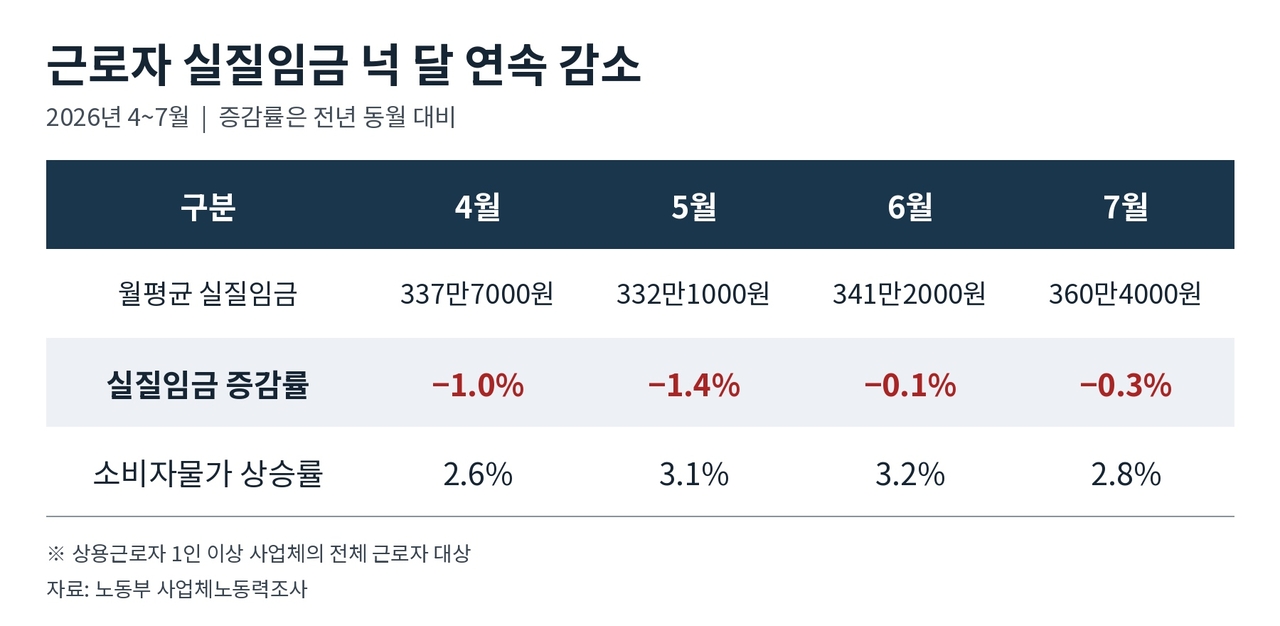
Real wages had already fallen 1.0 percent in April, 1.4 percent in May and 0.1 percent in June before declining again in July. Although the pace of decline narrowed in June, it widened slightly in July, extending a trend in which wage growth has failed to keep pace with inflation.
Breaking down wages by employment type, full-time workers earned an average of 4.63 million won per month, up 3.4 percent, or 151,000 won. Regular pay rose 2.5 percent to 3.74 million won, overtime pay climbed 8.7 percent to 269,000 won, and special allowances — including bonuses and performance pay — increased 6.7 percent to 620,000 won.
By contrast, wages for temporary and daily workers fell 2.6 percent, or 46,000 won, to 1.74 million won.
By business size, workers at firms with fewer than 300 employees earned an average of 3.85 million won, up 1.7 percent, while those at firms with 300 or more employees earned 6.49 million won, up 3.3 percent. The monthly wage gap between the two groups stood at 2.64 million won.
By industry, finance and insurance workers earned the most at 8.39 million won, followed by those in electricity, gas, steam and air conditioning supply at 7.65 million won. Workers in accommodation and food services earned 2.45 million won, while those in facility management, business support and rental services earned 2.89 million won — among the lowest across all sectors.
Average working hours per worker in July came to 161.9 hours, down seven hours, or 4.1 percent, from the same month last year, reflecting a reduction in working days from 23 to 22. Full-time workers logged 171 hours, down 6.9 hours, while temporary and daily workers averaged 87.6 hours, down 0.8 hours.
Employment continued to grow. As of the last business day of August, the total number of workers at businesses with at least one employee reached about 20.69 million, up 233,000, or 1.1 percent, from a year earlier — an increase 7,000 greater than the 226,000 gain recorded in July.
Full-time workers numbered about 17.281 million, up 92,000, while temporary and daily workers totaled about 2.043 million, up 141,000. Temporary and daily workers accounted for roughly 61 percent of the overall employment gain.
By industry, health and social welfare services posted the largest increase at 122,000 workers. Professional, scientific and technology services and finance and insurance each added 28,000 workers. Manufacturing employment grew by 17,000, up from a gain of 14,000 in July.
Wholesale and retail trade shed 30,000 workers, arts, sports and leisure services lost 7,000, and information and communications fell by 1,000.
A separate regional wage and working hours survey for April 2026, also released Wednesday, highlighted significant wage disparities across the country. Seoul recorded the highest average monthly wage among full-time workers at 4.85 million won, followed by Ulsan at 4.54 million won. Jeju posted the lowest at 3.41 million won, a gap of 1.44 million won below Seoul.
The Ministry of Employment and Labor attributed Seoul's high wages to the concentration of high-paying industries such as information and communications, professional and scientific services, and the headquarters of financial and insurance firms. Ulsan's strong showing reflects its large-scale manufacturing base in automobiles, shipbuilding and chemicals, while Jeju's lower wages stem from its heavy reliance on accommodation, food services and other service industries.
In terms of real wage growth adjusted for regional price levels, North Chungcheong Province posted the highest increase at 1.5 percent, followed by Jeju at 1.3 percent. Ulsan saw the steepest decline at 7.0 percent, with North Gyeongsang Province down 5.0 percent.
fact0514@heraldcorp.com