Survey of 794 school and education facility janitors finds 77.3% work part-time hours; more than half unable to save or prepare for retirement; 71% clean alone; 96.6% call bonus gap discriminatory; nationwide action planned for Oct. 21
More than seven in 10 school janitors earn less than 1.9 million won ($1,400) a month before taxes even when working full hours during the school term, a new survey has found. Nearly all respondents — 96.6 percent — said they consider the annual bonus they receive, which is half that paid to other education public workers under the same school board, to be discriminatory. The National Education Public Workers Federation is planning a nationwide joint action on Oct. 21 to demand equal bonus pay.
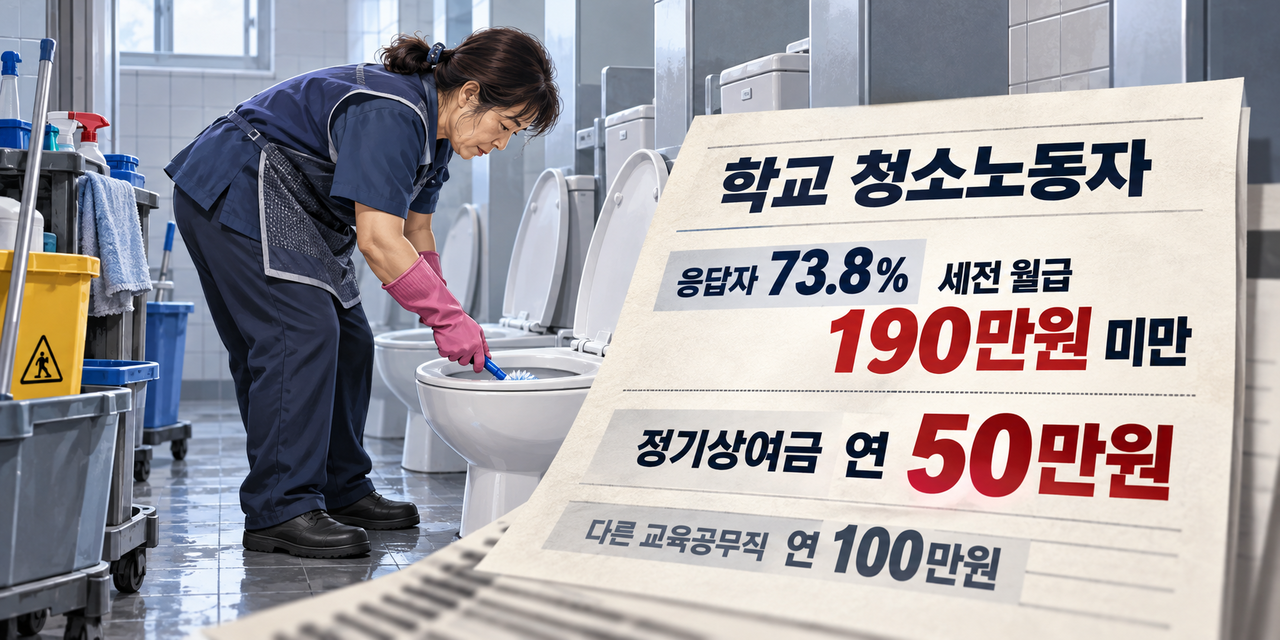
According to the federation's national environment division, an online survey conducted from Sept. 14 to Sept. 23 among 794 school and education facility janitors found that 586 respondents, or 73.8 percent, said their pre-tax monthly pay during the school term falls below 1.9 million won.
Breaking down the salary ranges, 225 respondents (28.3 percent) earned less than 1.5 million won, 217 (27.3 percent) earned between 1.5 million won and less than 1.7 million won, and 144 (18.1 percent) earned between 1.7 million won and less than 1.9 million won. Some 614 respondents, or 77.3 percent, worked fewer than eight hours a day. Those working five-hour shifts numbered 179 (22.5 percent) and six-hour shift workers numbered 243 (30.6 percent), together accounting for more than half of all respondents.
Financial strain was also evident. A total of 428 respondents (53.9 percent) said they had been unable to save or prepare for retirement over the past year because their wages were insufficient or living costs were too burdensome. Some 408 respondents (51.4 percent) said they had cut back on food and daily necessities, while 234 (29.5 percent) said they had looked for or actually taken on a side job or additional work.
Same employer, but bonus gap: 1 million won vs. 500,000 won
The sharpest grievance to emerge from the survey was the bonus disparity. According to the federation, other education public workers receive an annual regular bonus of 1 million won, while janitors receive only 500,000 won. Some 767 respondents, or 96.6 percent, said they regard this as discriminatory.
Among those who viewed it as discrimination, 624 respondents (78.6 percent) cited the fact that workers under the same school board are paid differently based on job category. Some 438 (55.2 percent) said it signals that janitors are not treated as equal members of the school community, and 347 (43.7 percent) said it reflects a failure to recognize the value of essential work in maintaining school hygiene. One respondent asked, "If the bonus is cut in half, should we only do half the cleaning?"
The federation said the gap has persisted since 2018, when cleaning and security workers were brought on as direct employees and placed under a separate "special operations" wage structure. When an annual regular bonus of 300,000 won was introduced for that category in 2022, other education public workers were already receiving 900,000 won a year. Both figures rose in 2023 — to 500,000 won and 1 million won respectively — but the gap remained. The federation also noted that seniority allowances do not apply to workers in the special operations category.
71% clean alone — one worker for every 64 toilets
The survey also highlighted heavy workloads and inadequate rest facilities. Some 564 respondents (71.0 percent) said they were the only janitor at their workplace. On average, each janitor was responsible for 64.1 squat or flush toilets, 37.8 urinals and 33.6 sinks.
When asked what they found most difficult about their work, 571 respondents (71.9 percent) cited low wages and unequal treatment, while 348 (43.8 percent) cited the heavy workload.
Some 264 respondents (33.2 percent) said they had no dedicated break room. Another 80 (10.1 percent) said they rested in storage areas for cleaning supplies or spare classrooms, or had nowhere to rest at all. Only 217 respondents (27.3 percent) said a shower facility was located near their break room.
The national environment division is demanding that school boards raise the annual regular bonus for janitors to 1 million won, bringing it in line with other education public workers. Some 721 respondents (90.8 percent) said collective action such as a strike would be necessary if the school boards refused, and 455 (57.3 percent) said they would definitely or if possible participate in a strike.
Jo Hye-jin, head of the national environment division, said there was no justification for paying janitors half the bonus given to other education public workers under the same school board. "We will organize the Oct. 21 nationwide joint action and an all-out campaign afterward to make school boards commit to equal annual bonus pay of 1 million won," she said.
Meanwhile, the Public Workers Committee under the prime minister, which launched on Sept. 18, is a statutory consultative body that deliberates on and coordinates employment, wages and other working conditions, as well as personnel and labor-related policy and systems, for public-sector workers. Related ministries, labor and management representatives, and experts participate in the committee to discuss ways to eliminate workplace discrimination and improve the quality of employment.
fact0514@heraldcorp.com