Nationwide apartment price quintile ratio reaches all-time high
Southern Gyeonggi Province, other key metropolitan areas drive upper-end surge
Seoul gap narrows as lower-priced apartments post stronger gains
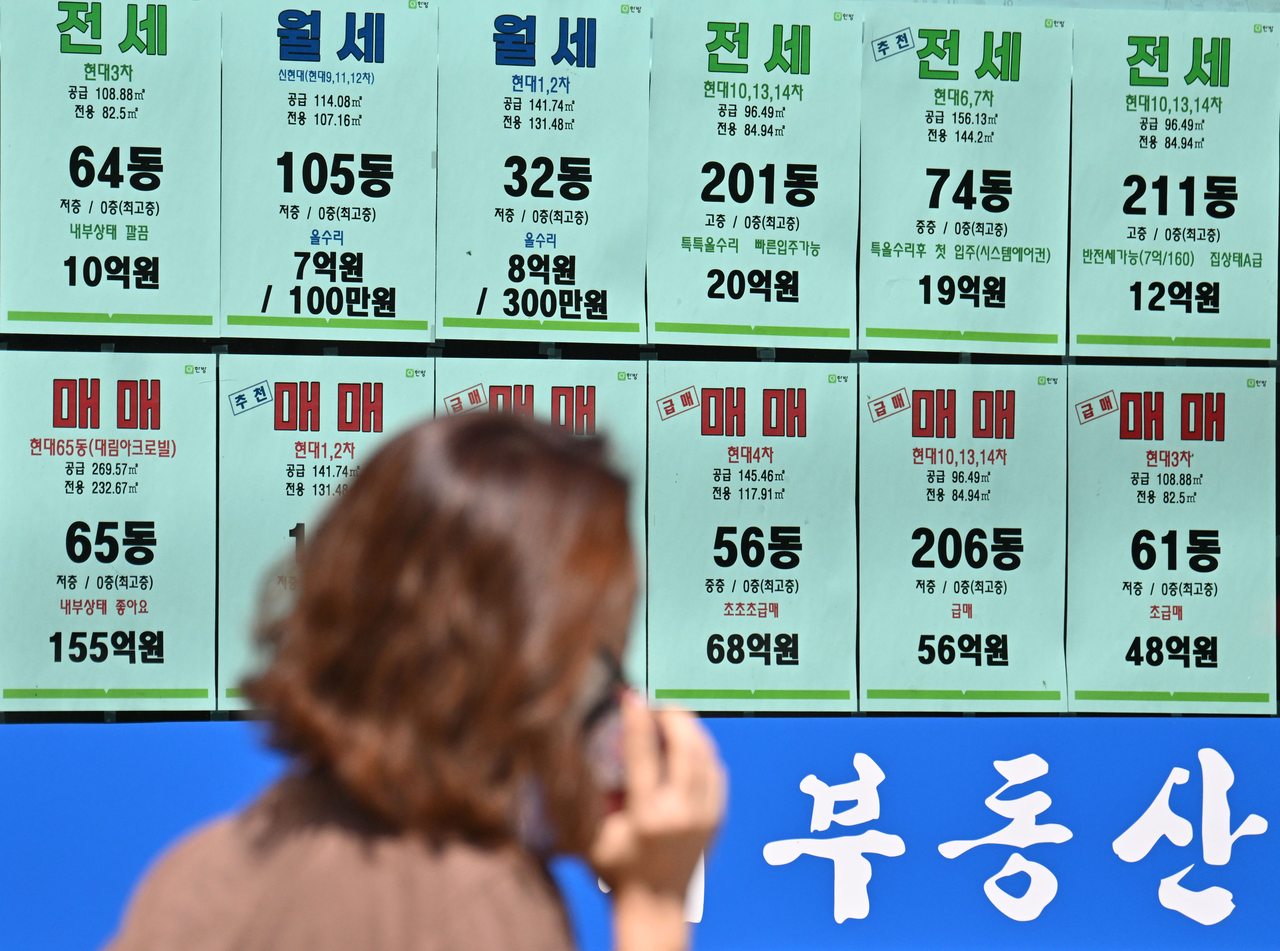
The price gap between the most and least expensive apartments in South Korea has widened to its largest margin since records began. Prices in Seoul's outer districts have risen enough to narrow the gap between high- and low-end units within the capital, but sharp gains in parts of the greater metropolitan area — particularly southern Gyeonggi Province — have deepened the nationwide divide.
Seoul gap narrows, but nationwide disparity keeps widening
According to KB's monthly housing price trend report for September, released Wednesday, the nationwide apartment price quintile ratio stood at 14.0 as of Sept. 14 — the highest since the data series began. The quintile ratio is calculated by dividing the average price of apartments in the top 20 percent by the average price of those in the bottom 20 percent, after ranking all apartments nationwide into five equal bands by price. A ratio of 14.0 means the amount needed to buy one apartment in the top tier is enough to purchase 14 units in the bottom tier.
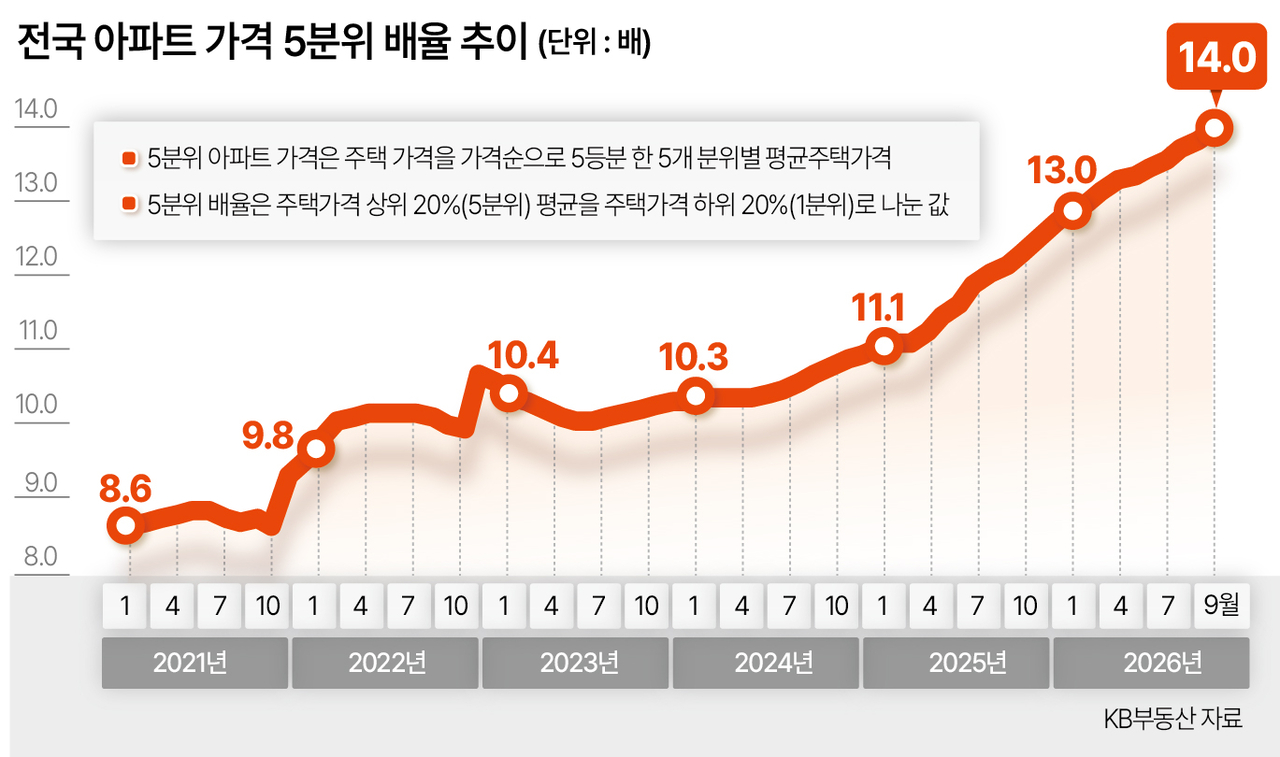
The record-wide gap reflects the fact that prices in the top quintile have risen far more steeply than those in the bottom quintile.
The national average sale price for top-quintile apartments this month reached 1.61 billion won ($1.18 million), up 21.06 million won, or 1.3 percent, from the previous month's 1.59 billion won. Bottom-quintile apartments, by contrast, edged up just 90,000 won, or 0.07 percent, to 115.09 million won from 115 million won the month before.
The nationwide quintile ratio had previously climbed to 10.1 during the property price surge between March and August 2022, before retreating. It has since resumed an upward trend, surpassing 14 for the first time this month.
KB compiles its housing price data from a sample of 62,220 households across 240 cities, counties and districts nationwide. Average apartment sale prices are calculated using market price data entered by KB-registered brokerages, subject to the firm's own verification process.
Yeongtong and Dongtan keep setting records as metropolitan price gaps widen
The rise in top-quintile prices nationally has been driven largely by the so-called "semiconductor belt" in southern Gyeonggi Province. According to the Korea Real Estate Board, apartment sale prices in Gyeonggi Province rose 0.23 percent in the week ending Sept. 21, outpacing Seoul's 0.13 percent gain — the first time Gyeonggi's rate of increase has exceeded Seoul's in about six months, since last March.
All four of the top-performing districts nationwide over the same period were in Gyeonggi Province. Suwon's Yeongtong-gu led with a 1.09 percent gain, followed by Gwonseon-gu at 0.66 percent, Yongin's Giheung-gu at 0.48 percent and Hwaseong's Dongtan-gu at 0.45 percent.
![An aerial view of the new town in Dongtan-gu, Hwaseong, Gyeonggi Province. [Herald DB]](https://wimg.heraldcorp.com/news/cms/2026/09/30/news-p.v1.20260701.d6c69f99943042119ab34a6ee077e463_P1.jpg)
In these areas, strong housing demand tied to the semiconductor industry has been reinforced by employee housing benefits — including in-house loans offered by Samsung Electronics and other semiconductor-related companies — which analysts say are helping to push prices higher.
Yeongtong-gu in Suwon, located near Samsung Electronics' Digital City campus, has seen a string of record-high transactions. An 84-square-meter unit at Yeongtong SK View sold for 1.12 billion won on Sept. 2, crossing the 1.1 billion won threshold for the first time. A nearby 84-square-meter unit at Hillstate Yeongtong also set a new high, changing hands for 1.54 billion won on Sept. 14.
In Dongtan-gu, an 84-square-meter unit at Dongtan Station Yurim Norway Forest on the 42nd floor sold for 1.64 billion won on Sept. 5, setting another record. In Giheung-gu, a same-sized unit at Giheung Station Central Prugio sold for 1.1 billion won on the 28th floor, the complex's first transaction at that level.
Experts point to the concentration of resources in the greater metropolitan area as the primary driver of nationwide polarization. With quality lifestyle infrastructure increasingly clustered around the capital region, they expect property prices in regional cities to remain sluggish.
Analysts also see the heated market in southern Gyeonggi Province generating secondary demand in neighboring areas. "Those who sell in Suwon may move to Gwanggyo or Bundang, and those who sell in Gwanggyo or Bundang may shift to Wirye or Munjeong-dong in Songpa-gu," said Nam Hyeok-woo, a real estate researcher at Woori Bank. "If liquidity flows into neighboring areas, prices there will rise as well."
Within Seoul, the picture is different. High-end apartments in Gangnam have stalled while mid- to lower-priced units have climbed sharply, pushing the city's apartment quintile ratio down to 6.3 this month — its lowest level in 16 months, since May last year's 6.1. The average price of Seoul's top-quintile apartments rose 0.42 percent from the previous month to 3.47 billion won, while bottom-quintile apartments climbed 2.13 percent, from 541.38 million won to 552.92 million won.
hss@heraldcorp.com