Total national tax revenue forecast at 478.6 trillion won, up 15.2% from supplementary budget estimate; corporate tax alone accounts for 35 trillion won of the increase; domestic tax surplus of 56.2 trillion won could fund future reserve

South Korea's national tax revenue this year is expected to come in 63.2 trillion won ($46.5 billion) higher than the government projected when it drew up its supplementary budget in March, driven by a semiconductor boom and a buoyant stock market. Compared with the original budget estimate set at the end of last year, the increase reaches 88.4 trillion won.
Of that total, the "surplus tax revenue" available as a funding source for the government's future reserve fund is expected to reach around 56 trillion won, raising the prospect that the fund could exceed 200 trillion won in total.
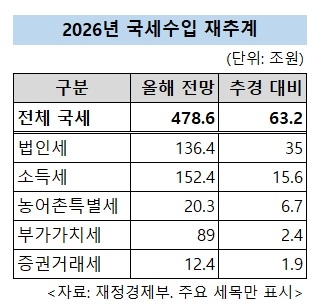
The Ministry of Economy and Finance said Wednesday it had revised its national tax revenue forecast to 478.6 trillion won after a review by the Tax Revenue Estimation Committee. That is 63.2 trillion won, or 15.2 percent, above the 415.4 trillion won incorporated in the supplementary budget. Compared with last year's actual revenue of 373.9 trillion won, this year's figure represents an increase of 104.7 trillion won, or 28 percent. The forecast has now been raised twice — from the original budget figure of 390.2 trillion won to 415.4 trillion won in the March supplementary budget, and again to 478.6 trillion won in this latest revision.
The 15.2 percent gap between the supplementary budget estimate and the revised forecast is the fifth-largest such discrepancy on record. The historical rankings stand at 21.5 percent in 1950, 17.6 percent in 1988, 16.6 percent in 2000 and 15.3 percent in 1989. If collections come in as projected, this year would mark the largest surplus tax revenue error rate since 2000 — a span of 26 years.
Corporate tax posted the biggest increase by category. Corporate tax revenue is now expected to reach 136.4 trillion won this year, up 35 trillion won from the 101.3 trillion won projected in February when the supplementary budget was being drafted. Market forecasts for the combined operating profit of Samsung Electronics and SK hynix have risen to 638 trillion won this month from 339 trillion won at the time of the February supplementary budget, a gain of 299 trillion won.
Income tax revenue is also expected to exceed the supplementary budget projection by 15.6 trillion won, coming in at 152.4 trillion won. The revision reflects higher performance bonuses in the semiconductor and financial sectors, special dividends from chipmakers, and an expansion in housing transactions. Capital gains tax is projected to rise 6.2 trillion won above the supplementary budget estimate, wage income tax by 4.4 trillion won, and dividend income tax by 3.9 trillion won.
The stock market rally also contributed. The special rural development tax is forecast at 20.3 trillion won, up 6.7 trillion won from the supplementary budget estimate, while the securities transaction tax is expected to rise 1.9 trillion won to 12.4 trillion won. Value-added tax is projected to increase 2.4 trillion won to 89 trillion won. The transportation, energy and environment tax, however, is expected to come in 700 billion won below the supplementary budget projection.
National tax revenue for August alone reached 55.9 trillion won, up 27.7 trillion won from the same month last year. Corporate tax accounted for most of the increase at 23.8 trillion won, reflecting interim corporate tax payments tied to chipmakers' improved first-half earnings.
Cumulative national tax revenue for January through August stood at 329.9 trillion won, up 69.1 trillion won from the same period last year. The collection rate against the supplementary budget target reached 79.4 percent, outpacing the five-year average of 70.7 percent by 8.7 percentage points. The special rural development tax had already collected 15 trillion won through August, surpassing the full-year supplementary budget projection of 13.6 trillion won.
The figures have prompted forecasts that the total size of the future reserve fund available for the government to deploy next year could exceed 200 trillion won.
In the latest revision, domestic tax revenue is projected at 424.3 trillion won, up 56.2 trillion won ($41.4 billion) from the 368.1 trillion won in the supplementary budget. Adding the base funding of 162.3 trillion won in "additional tax revenue," the theoretical maximum that could be accumulated as fund resources reaches around 218 trillion won.
The bill on establishing and operating the future reserve fund, which the government submitted to the National Assembly earlier this month, designates additional tax revenue, surplus tax revenue, transfers from year-end budget surpluses, and fund operating returns as funding sources. Surplus tax revenue is defined as the amount by which actual domestic tax receipts exceed the original domestic tax revenue budget — or, when a supplementary budget has been passed, the supplementary budget figure.
Kim Byeong-cheol, the Ministry of Economy and Finance's director general for tax policy, said the legislation currently before the National Assembly "only stipulates that surplus tax revenue may be transferred to the future fund," adding that "how it will be used is currently being discussed among the relevant ministries."
fact0514@heraldcorp.com