
Annual injection of 1% of GDP assumed — fund depletion pushed from 2069 to 2100
Late support starting at depletion point extends fund by only one year; early action key
Raising long-term average returns by 2 percentage points keeps fund solvent through 2120
![[Yonhap]](https://wimg.heraldcorp.com/news/cms/2026/09/30/news-p.v1.20260527.b2bd6d9f09bc4ae3959de167c4877eb6_P1.jpg)
If the government begins channeling 1 percent of GDP into the national pension fund every year starting this year, the fund could remain solvent through 2100, according to a new analysis. Under the current system, the fund is projected to run dry in 2069, but injecting public money early — allowing reserves to accumulate and investment returns to compound — could significantly delay that point.
In a separate scenario, raising the fund's long-term average investment return by 2 percentage points above the baseline projection would keep the fiscal balance in surplus and prevent fund depletion through 2120, the end of the projection period.
The findings come from a scenario-based fiscal outlook for the national pension system that the National Assembly Budget Office prepared at the request of the office of Democratic Party lawmaker Nam In-soon of the National Assembly's Health and Welfare Committee, released Wednesday. Under the current system, the national pension's fiscal balance is estimated to turn negative in 2050, with the fund exhausted by 2069.
The projections reflect changes introduced by last year's revision to the National Pension Act, which raised both the contribution rate and the income replacement rate. The contribution rate will rise by 0.5 percentage points each year starting this year, reaching 13 percent in 2033, while the nominal income replacement rate has been set at 43 percent beginning this year. The nominal income replacement rate refers to the ratio of pension benefits to average lifetime income, based on 40 years of contributions.
The analysis assumes the medium-variant population projection released in December 2023 and an average fund return of about 4.6 percent over the projection period. Even with higher contribution rates, the long-term fiscal imbalance is expected to persist as the low birth rate and aging population reduce the number of contributors while pension outlays continue to grow.
Earlier support yields greater gains — starting this year extends fund to 2100
In the government-support scenarios, the timing of when funding begins proved to matter as much as the amount injected, even when the same share of GDP was committed.
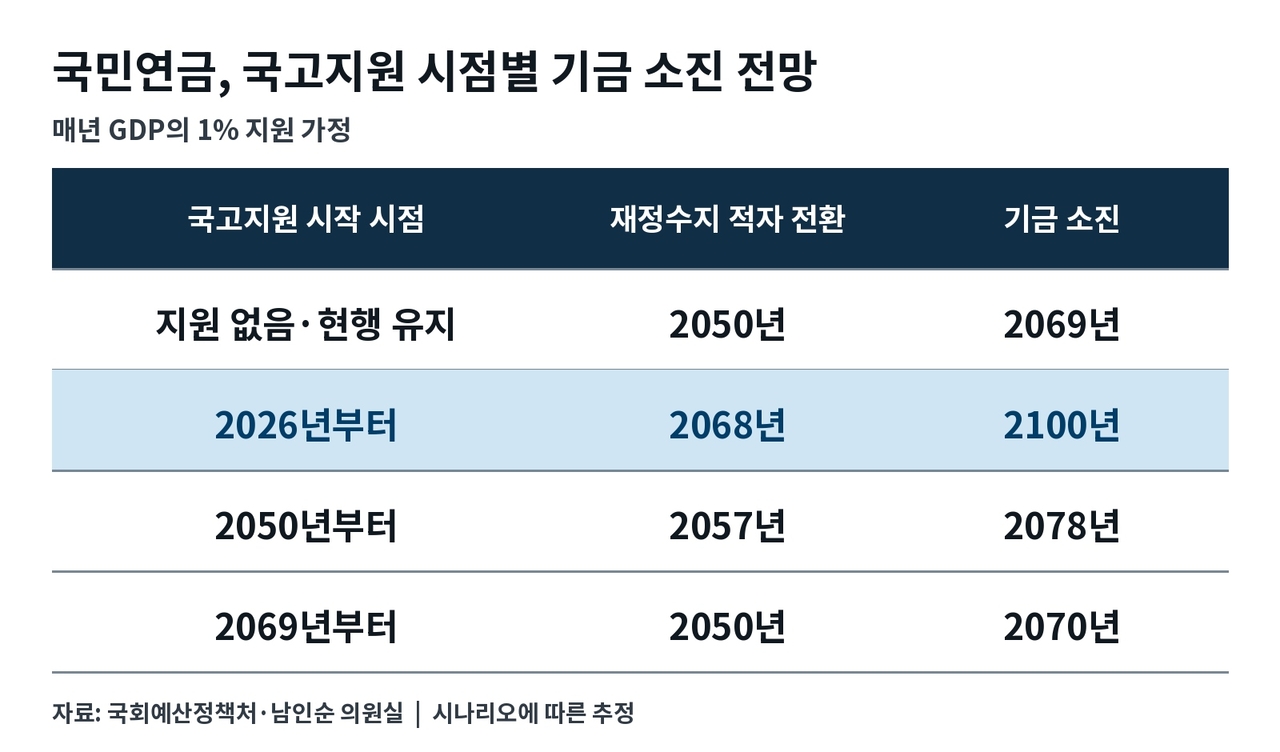
Starting annual transfers of 1 percent of GDP this year would push the fiscal deficit onset back from 2050 to 2068 and delay fund depletion from 2069 to 2100. The gain reflects the compounding effect of early contributions: reserves build up sooner, generating additional investment returns over time.
By contrast, beginning the same 1-percent-of-GDP transfers in 2050 — when the fiscal balance is projected to first turn negative — would push the deficit onset to 2057 and fund depletion to 2078, a fund life 22 years shorter than under the scenario starting this year.
Waiting until 2069, when depletion is projected to occur, would extend the fund's life by only one year, to 2070. The analysis underscores that the timing of government support, not just its scale, is a critical variable in the national pension's long-term fiscal health.
Scaling up support to 2 percent of GDP starting this year would prevent both a fiscal deficit and fund depletion through 2120. Even starting at 2 percent in 2050 would push the deficit onset to 2071 and depletion to 2104. Beginning at that level only in 2069 would again extend the fund by just one year, to 2070.
At 3 percent of GDP, starting either this year or in 2050 would maintain a fiscal surplus and keep the fund intact through 2120. But beginning support only in 2069 would delay depletion by just three years, to 2072.
Returns up 1 pct point extends fund to 2082; up 2 pct points keeps it solvent through 2120
Scenarios involving higher investment returns also showed meaningful improvements in the fund's fiscal outlook.
Raising the average return over the projection period by 1 percentage point above the baseline assumption would push the fiscal deficit onset from 2050 to 2060 and delay fund depletion from 2069 to 2082.
A 2-percentage-point increase in the average return would sustain a fiscal surplus through 2120 with no fund depletion. The result assumes that the long-term average return — not the performance of any single year — remains persistently above the baseline projection.
Based on the analysis, the lawmaker's office said the discussion should go beyond contribution rate increases to also include strategies for improving fund investment returns and providing early government support. It argued that injecting public funds while fiscal conditions remain favorable would enhance the long-term effectiveness of fund management.
The National Assembly Budget Office noted, however, that the analysis is a simulation prepared on the basis of assumptions requested by the lawmaker's office and does not represent the office's official position.
fact0514@heraldcorp.com




