Largest Ethereum holder among US-listed companies
Tom Lee says Ethereum to serve as financial infrastructure
Urges Korean financial firms to disrupt their own legacy businesses
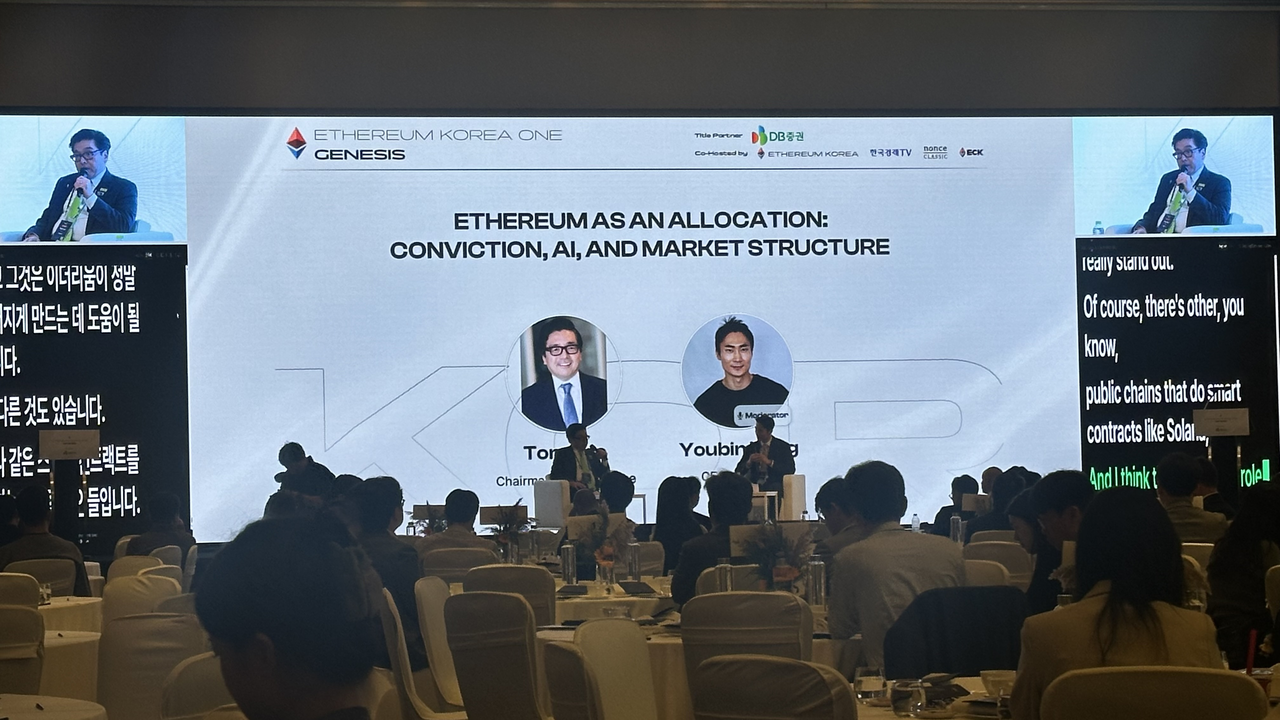
"Going forward, shares, bonds, real estate, airline miles and countless other things will take on a form similar to money. I think the way people assess the value of assets will also change in the process."
Tom Lee, chairman of Bitmine's board of directors, made the remarks Monday at "Ethereum Korea One: Genesis," held at Conrad Seoul in Yeouido. His argument: as money goes digital and takes the form of software, and as diverse assets — shares, bonds, real estate — come to be traded on blockchain, Ethereum is positioned to become the core infrastructure of future finance.
Bitmine is a digital asset treasury company that holds Ethereum as its primary asset and carries the largest Ethereum holdings of any US-listed firm. The company announced Monday that its Ethereum holdings had grown to 6,001,302. Lee is also a co-founder of the research firm Fundstrat.
Lee drew a clear distinction between the roles of Bitcoin and Ethereum. "What Bitcoin is really good at is being a store of value," he said. "But that doesn't make it the most suitable platform for the settlement rails of future finance." His point was that while Bitcoin functions as a digital equivalent of gold, Ethereum can expand its role into the financial infrastructure where assets are issued, traded and settled.
He identified tokenization as one of the most significant shifts coming to financial markets. "Smart contract platforms make it possible to turn a wide range of assets into new forms of value-storing assets," Lee said. "In the next cycle, tokenization will be one of the most important pillars, and that will be a significant tailwind for Ethereum."
He also said Ethereum's value should not be measured solely by cash flows such as gas fees. "Traditional finance tries to measure Ethereum's value based on gas fees generated when transactions occur," Lee said. "That is essentially applying a traditional cash flow model, and it is wrong to think that is the only way to capture value."
"In the stock market, value is determined not just by earnings themselves but by what multiple the market assigns to those earnings," he said, adding that the same logic applies to crypto.
Lee also sees AI agents as a major growth driver for Ethereum. "As AI agents grow in capability and physical AI — drones, robots and the like — becomes more capable, they will create economic activity involving receiving and making payments," he said, predicting that crypto will become the dominant payment rail of the future.
On South Korea's approach to tokenization regulation, Lee said he understood the country's stance. "Public policy has to balance multiple interests — government sovereignty, the power to tax, and economic policies that protect industries the government considers important," he said.
He added that "Korea already has abundant resources and talented people," and that the country "may not necessarily need to bring in outside players to shake up its domestic industries." He said, however, that he did not see that approach as one the rest of the world would adopt, noting that the global tokenization trend could unfold differently in each country.
On South Korea's traditional financial institutions, Lee advised that they must be willing to disrupt their own existing business models. "Banks already have customers and legacy systems, and they generate significant value from that structure, whereas technology companies and consumer goods companies are trying to build new financial relationships with customers from scratch," he said. "One side is the incumbent, and the other is the disruptive innovator."
He added that "looking back at past waves of technological innovation, many companies had to disrupt themselves to survive," noting that some members of the Magnificent Seven had done exactly that with their own legacy businesses — and as a result now hold leading positions in AI.

kyoung@heraldcorp.com